Correction CCNA Version 7

Correction CCNA Version 7

Correction CCNA 1

Correction CCNA 1

Cisco - CCNA version 6 Answes

Cisco - CCNA 4 version 6 Answe

Correction CCNA 3

Correction CCNA 2

CCNA 1 version 7 Modules 8 – 10: Communicating Between Networks Exam Answers 2020

1. Which information is used by routers to forward a data packet toward its destination?
  • source IP address
  • destination IP address
  • source data-link address
  • destination data-link address
2. A computer has to send a packet to a destination host in the same LAN. How will the packet be sent?
  • The packet will be sent to the default gateway first, and then, depending on the response from the gateway, it may be sent to the destination host.
  • The packet will be sent directly to the destination host.
  • The packet will first be sent to the default gateway, and then from the default gateway it will be sent directly to the destination host.
  • The packet will be sent only to the default gateway.
3. A router receives a packet from the Gigabit 0/0 interface and determines that the packet needs to be forwarded out the Gigabit 0/1 interface. What will the router do next?
  • route the packet out the Gigabit 0/1 interface
  • create a new Layer 2 Ethernet frame to be sent to the destination
  • look into the ARP cache to determine the destination IP address
  • look into the routing table to determine if the destination network is in the routing table
4. Which IPv4 address can a host use to ping the loopback interface?
  • 126.0.0.1
  • 127.0.0.0
  • 126.0.0.0
  • 127.0.0.1
5. A computer can access devices on the same network but cannot access devices on other networks. What is the probable cause of this problem?
  • The cable is not connected properly to the NIC.
  • The computer has an invalid IP address.
  • The computer has an incorrect subnet mask.
  • The computer has an invalid default gateway address.
6. Which statement describes a feature of the IP protocol?
  • IP encapsulation is modified based on network media.
  • IP relies on Layer 2 protocols for transmission error control.
  • MAC addresses are used during the IP packet encapsulation.
  • IP relies on upper layer services to handle situations of missing or out-of-order packets.
Explanation: IP protocol is a connection-less protocol, considered unreliable in terms of end-to-end delivery. It does not provide error control in the cases where receiving packets are out-of-order or in cases of missing packets. It relies on upper layer services, such as TCP, to resolve these issues.
7. Why is NAT not needed in IPv6?​
  • Because IPv6 has integrated security, there is no need to hide the IPv6 addresses of internal networks.​
  • Any host or user can get a public IPv6 network address because the number of available IPv6 addresses is extremely large.​
  • The problems that are induced by NAT applications are solved because the IPv6 header improves packet handling by intermediate routers.​
  • The end-to-end connectivity problems that are caused by NAT are solved because the number of routes increases with the number of nodes that are connected to the Internet.
8. Which parameter does the router use to choose the path to the destination when there are multiple routes available?
  • the lower metric value that is associated with the destination network
  • the lower gateway IP address to get to the destination network
  • the higher metric value that is associated with the destination network
  • the higher gateway IP address to get to the destination network
9. What are two services provided by the OSI network layer? (Choose two.)
  • performing error detection
  • routing packets toward the destination
  • encapsulating PDUs from the transport layer
  • placement of frames on the media
  • collision detection
Explanation: The OSI network layer provides several services to allow communication between devices:
  • addressing
  • encapsulation
  • routing
  • de-encapsulation
Error detection, placing frames on the media, and collision detection are all functions of the data ink layer.
10. Within a production network, what is the purpose of configuring a switch with a default gateway address?
  • Hosts that are connected to the switch can use the switch default gateway address to forward packets to a remote destination.
  • A switch must have a default gateway to be accessible by Telnet and SSH.
  • The default gateway address is used to forward packets originating from the switch to remote networks.
  • It provides a next-hop address for all traffic that flows through the switch.
Explanation: A default gateway address allows a switch to forward packets that originate on the switch to remote networks. A default gateway address on a switch does not provide Layer 3 routing for PCs that are connected on that switch. A switch can still be accessible from Telnet as long as the source of the Telnet connection is on the local network.
11. What is a basic characteristic of the IP protocol?
  • connectionless
  • media dependent
  • user data segmentation
  • reliable end-to-end delivery
Explanation: Internet Protocol (IP) is a network layer protocol that does not require initial exchange of control information to establish an end-to-end connection before packets are forwarded. Thus, IP is connectionless and does not provide reliable end-to-end delivery by itself. IP is media independent. User data segmentation is a service provided at the transport layer.
12. Which field in the IPv4 header is used to prevent a packet from traversing a network endlessly?
  • Time-to-Live
  • Sequence Number
  • Acknowledgment Number
  • Differentiated Services
Explanation: The value of the Time-to-Live (TTL) field in the IPv4 header is used to limit the lifetime of a packet. The sending host sets the initial TTL value; which is decreased by one each time the packet is processed by a router. If the TTL field decrements to zero, the router discards the packet and sends an Internet Control Message Protocol (ICMP) Time Exceeded message to the source IP address. The Differentiated Services (DS) field is used to determine the priority of each packet. Sequence Number and Acknowledgment Number are two fields in the TCP header.
13. What is one advantage that the IPv6 simplified header offers over IPv4?
  • smaller-sized header
  • little requirement for processing checksums
  • smaller-sized source and destination IP addresses
  • efficient packet handling
Explanation: The IPv6 simplified header offers several advantages over IPv4:
  • Better routing efficiency and efficient packet handling for performance and forwarding-rate scalability
  • No requirement for processing checksums
  • Simplified and more efficient extension header mechanisms (as opposed to the IPv4 Options field)
  • A Flow Label field for per-flow processing with no need to open the transport inner packet to identify the various traffic flows
14. What IPv4 header field identifies the upper layer protocol carried in the packet?
  • Protocol
  • Identification
  • Version
  • Differentiated Services
Explanation: It is the Protocol field in the IP header that identifies the upper-layer protocol the packet is carrying. The Version field identifies the IP version. The Differential Services field is used for setting packet priority. The Identification field is used to reorder fragmented packets.
15. Refer to the exhibit. Match the packets with their destination IP address to the exiting interfaces on the router. (Not all targets are used.)


Explanation: Packets with a destination of 172.17.6.15 are forwarded through Fa0/0. Packets with a destination of 172.17.10.5 are forwarded through Fa1/1. Packets with a destination of 172.17.12.10 are forwarded through Fa1/0. Packets with a destination of 172.17.14.8 are forwarded through Fa0/1. Because network 172.17.8.0 has no entry in the routing table, it will take the gateway of last resort, which means that packets with a destination of 172.17.8.20 are forwarded through Serial0/0/0. Because a gateway of last resort exists, no packets will be dropped.
16. What information does the loopback test provide?
  • The TCP/IP stack on the device is working correctly.
  • The device has end-to-end connectivity.
  • DHCP is working correctly.
  • The Ethernet cable is working correctly.
  • The device has the correct IP address on the network.
17. What routing table entry has a next hop address associated with a destination network?
  • directly-connected routes
  • local routes
  • remote routes
  • C and L source routes
18. How do hosts ensure that their packets are directed to the correct network destination?
  • They have to keep their own local routing table that contains a route to the loopback interface, a local network route, and a remote default route.​
  • They always direct their packets to the default gateway, which will be responsible for the packet delivery.
  • They search in their own local routing table for a route to the network destination address and pass this information to the default gateway.
  • They send a query packet to the default gateway asking for the best route.
19. When transporting data from real-time applications, such as streaming audio and video, which field in the IPv6 header can be used to inform the routers and switches to maintain the same path for the packets in the same conversation?
  • Next Header
  • Flow Label
  • Traffic Class
  • Differentiated Services
Explanation: The Flow Label in IPv6 header is a 20-bit field that provides a special service for real-time applications. This field can be used to inform routers and switches to maintain the same path for the packet flow so that packets will not be reordered.
20. What statement describes the function of the Address Resolution Protocol?
  • ARP is used to discover the IP address of any host on a different network.
  • ARP is used to discover the IP address of any host on the local network.
  • ARP is used to discover the MAC address of any host on a different network.
  • ARP is used to discover the MAC address of any host on the local network.
21. Under which two circumstances will a switch flood a frame out of every port except the port that the frame was received on? (Choose two.)
  • The frame has the broadcast address as the destination address.
  • The destination address is unknown to the switch.
  • The source address in the frame header is the broadcast address.
  • The source address in the frame is a multicast address.
  • The destination address in the frame is a known unicast address.
Explanation: A switch will flood a frame out of every port, except the one that the frame was received from, under two circumstances. Either the frame has the broadcast address as the destination address, or the destination address is unknown to the switch.
22. Which statement describes the treatment of ARP requests on the local link?
  • They must be forwarded by all routers on the local network.
  • They are received and processed by every device on the local network.
  • They are dropped by all switches on the local network.
  • They are received and processed only by the target device.
Explanation: One of the negative issues with ARP requests is that they are sent as a broadcast. This means all devices on the local link must receive and process the request.
23. Which destination address is used in an ARP request frame?
  • 0.0.0.0
  • 255.255.255.255
  • FFFF.FFFF.FFFF
  • AAAA.AAAA.AAAA
  • the physical address of the destination host
Explanation: The purpose of an ARP request is to find the MAC address of the destination host on an Ethernet LAN. The ARP process sends a Layer 2 broadcast to all devices on the Ethernet LAN. The frame contains the IP address of the destination and the broadcast MAC address, FFFF.FFFF.FFFF. The host with the IP address that matches the IP address in the ARP request will reply with a unicast frame that includes the MAC address of the host. Thus the original sending host will obtain the destination IP and MAC address pair to continue the encapsulation process for data transmission.
24. A network technician issues the arp -d * command on a PC after the router that is connected to the LAN is reconfigured. What is the result after this command is issued?
  • The ARP cache is cleared.
  • The current content of the ARP cache is displayed.
  • The detailed information of the ARP cache is displayed.
  • The ARP cache is synchronized with the router interface.
Explanation: Issuing the arp –d * command on a PC will clear the ARP cache content. This is helpful when a network technician wants to ensure the cache is populated with updated information.
25. Refer to the exhibit. The exhibit shows a small switched network and the contents of the MAC address table of the switch. PC1 has sent a frame addressed to PC3. What will the switch do with the frame?

  • The switch will discard the frame.
  • The switch will forward the frame only to port 2.
  • The switch will forward the frame to all ports except port 4.
  • The switch will forward the frame to all ports.
  • The switch will forward the frame only to ports 1 and 3.
Explanation: The MAC address of PC3 is not present in the MAC table of the switch. Because the switch does not know where to send the frame that is addressed to PC3, it will forward the frame to all the switch ports, except for port 4, which is the incoming port.
26. Which two types of IPv6 messages are used in place of ARP for address resolution?
  • anycast
  • broadcast
  • echo reply
  • echo request
  • neighbor solicitation
  • neighbor advertisement
Explanation: IPv6 does not use ARP. Instead, ICMPv6 neighbor discovery is used by sending neighbor solicitation and neighbor advertisement messages.
27. What is the aim of an ARP spoofing attack?
  • to flood the network with ARP reply broadcasts
  • to fill switch MAC address tables with bogus addresses
  • to associate IP addresses to the wrong MAC address
  • to overwhelm network hosts with ARP requests
28. Refer to the exhibit. PC1 attempts to connect to File_server1 and sends an ARP request to obtain a destination MAC address. Which MAC address will PC1 receive in the ARP reply?

  • the MAC address of S1
  • the MAC address of the G0/0 interface on R1
  • the MAC address of the G0/0 interface on R2
  • the MAC address of S2
  • the MAC address of File_server1
29. Where are IPv4 address to Layer 2 Ethernet address mappings maintained on a host computer?
  • neighbor table
  • ARP cache
  • routing table
  • MAC address table
30. What important information is examined in the Ethernet frame header by a Layer 2 device in order to forward the data onward?
  • source MAC address
  • source IP address
  • destination MAC address
  • Ethernet type
  • destination IP address
Explanation: The Layer 2 device, such as a switch, uses the destination MAC address to determine which path (interface or port) should be used to send the data onward to the destination device.
31. Match the commands to the correct actions. (Not all options are used.)

32. A new network administrator has been asked to enter a banner message on a Cisco device. What is the fastest way a network administrator could test whether the banner is properly configured?
  • Reboot the device.
  • Enter CTRL-Z at the privileged mode prompt.
  • Exit global configuration mode.
  • Power cycle the device.
  • Exit privileged EXEC mode and press Enter.
Explanation: While at the privileged mode prompt such as Router#, type exit,press Enter, and the banner message appears. Power cycling a network device that has had the banner motd command issued will also display the banner message, but this is not a quick way to test the configuration.
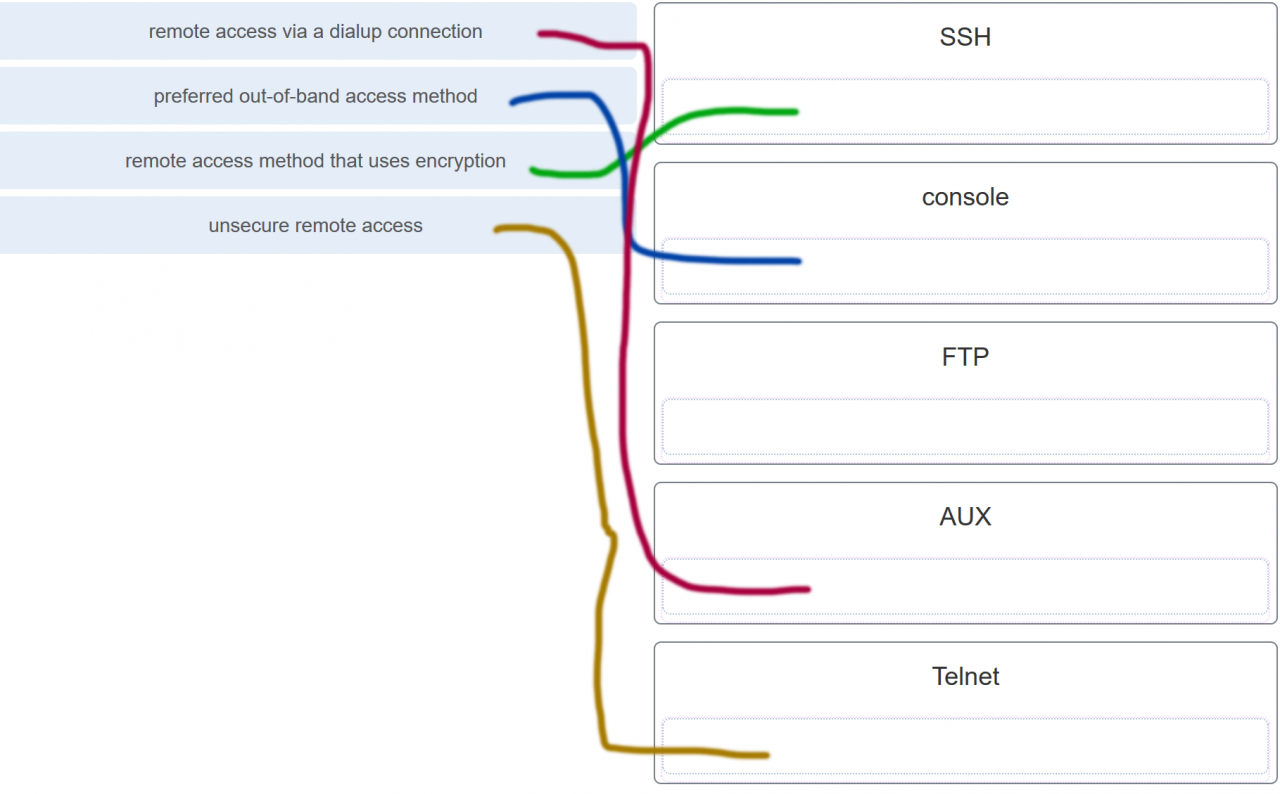
33. A network administrator requires access to manage routers and switches locally and remotely. Match the description to the access method. (Not all options are used.)

Explanation: Both the console and AUX ports can be used to directly connect to a Cisco network device for management purposes. However, it is more common to use the console port. The AUX port is more often used for remote access via a dial up connection. SSH and Telnet are both remote access methods that depend on an active network connection. SSH uses a stronger password authentication than Telnet uses and also uses encryption on transmitted data.
34. Match the phases to the functions during the boot up process of a Cisco router. (Not all options are used.)

Explanation: There are three major phases to the bootup process of a Cisco router:
  1. Perform the POST and load the bootstrap program.
  2. Locate and load the Cisco IOS software.
  3. Locate and load the startup configuration file
If a startup configuration file cannot be located, the router will enter setup mode by displaying the setup mode prompt.
35. Match the command with the device mode at which the command is entered. (Not all options are used.)

Explanation: The enable command is entered in R1> mode. The login command is entered in R1(config-line)# mode. The copy running-config startup-config command is entered in R1# mode. The ip address 192.168.4.4 255.255.255.0 command is entered in R1(config-if)# mode. The service password-encryption command is entered in global configuration mode.
36. What are two functions of NVRAM? (Choose two.)
  • to store the routing table
  • to retain contents when power is removed
  • to store the startup configuration file
  • to contain the running configuration file
  • to store the ARP table
Explanation: NVRAM is permanent memory storage, so the startup configuration file is preserved even if the router loses power.
37. A router boots and enters setup mode. What is the reason for this?
  • The IOS image is corrupt.
  • Cisco IOS is missing from flash memory.
  • The configuration file is missing from NVRAM.
  • The POST process has detected hardware failure.
38. The global configuration command ip default-gateway 172.16.100.1 is applied to a switch. What is the effect of this command?
  • The switch will have a management interface with the address 172.16.100.1.
  • The switch can be remotely managed from a host on another network.
  • The switch can communicate with other hosts on the 172.16.100.0 network.
  • The switch is limited to sending and receiving frames to and from the gateway 172.16.100.1.
Explanation: A default gateway address is typically configured on all devices to allow them to communicate beyond just their local network.In a switch this is achieved using the command ip default-gateway <ip address>.
39. What happens when the transport input ssh command is entered on the switch vty lines?
  • The SSH client on the switch is enabled.
  • Communication between the switch and remote users is encrypted.
  • The switch requires a username/password combination for remote access.
  • The switch requires remote connections via a proprietary client software.
Explanation: The transport input ssh command when entered on the switch vty (virtual terminal lines) will encrypt all inbound controlled telnet connections.
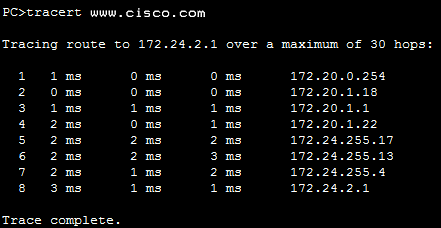
40. Refer to the exhibit. A user PC has successfully transmitted packets to www.cisco.com. Which IP address does the user PC target in order to forward its data off the local network?

  • 172.24.255.17
  • 172.24.1.22
  • 172.20.0.254
  • 172.24.255.4
  • 172.20.1.18
41. Match the configuration mode with the command that is available in that mode. (Not all options are used.)

Explanation: The enable command is entered at the R1> prompt. The login command is entered at the R1(config-line)# prompt. The copy running-config startup-config command is entered at the R1# prompt. The interface fastethernet 0/0 command is entered at the R1(config)# prompt.
42. Which three commands are used to set up secure access to a router through a connection to the console interface? (Choose three.)
  • interface fastethernet 0/0
  • line vty 0 4
  • line console 0
  • enable secret cisco
  • login
  • password cisco
Explanation: The three commands needed to password protect the console port are as follows:
  • line console 0
  • password cisco
  • login
The interface fastethernet 0/0 command is commonly used to access the configuration mode used to apply specific parameters such as the IP address to the Fa0/0 port. The line vty 0 4 command is used to access the configuration mode for Telnet. The0and 4 parameters specify ports 0 through 4, or a maximum of five simultaneous Telnet connections. The enable secret command is used to apply a password used on the router to access the privileged mode.
43. Refer to the exhibit. Consider the IP address configuration shown from PC1. What is a description of the default gateway address?

  • It is the IP address of the Router1 interface that connects the company to the Internet.
  • It is the IP address of the Router1 interface that connects the PC1 LAN to Router1.
  • It is the IP address of Switch1 that connects PC1 to other devices on the same LAN.
  • It is the IP address of the ISP network device located in the cloud.
44. Which two functions are primary functions of a router? (Choose two.)
  • packet forwarding
  • microsegmentation
  • domain name resolution
  • path selection
  • flow control
Explanation: A router accepts a packet and accesses its routing table to determine the appropriate exit interface based on the destination address. The router then forwards the packet out of that interface.
45. What is the effect of using the Router# copy running-config startup-config command on a router?
  • The contents of ROM will change.
  • The contents of RAM will change.
  • The contents of NVRAM will change.
  • The contents of flash will change.
Explanation: The command copy running-config startup-config copies the running-configuration file from RAM into NVRAM and saves it as the startup-configuration file. Since NVRAM is none-volatile memory it will be able to retain the configuration details when the router is powered off.
46. What will happen if the default gateway address is incorrectly configured on a host?
  • The host cannot communicate with other hosts in the local network.
  • The switch will not forward packets initiated by the host.
  • The host will have to use ARP to determine the correct address of the default gateway.
  • The host cannot communicate with hosts in other networks.
  • A ping from the host to 127.0.0.1 would not be successful.
Explanation: When a host needs to send a message to another host located on the same network, it can forward the message directly. However, when a host needs to send a message to a remote network, it must use the router, also known as the default gateway. This is because the data link frame address of the remote destination host cannot be used directly. Instead, the IP packet has to be sent to the router (default gateway) and the router will forward the packet toward its destination. Therefore, if the default gateway is incorrectly configured, the host can communicate with other hosts on the same network, but not with hosts on remote networks.
47. What are two potential network problems that can result from ARP operation? (Choose two.)
  • Manually configuring static ARP associations could facilitate ARP poisoning or MAC address spoofing.
  • On large networks with low bandwidth, multiple ARP broadcasts could cause data communication delays.
  • Network attackers could manipulate MAC address and IP address mappings in ARP messages with the intent of intercepting network traffic.
  • Large numbers of ARP request broadcasts could cause the host MAC address table to overflow and prevent the host from communicating on the network.
  • Multiple ARP replies result in the switch MAC address table containing entries that match the MAC addresses of hosts that are connected to the relevant switch port.
Explanation: Large numbers of ARP broadcast messages could cause momentary data communications delays. Network attackers could manipulate MAC address and IP address mappings in ARP messages with the intent to intercept network traffic. ARP requests and replies cause entries to be made into the ARP table, not the MAC address table. ARP table overflows are very unlikely. Manually configuring static ARP associations is a way to prevent, not facilitate, ARP poisoning and MAC address spoofing. Multiple ARP replies resulting in the switch MAC address table containing entries that match the MAC addresses of connected nodes and are associated with the relevant switch port are required for normal switch frame forwarding operations. It is not an ARP caused network problem.
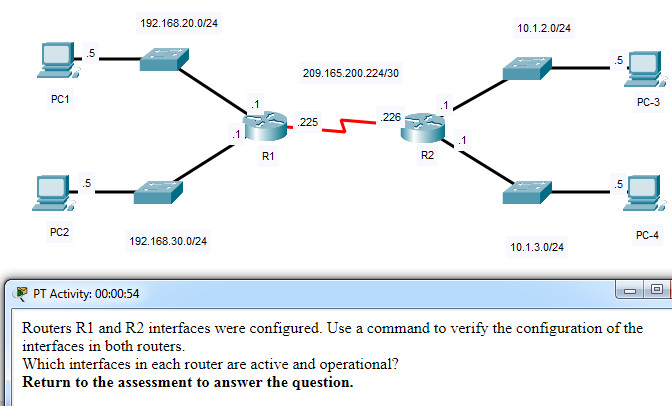
48. Open the PT activity. Perform the tasks in the activity instructions and then answer the question.

CCNA 1 v7 Modules 8 - 10 Communicating Between Networks Exam
CCNA 1 v7 Modules 8 – 10 Communicating Between Networks Exam

Which interfaces in each router are active and operational? R1: G0/0 and S0/0/0
R2: G0/0 and S0/0/0
R1: G0/1 and S0/0/1
R2: G0/0 and S0/0/1
R1: G0/0 and S0/0/0
R2: G0/1 and S0/0/0
R1: G0/0 and S0/0/1
R2: G0/1 and S0/0/1
Explanation: The command to use for this activity is show ip interface brief in each router. The active and operational interfaces are represented by the value “up” in the “Status” and “Protocol” columns. The interfaces in R1 with these characteristics are G0/0 and S0/0/0. In R2 they are G0/1 and S0/0/0.
49. Which term describes a field in the IPv4 packet header used to identify the next level protocol?
  • protocol
  • destination IPv4 address
  • source IPv4 address
  • TTL
50. Which term describes a field in the IPv4 packet header that contains an 8-bit binary value used to determine the priority of each packet?
  • differentiated services
  • destination IPv4 address
  • source IPv4 address
  • protocol
51. Which term describes a field in the IPv4 packet header that contains a 32-bit binary value associated with an interface on the sending device?
  • source IPv4 address
  • destination IPv4 address
  • protocol
  • TTL
52. Which term describes a field in the IPv4 packet header used to detect corruption in the IPv4 header?
  • header checksum
  • source IPv4 address
  • protocol
  • TTL
53. 
RTR1(config)# interface gi0/1
RTR1(config-if)# description Connects to the Marketing LAN
RTR1(config-if)# ip address 10.27.15.17 255.255.255.0
RTR1(config-if)# no shutdown
RTR1(config-if)# interface gi0/0
RTR1(config-if)# description Connects to the Payroll LAN
RTR1(config-if)# ip address 10.27.14.148 255.255.255.0
RTR1(config-if)# no shutdown
RTR1(config-if)# interface s0/0/0
RTR1(config-if)# description Connects to the ISP
RTR1(config-if)# ip address 10.14.15.254 255.255.255.0
RTR1(config-if)# no shutdown
RTR1(config-if)# interface s0/0/1
RTR1(config-if)# description Connects to the Head Office WAN
RTR1(config-if)# ip address 203.0.113.39 255.255.255.0
RTR1(config-if)# no shutdown
RTR1(config-if)# end
Refer to the exhibit. A network administrator is connecting a new host to the Payroll LAN. The host needs to communicate with remote networks. What IP address would be configured as the default gateway on the new host?
  • 10.27.14.148
  • 10.27.14.1
  • 10.14.15.254
  • 203.0.113.39
  • 10.27.15.17
54. Which term describes a field in the IPv4 packet header that contains a unicast, multicast, or broadcast address?
  • destination IPv4 address
  • protocol
  • TTL
  • header checksum
55. Which term describes a field in the IPv4 packet header used to limit the lifetime of a packet?
  • TTL
  • source IPv4 address
  • protocol
  • header checksum
56. Which term describes a field in the IPv4 packet header that contains a 4-bit binary value set to 0100?
  • version
  • source IPv4 address
  • protocol
  • TTL
57. Which term describes a field in the IPv4 packet header used to identify the next level protocol?
  • protocol
  • version
  • differentiated services
  • header checksum
58. Which term describes a field in the IPv4 packet header that contains a 4-bit binary value set to 0100?
  • version
  • differentiated services
  • header checksum
  • TTL
59. What property of ARP causes cached IP-to-MAC mappings to remain in memory longer?
  • Entries in an ARP table are time-stamped and are purged after the timeout expires.
  • A static IP-to-MAC address entry can be entered manually into an ARP table.
  • The type field 0x806 appears in the header of the Ethernet frame.
  • The port-to-MAC address table on a switch has the same entries as the ARP table on the switch.
60. What property of ARP allows MAC addresses of frequently used servers to be fixed in the ARP table?
  • A static IP-to-MAC address entry can be entered manually into an ARP table.
  • Entries in an ARP table are time-stamped and are purged after the timeout expires.
  • The type field 0x806 appears in the header of the Ethernet frame.
  • The port-to-MAC address table on a switch has the same entries as the ARP table on the switch.
61. What property of ARP allows MAC addresses of frequently used servers to be fixed in the ARP table?
  • A static IP-to-MAC address entry can be entered manually into an ARP table.
  • The destination MAC address FF-FF-FF-FF-FF-FF appears in the header of the Ethernet frame.
  • The source MAC address appears in the header of the Ethernet frame.
  • The port-to-MAC address table on a switch has the same entries as the ARP table on the switch.
62. What property of ARP allows hosts on a LAN to send traffic to remote networks?
  • Local hosts learn the MAC address of the default gateway.
  • The destination MAC address FF-FF-FF-FF-FF-FF appears in the header of the Ethernet frame.
  • The source MAC address appears in the header of the Ethernet frame.
  • The port-to-MAC address table on a switch has the same entries as the ARP table on the switch.
63. 
Floor(config)# interface gi0/1
Floor(config-if)# description Connects to the Registrar LAN
Floor(config-if)# ip address 192.168.235.234 255.255.255.0
Floor(config-if)# no shutdown
Floor(config-if)# interface gi0/0
Floor(config-if)# description Connects to the Manager LAN
Floor(config-if)# ip address 192.168.234.114 255.255.255.0
Floor(config-if)# no shutdown
Floor(config-if)# interface s0/0/0
Floor(config-if)# description Connects to the ISP
Floor(config-if)# ip address 10.234.235.254 255.255.255.0
Floor(config-if)# no shutdown
Floor(config-if)# interface s0/0/1
Floor(config-if)# description Connects to the Head Office WAN
Floor(config-if)# ip address 203.0.113.3 255.255.255.0
Floor(config-if)# no shutdown
Floor(config-if)# end
Refer to the exhibit. A network administrator is connecting a new host to the Registrar LAN. The host needs to communicate with remote networks. What IP address would be configured as the default gateway on the new host?
  • 192.168.235.234
  • 192.168.235.1
  • 10.234.235.254
  • 203.0.113.3
  • 192.168.234.114
64. What property of ARP forces all Ethernet NICs to process an ARP request?
  • The destination MAC address FF-FF-FF-FF-FF-FF appears in the header of the Ethernet frame.
  • The source MAC address appears in the header of the Ethernet frame.
  • The type field 0x806 appears in the header of the Ethernet frame.
  • ARP replies are broadcast on the network when a host receives an ARP request.
65. What property of ARP causes a reply only to the source sending an ARP request?
  • The source MAC address appears in the header of the Ethernet frame.
  • The destination MAC address FF-FF-FF-FF-FF-FF appears in the header of the Ethernet frame.
  • The type field 0x806 appears in the header of the Ethernet frame.
  • ARP replies are broadcast on the network when a host receives an ARP request.
66. What property of ARP causes the request to be flooded out all ports of a switch except for the port receiving the ARP request?
  • The destination MAC address FF-FF-FF-FF-FF-FF appears in the header of the Ethernet frame.
  • The type field 0x806 appears in the header of the Ethernet frame.
  • Entries in an ARP table are time-stamped and are purged after the timeout expires.
  • ARP replies are broadcast on the network when a host receives an ARP request.
67. What property of ARP causes the NICs receiving an ARP request to pass the data portion of the Ethernet frame to the ARP process?
  • The type field 0x806 appears in the header of the Ethernet frame.
  • The destination MAC address FF-FF-FF-FF-FF-FF appears in the header of the Ethernet frame.
  • Entries in an ARP table are time-stamped and are purged after the timeout expires.
  • ARP replies are broadcast on the network when a host receives an ARP request.
68. What property of ARP causes the NICs receiving an ARP request to pass the data portion of the Ethernet frame to the ARP process?
  • The type field 0x806 appears in the header of the Ethernet frame.
  • The destination MAC address FF-FF-FF-FF-FF-FF appears in the header of the Ethernet frame.
  • Entries in an ARP table are time-stamped and are purged after the timeout expires.
  • The port-to-MAC address table on a switch has the same entries as the ARP table on the switch.
69. 
Main(config)# interface gi0/1
Main(config-if)# description Connects to the Service LAN
Main(config-if)# ip address 172.29.157.156 255.255.255.0
Main(config-if)# no shutdown
Main(config-if)# interface gi0/0
Main(config-if)# description Connects to the Engineering LAN
Main(config-if)# ip address 172.29.156.36 255.255.255.0
Main(config-if)# no shutdown
Main(config-if)# interface s0/0/0
Main(config-if)# description Connects to the ISP
Main(config-if)# ip address 10.156.157.254 255.255.255.0
Main(config-if)# no shutdown
Main(config-if)# interface s0/0/1
Main(config-if)# description Connects to the Head Office WAN
Main(config-if)# ip address 198.51.100.177 255.255.255.0
Main(config-if)# no shutdown
Main(config-if)# end
Refer to the exhibit. A network administrator is connecting a new host to the Service LAN. The host needs to communicate with remote networks. What IP address would be configured as the default gateway on the new host?
  • 172.29.157.156
  • 172.29.157.1
  • 10.156.157.254
  • 198.51.100.177
  • 172.29.156.36
70. 
BldgA(config)# interface gi0/1
BldgA(config-if)# description Connects to the Medical LAN
BldgA(config-if)# ip address 192.168.191.189 255.255.255.0
BldgA(config-if)# no shutdown
BldgA(config-if)# interface gi0/0
BldgA(config-if)# description Connects to the Client LAN
BldgA(config-if)# ip address 192.168.190.70 255.255.255.0
BldgA(config-if)# no shutdown
BldgA(config-if)# interface s0/0/0
BldgA(config-if)# description Connects to the ISP
BldgA(config-if)# ip address 10.190.191.254 255.255.255.0
BldgA(config-if)# no shutdown
BldgA(config-if)# interface s0/0/1
BldgA(config-if)# description Connects to the Head Office WAN
BldgA(config-if)# ip address 198.51.100.213 255.255.255.0
BldgA(config-if)# no shutdown
BldgA(config-if)# end
Refer to the exhibit. A network administrator is connecting a new host to the Medical LAN. The host needs to communicate with remote networks. What IP address would be configured as the default gateway on the new host?
  • 192.168.191.189
  • 192.168.191.1
  • 10.190.191.254
  • 198.51.100.213
  • 192.168.190.70
71. 
Floor(config)# interface gi0/1
Floor(config-if)# description Connects to the Registrar LAN
Floor(config-if)# ip address 192.168.225.223 255.255.255.0
Floor(config-if)# no shutdown
Floor(config-if)# interface gi0/0
Floor(config-if)# description Connects to the Manager LAN
Floor(config-if)# ip address 192.168.224.103 255.255.255.0
Floor(config-if)# no shutdown
Floor(config-if)# interface s0/0/0
Floor(config-if)# description Connects to the ISP
Floor(config-if)# ip address 10.224.225.254 255.255.255.0
Floor(config-if)# no shutdown
Floor(config-if)# interface s0/0/1
Floor(config-if)# description Connects to the Head Office WAN
Floor(config-if)# ip address 203.0.113.246 255.255.255.0
Floor(config-if)# no shutdown
Floor(config-if)# end
Refer to the exhibit. A network administrator is connecting a new host to the Registrar LAN. The host needs to communicate with remote networks. What IP address would be configured as the default gateway on the new host?
  • 192.168.225.223
  • 192.168.225.1
  • 10.224.225.254
  • 203.0.113.246
  • 192.168.224.103
72. 
Floor(config)# interface gi0/1
Floor(config-if)# description Connects to the Registrar LAN
Floor(config-if)# ip address 10.118.63.65 255.255.255.0
Floor(config-if)# no shutdown
Floor(config-if)# interface gi0/0
Floor(config-if)# description Connects to the Manager LAN
Floor(config-if)# ip address 10.118.62.196 255.255.255.0
Floor(config-if)# no shutdown
Floor(config-if)# interface s0/0/0
Floor(config-if)# description Connects to the ISP
Floor(config-if)# ip address 10.62.63.254 255.255.255.0
Floor(config-if)# no shutdown
Floor(config-if)# interface s0/0/1
Floor(config-if)# description Connects to the Head Office WAN
Floor(config-if)# ip address 209.165.200.87 255.255.255.0
Floor(config-if)# no shutdown
Floor(config-if)# end
Refer to the exhibit. A network administrator is connecting a new host to the Manager LAN. The host needs to communicate with remote networks. What IP address would be configured as the default gateway on the new host?
  • 10.118.62.196
  • 10.118.62.1
  • 10.62.63.254
  • 209.165.200.87
  • 10.118.63.65
73. 
HQ(config)# interface gi0/1
HQ(config-if)# description Connects to the Branch LAN
HQ(config-if)# ip address 172.19.99.99 255.255.255.0
HQ(config-if)# no shutdown
HQ(config-if)# interface gi0/0
HQ(config-if)# description Connects to the Store LAN
HQ(config-if)# ip address 172.19.98.230 255.255.255.0
HQ(config-if)# no shutdown
HQ(config-if)# interface s0/0/0
HQ(config-if)# description Connects to the ISP
HQ(config-if)# ip address 10.98.99.254 255.255.255.0
HQ(config-if)# no shutdown
HQ(config-if)# interface s0/0/1
HQ(config-if)# description Connects to the Head Office WAN
HQ(config-if)# ip address 209.165.200.120 255.255.255.0
HQ(config-if)# no shutdown
HQ(config-if)# end
Refer to the exhibit. A network administrator is connecting a new host to the Store LAN. The host needs to communicate with remote networks. What IP address would be configured as the default gateway on the new host?
  • 172.19.98.230
  • 172.19.98.1
  • 10.98.99.254
  • 209.165.200.120
  • 172.19.99.99
74. 
HQ(config)# interface gi0/1
HQ(config-if)# description Connects to the Branch LAN
HQ(config-if)# ip address 172.20.133.132 255.255.255.0
HQ(config-if)# no shutdown
HQ(config-if)# interface gi0/0
HQ(config-if)# description Connects to the Store LAN
HQ(config-if)# ip address 172.20.132.13 255.255.255.0
HQ(config-if)# no shutdown
HQ(config-if)# interface s0/0/0
HQ(config-if)# description Connects to the ISP
HQ(config-if)# ip address 10.132.133.254 255.255.255.0
HQ(config-if)# no shutdown
HQ(config-if)# interface s0/0/1
HQ(config-if)# description Connects to the Head Office WAN
HQ(config-if)# ip address 198.51.100.156 255.255.255.0
HQ(config-if)# no shutdown
HQ(config-if)# end
Refer to the exhibit. A network administrator is connecting a new host to the Store LAN. The host needs to communicate with remote networks. What IP address would be configured as the default gateway on the new host?
  • 172.20.132.13
  • 172.20.132.1
  • 10.132.133.254
  • 198.51.100.156
  • 172.20.133.132
75. 
Main(config)# interface gi0/1
Main(config-if)# description Connects to the Service LAN
Main(config-if)# ip address 192.168.167.166 255.255.255.0
Main(config-if)# no shutdown
Main(config-if)# interface gi0/0
Main(config-if)# description Connects to the Engineering LAN
Main(config-if)# ip address 192.168.166.46 255.255.255.0
Main(config-if)# no shutdown
Main(config-if)# interface s0/0/0
Main(config-if)# description Connects to the ISP
Main(config-if)# ip address 10.166.167.254 255.255.255.0
Main(config-if)# no shutdown
Main(config-if)# interface s0/0/1
Main(config-if)# description Connects to the Head Office WAN
Main(config-if)# ip address 198.51.100.189 255.255.255.0
Main(config-if)# no shutdown
Main(config-if)# end
Refer to the exhibit. A network administrator is connecting a new host to the Service LAN. The host needs to communicate with remote networks. What IP address would be configured as the default gateway on the new host?
  • 192.168.167.166
  • 192.168.167.1
  • 10.166.167.254
  • 198.51.100.189
  • 192.168.166.46
76. 
BldgA(config)# interface gi0/1
BldgA(config-if)# description Connects to the Medical LAN
BldgA(config-if)# ip address 192.168.201.200 255.255.255.0
BldgA(config-if)# no shutdown
BldgA(config-if)# interface gi0/0
BldgA(config-if)# description Connects to the Client LAN
BldgA(config-if)# ip address 192.168.200.80 255.255.255.0
BldgA(config-if)# no shutdown
BldgA(config-if)# interface s0/0/0
BldgA(config-if)# description Connects to the ISP
BldgA(config-if)# ip address 10.200.201.254 255.255.255.0
BldgA(config-if)# no shutdown
BldgA(config-if)# interface s0/0/1
BldgA(config-if)# description Connects to the Head Office WAN
BldgA(config-if)# ip address 203.0.113.222 255.255.255.0
BldgA(config-if)# no shutdown
BldgA(config-if)# end
Refer to the exhibit. A network administrator is connecting a new host to the Medical LAN. The host needs to communicate with remote networks. What IP address would be configured as the default gateway on the new host?
  • 192.168.201.200
  • 192.168.201.1
  • 10.200.201.254
  • 203.0.113.222
  • 192.168.200.80

CCNA 1 version 7 Modules 4 – 7: Ethernet Concepts Exam Answers 2020


1. What action will occur if a switch receives a frame with the destination MAC address FF:FF:FF:FF:FF:FF?
  • The switch forwards it out all ports except the ingress port.
  • The switch refreshes the timer on that entry.
  • The switch does not forward the frame.
  • The switch sends the frame to a connected router because the destination MAC address is not local.

2. Why are two strands of fiber used for a single fiber optic connection?
  • The two strands allow the data to travel for longer distances without degrading.
  • They prevent crosstalk from causing interference on the connection.
  • They increase the speed at which the data can travel.
  • They allow for full-duplex connectivity.
3. Which characteristic describes crosstalk?
  • the distortion of the network signal from fluorescent lighting
  • the distortion of the transmitted messages from signals carried in adjacent wires
  • the weakening of the network signal over long cable lengths
  • the loss of wireless signal over excessive distance from the access point
4. Which procedure is used to reduce the effect of crosstalk in copper cables?
  • requiring proper grounding connections
  • twisting opposing circuit wire pairs together
  • wrapping the bundle of wires with metallic shielding
  • designing a cable infrastructure to avoid crosstalk interference
  • avoiding sharp bends during installation
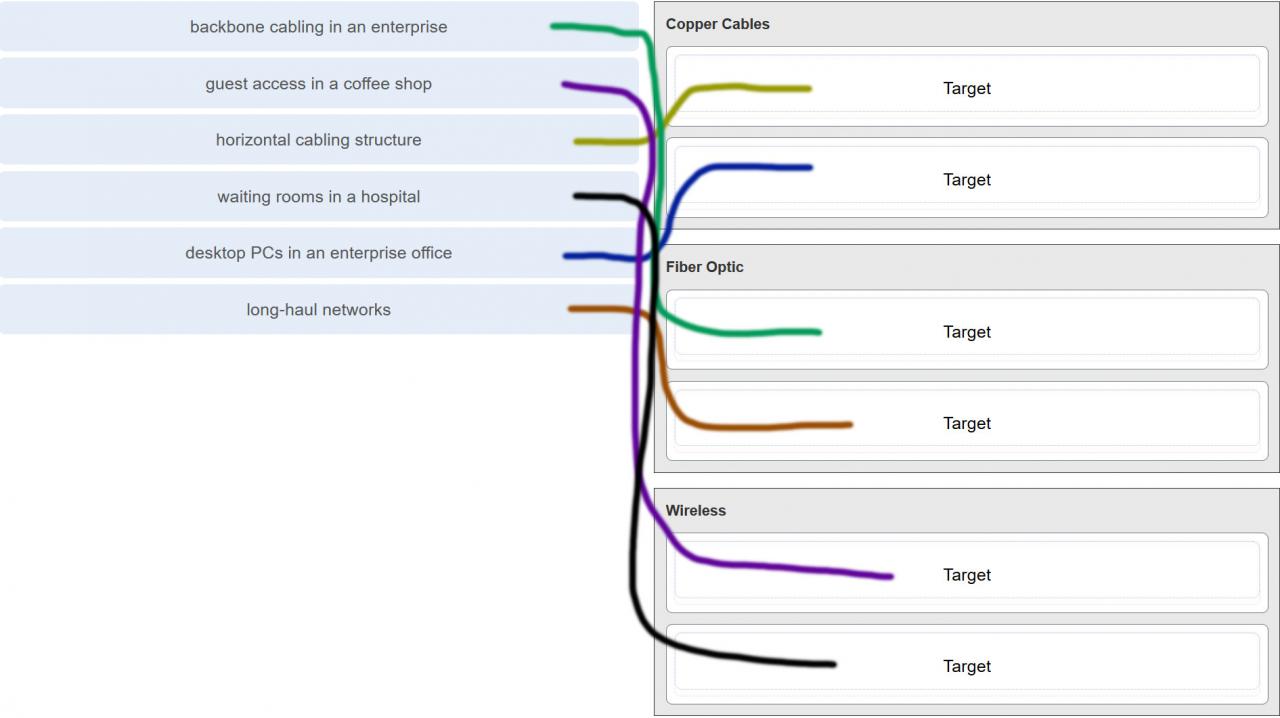
5. Match the situation with the appropriate use of network media.

6. A network administrator is measuring the transfer of bits across the company backbone for a mission critical financial application. The administrator notices that the network throughput appears lower than the bandwidth expected. Which three factors could influence the differences in throughput? (Choose three.)
  • the amount of traffic that is currently crossing the network
  • the sophistication of the encapsulation method applied to the data
  • the type of traffic that is crossing the network
  • the latency that is created by the number of network devices that the data is crossing
  • the bandwidth of the WAN connection to the Internet
  • the reliability of the gigabit Ethernet infrastructure of the backbone
7. What are two characteristics of fiber-optic cable? (Choose two.)
  • It is not affected by EMI or RFI.
  • Each pair of cables is wrapped in metallic foil.
  • It combines the technique of cancellation, shielding, and twisting to protect data.
  • It typically contains 4 pairs of fiber-optic wires.
  • It is more expensive than UTP cabling is.
8. What is a primary role of the Physical layer in transmitting data on the network?
  • create the signals that represent the bits in each frame on to the media
  • provide physical addressing to the devices
  • determine the path packets take through the network
  • control data access to the media
Explanation: The OSI physical layer provides the means to transport the bits that make up a frame across the network media. This layer accepts a complete frame from the data link layer and encodes it as a series of signals that are transmitted to the local media.
9. With the use of unshielded twisted-pair copper wire in a network, what causes crosstalk within the cable pairs?
  • the magnetic field around the adjacent pairs of wire
  • the use of braided wire to shield the adjacent wire pairs
  • the reflection of the electrical wave back from the far end of the cable
  • the collision caused by two nodes trying to use the media simultaneously
Explanation: Crosstalk is a type of noise, or interference that occurs when signal transmission on one wire interferes with another wire. When current flows through a wire a magnetic field is produced. The produced magnetic field will interface the signal carried in the adjacent wire.
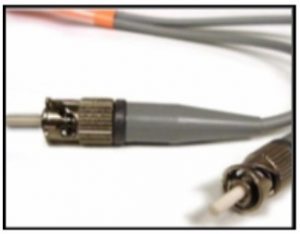
10. Refer to the graphic. What type of cabling is shown?

  • STP
  • UTP
  • coax
  • fiber
Explanation: Network cabling include different types of cables:
  • UTP cable consists of four pairs of color-coded wires that have been twisted together and then encased in a flexible plastic sheath.
  • STP cable uses four pairs of wires, each wrapped in a foil shield, which are then wrapped in an overall metallic braid or foil.
  • Coaxial cable uses a copper conductor and a layer of flexible plastic insulation surrounds the copper conductor.
  • Fiber cable is a flexible, extremely thin, transparent strand of glass surrounded by plastic insulation.
11. In addition to the cable length, what two factors could interfere with the communication carried over UTP cables? (Choose two.)
  • crosstalk
  • bandwidth
  • size of the network
  • signal modulation technique
  • electromagnetic interference
Explanation: Copper media is widely used in network communications. However, copper media is limited by distance and signal interference. Data is transmitted on copper cables as electrical pulses. The electrical pulses are susceptible to interference from two sources:
  • Electromagnetic interference (EMI) or radio frequency interference (RFI) – EMI and RFI signals can distort and corrupt the data signals being carried by copper media.
  • Crosstalk – Crosstalk is a disturbance caused by the electric or magnetic fields of a signal on one wire interfering with the signal in an adjacent wire.
12. Refer to the graphic. What type of cabling is shown?

  • STP
  • UTP
  • coax
  • fiber
13. Which two devices commonly affect wireless networks? (Choose two.)
  • Blu-ray players
  • home theaters
  • cordless phones
  • microwaves
  • incandescent light bulbs
  • external hard drives
Explanation: Radio Frequency Interference (RFI) is the interference that is caused by radio transmitters and other devices that are transmitting in the same frequency.
14. Which two statements describe the services provided by the data link layer? (Choose two.)
  • It defines the end-to-end delivery addressing scheme.
  • It maintains the path between the source and destination devices during the data transmission.
  • It manages the access of frames to the network media.
  • It provides reliable delivery through link establishment and flow control.
  • It ensures that application data will be transmitted according to the prioritization.
  • It packages various Layer 3 PDUs into a frame format that is compatible with the network interface.
Explanation: The data link layer is divided into two sub layers, namely Logical Link Control (LLC) and Media Access Control (MAC). LLC forms a frame from the network layer PDU into a format that conforms to the requirements of the network interface and media. A network layer PDU might be for IPv4 or IPv6. The MAC sub layer defines the media access processes performed by the hardware. It manages the frame access to the network media according to the physical signaling requirements (copper cable, fiber optic, wireless, etc.)
15. What is the function of the CRC value that is found in the FCS field of a frame?
  • to verify the integrity of the received frame
  • to verify the physical address in the frame
  • to verify the logical address in the frame
  • to compute the checksum header for the data field in the frame
16. What is contained in the trailer of a data-link frame?
  • logical address
  • physical address
  • data
  • error detection
17. Which statement describes a characteristic of the frame header fields of the data link layer?
  • They all include the flow control and logical connection fields.
  • Ethernet frame header fields contain Layer 3 source and destination addresses.
  • They vary depending on protocols.
  • They include information on user applications.
Explanation: All data link layer protocols encapsulate the Layer 3 PDU within the data field of the frame. However, the structure of the frame and the fields that are contained in the header vary according to the protocol. Different data link layer protocols may use different fields, like priority/quality of service, logical connection control, physical link control, flow control, and congestion control.
18. A network team is comparing physical WAN topologies for connecting remote sites to a headquarters building. Which topology provides high availability and connects some, but not all, remote sites?
  • mesh
  • partial mesh
  • hub and spoke
  • point-to-point
Explanation: Partial mesh topologies provide high availability by interconnecting multiple remote sites, but do not require a connection between all remote sites. A mesh topology requires point-to-point links with every system being connected to every other system. A point-to-point topology is where each device is connected to one other device. A hub and spoke uses a central device in a star topology that connects to other point-to-point devices.
19. Which two fields or features does Ethernet examine to determine if a received frame is passed to the data link layer or discarded by the NIC? (Choose two.)
  • auto-MDIX
  • CEF
  • Frame Check Sequence
  • minimum frame size
  • source MAC address
20. Which media communication type does not require media arbitration in the data link layer?
  • deterministic
  • half-duplex
  • full-duplex
  • controlled access
Explanation: Half-duplex communication occurs when both devices can both transmit and receive on the medium but cannot do so simultaneously. Full-duplex communication occurs when both devices can transmit and receive on the medium at the same time and therefore does not require media arbitration. Half-duplex communication is typically contention-based, whereas controlled (deterministic) access is applied in technologies where devices take turns to access the medium.
21. Which statement describes an extended star topology?
  • End devices connect to a central intermediate device, which in turn connects to other central intermediate devices.
  • End devices are connected together by a bus and each bus connects to a central intermediate device.
  • Each end system is connected to its respective neighbor via an intermediate device.
  • All end and intermediate devices are connected in a chain to each other.
Explanation: In an extended star topology, central intermediate devices interconnect other star topologies.
22. What is a characteristic of the LLC sublayer?
  • It provides the logical addressing required that identifies the device.
  • It provides delimitation of data according to the physical signaling requirements of the medium.
  • It places information in the frame allowing multiple Layer 3 protocols to use the same network interface and media.
  • It defines software processes that provide services to the physical layer.
23. What are three ways that media access control is used in networking? (Choose three.)
  • Ethernet utilizes CSMA/CD.
  • Media access control provides placement of data frames onto the media.
  • Contention-based access is also known as deterministic.
  • 802.11 utilizes CSMA/CD.
  • Data link layer protocols define the rules for access to different media.
  • Networks with controlled access have reduced performance due to data collisions.
24. During the encapsulation process, what occurs at the data link layer for a PC connected to an Ethernet network?
  • An IP address is added.
  • The logical address is added.
  • The physical address is added.
  • The process port number is added.
Explanation: The Ethernet frame includes the source and destination physical address. The trailer includes a CRC value in the Frame Check Sequence field to allow the receiving device to determine if the frame has been changed (has errors) during the transmission.
25. What three items are contained in an Ethernet header and trailer? (Choose three.)
  • source IP address
  • source MAC address
  • destination IP address
  • destination MAC address
  • error-checking information
Explanation: Layer 2 headers contain the following:
  • Frame start and stop indicator flags at the beginning and end of a frame
  • Addressing – for Ethernet networks this part of the header contains source and destination MAC addresses
  • Type field to indicate what Layer 3 protocol is being used
  • Error detection to determine if the frame arrived without error
26. What type of communication rule would best describe CSMA/CD?
  • access method
  • flow control
  • message encapsulation
  • message encoding
Explanation: Carrier sense multiple access collision detection (CSMA/CD) is the access method used with Ethernet. The access method rule of communication dictates how a network device is able to place a signal on the carrier. CSMA/CD dictates those rules on an Ethernet network and CSMA/CA dictates those rules on an 802.11 wireless LAN.
27. Which three basic parts are common to all frame types supported by the data link layer? (Choose three.)
  • header
  • type field
  • MTU size
  • data
  • trailer
  • CRC value
Explanation: The data link protocol is responsible for NIC-to-NIC communications within the same network. Although there are many different data link layer protocols that describe data link layer frames, each frame type has three basic parts:
  • Header
  • Data
  • Trailer
28. Which statement is true about the CSMA/CD access method that is used in Ethernet?
  • When a device hears a carrier signal and transmits, a collision cannot occur.
  • A jamming signal causes only devices that caused the collision to execute a backoff algorithm.
  • All network devices must listen before transmitting.
  • Devices involved in a collision get priority to transmit after the backoff period.
29. What is the auto-MDIX feature on a switch?
  • the automatic configuration of an interface for 10/100/1000 Mb/s operation
  • the automatic configuration of an interface for a straight-through or a crossover Ethernet cable connection
  • the automatic configuration of full-duplex operation over a single Ethernet copper or optical cable
  • the ability to turn a switch interface on or off accordingly if an active connection is detected
Explanation: The auto-MDIX enables a switch to use a crossover or a straight-through Ethernet cable to connect to a device regardless of the device on the other end of the connection.
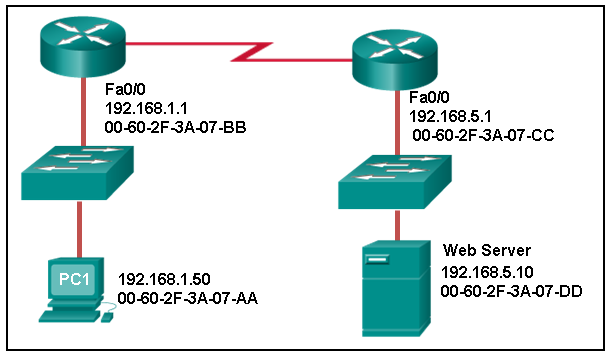
30. Refer to the exhibit. What is the destination MAC address of the Ethernet frame as it leaves the web server if the final destination is PC1?

  • 00-60-2F-3A-07-AA
  • 00-60-2F-3A-07-BB
  • 00-60-2F-3A-07-CC
  • 00-60-2F-3A-07-DD
Explanation: The destination MAC address is used for local delivery of Ethernet frames. The MAC (Layer 2) address changes at each network segment along the path. As the frame leaves the web server, it will be delivered by using the MAC address of the default gateway.
31. A Layer 2 switch is used to switch incoming frames from a 1000BASE-T port to a port connected to a 100Base-T network. Which method of memory buffering would work best for this task?
  • port-based buffering
  • level 1 cache buffering
  • shared memory buffering
  • fixed configuration buffering
32. What are two examples of the cut-through switching method? (Choose two.)
  • store-and-forward switching
  • fast-forward switching
  • CRC switching
  • fragment-free switching
  • QOS switching
33. Which frame forwarding method receives the entire frame and performs a CRC check to detect errors before forwarding the frame?
  • cut-through switching
  • store-and-forward switching
  • fragment-free switching
  • fast-forward switching
Explanation: Fast-forward and fragment-free switching are variations of cut-through switching, which begins to forward the frame before the entire frame is received.
34. What is the purpose of the FCS field in a frame?
  • to obtain the MAC address of the sending node
  • to verify the logical address of the sending node
  • to compute the CRC header for the data field
  • to determine if errors occurred in the transmission and reception
Explanation: The FCS field in a frame is used to detect any errors in the transmission and receipt of a frame. This is done by comparing the CRC value within the frame against a computed CRC value of the frame. If the two values do not match, then the frame is discarded.
35. Which switching method has the lowest level of latency?
  • cut-through
  • store-and-forward
  • fragment-free
  • fast-forward
Explanation: Fast-forward switching begins to forward a frame after reading the destination MAC address, resulting in the lowest latency. Fragment-free reads the first 64 bytes before forwarding. Store-and-forward has the highest latency because it reads the entire frame before beginning to forward it. Both fragment-free and fast-forward are types of cut-through switching.
36. A network administrator is connecting two modern switches using a straight-through cable. The switches are new and have never been configured. Which three statements are correct about the final result of the connection? (Choose three.)
  • The link between the switches will work at the fastest speed that is supported by both switches.
  • The link between switches will work as full-duplex.
  • If both switches support different speeds, they will each work at their own fastest speed.
  • The auto-MDIX feature will configure the interfaces eliminating the need for a crossover cable.
  • The connection will not be possible unless the administrator changes the cable to a crossover cable.
  • The duplex capability has to be manually configured because it cannot be negotiated.
Explanation: Modern switches can negotiate to work in full-duplex mode if both switches are capable. They will negotiate to work using the fastest possible speed and the auto-MDIX feature is enabled by default, so a cable change is not needed.
37. Which advantage does the store-and-forward switching method have compared with the cut-through switching method?
  • collision detecting
  • frame error checking
  • faster frame forwarding
  • frame forwarding using IPv4 Layer 3 and 4 information
Explanation: A switch using the store-and-forward switching method performs an error check on an incoming frame by comparing the FCS value against its own FCS calculations after the entire frame is received. In comparison, a switch using the cut-through switching method makes quick forwarding decisions and starts the forwarding process without waiting for the entire frame to be received. Thus a switch using cut-through switching may send invalid frames to the network. The performance of store-and-forward switching is slower compared to cut-through switching performance. Collision detection is monitored by the sending device. Store-and-forward switching does not use IPv4 Layer 3 and 4 information for its forwarding decisions.
38. When the store-and-forward method of switching is in use, what part of the Ethernet frame is used to perform an error check?
  • CRC in the trailer
  • source MAC address in the header
  • destination MAC address in the header
  • protocol type in the header
39. Which switching method uses the CRC value in a frame?
  • cut-through
  • fast-forward
  • fragment-free
  • store-and-forward
Explanation: When the store-and-forward switching method is used, the switch receives the complete frame before forwarding it on to the destination. The cyclic redundancy check (CRC) part of the trailer is used to determine if the frame has been modified during transit.​​ In contrast, a cut-through switch forwards the frame once the destination Layer 2 address is read. Two types of cut-through switching methods are fast-forward and fragment-free.
40. What are two actions performed by a Cisco switch? (Choose two.)
  • building a routing table that is based on the first IP address in the frame header
  • using the source MAC addresses of frames to build and maintain a MAC address table
  • forwarding frames with unknown destination IP addresses to the default gateway
  • utilizing the MAC address table to forward frames via the destination MAC address
  • examining the destination MAC address to add new entries to the MAC address table
Explanation: Important actions that a switch performs are as follows:
  • When a frame comes in, the switch examines the Layer 2 source address to build and maintain the Layer 2 MAC address table.
  • It examines the Layer 2 destination address to determine how to forward the frame. When the destination address is in the MAC address table, then the frame is sent out a particular port. When the address is unknown, the frame is sent to all ports that have devices connected to that network.
41. Which two statements describe features or functions of the logical link control sublayer in Ethernet standards? (Choose two.)
  • Logical link control is implemented in software.
  • Logical link control is specified in the IEEE 802.3 standard.
  • The LLC sublayer adds a header and a trailer to the data.
  • The data link layer uses LLC to communicate with the upper layers of the protocol suite.
  • The LLC sublayer is responsible for the placement and retrieval of frames on and off the media.
Explanation: Logical link control is implemented in software and enables the data link layer to communicate with the upper layers of the protocol suite. Logical link control is specified in the IEEE 802.2 standard. IEEE 802.3 is a suite of standards that define the different Ethernet types. The MAC (Media Access Control) sublayer is responsible for the placement and retrieval of frames on and off the media. The MAC sublayer is also responsible for adding a header and a trailer to the network layer protocol data unit (PDU).
42. What is the auto-MDIX feature?
  • It enables a device to automatically configure an interface to use a straight-through or a crossover cable.
  • It enables a device to automatically configure the duplex settings of a segment.
  • It enables a device to automatically configure the speed of its interface.
  • It enables a switch to dynamically select the forwarding method.
43. What is one advantage of using the cut-through switching method instead of the store-and-forward switching method?
  • has a positive impact on bandwidth by dropping most of the invalid frames
  • makes a fast forwarding decision based on the source MAC address of the frame
  • has a lower latency appropriate for high-performance computing applications​
  • provides the flexibility to support any mix of Ethernet speeds
Explanation: Cut-through switching provides lower latency switching for high-performance computing (HPC) applications. Cut-through switching allows more invalid frames to cross the network than store-and-forward switching. The cut-through switching method can make a forwarding decision as soon as it looks up the destination MAC address of the frame.
44. Which is a multicast MAC address?
  • FF-FF-FF-FF-FF-FF
  • 5C-26-0A-4B-19-3E
  • 01-00-5E-00-00-03
  • 00-26-0F-4B-00-3E
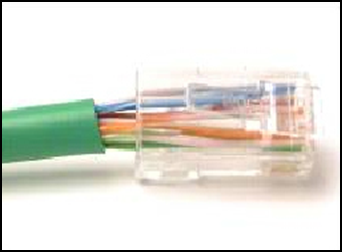
45. Refer to the exhibit. What is wrong with the displayed termination?

  • The woven copper braid should not have been removed.
  • The wrong type of connector is being used.
  • The untwisted length of each wire is too long.
  • The wires are too thick for the connector that is used.
Explanation: When a cable to an RJ-45 connector is terminated, it is important to ensure that the untwisted wires are not too long and that the flexible plastic sheath surrounding the wires is crimped down and not the bare wires. None of the colored wires should be visible from the bottom of the jack.
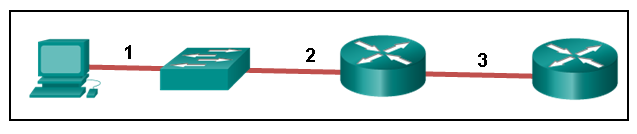
46. Refer to the exhibit. The PC is connected to the console port of the switch. All the other connections are made through FastEthernet links. Which types of UTP cables can be used to connect the devices?​

  • 1 – rollover, 2 – crossover, 3 – straight-through
  • 1 – rollover, 2 – straight-through, 3 – crossover
  • 1 – crossover, 2 – straight-through, 3 – rollover
  • 1 – crossover, 2 – rollover, 3 – straight-through
Explanation: A straight-through cable is commonly used to interconnect a host to a switch and a switch to a router. A crossover cable is used to interconnect similar devices together like switch to a switch, a host to a host, or a router to a router. If a switch has the MDIX capability, a crossover could be used to connect the switch to the router; however, that option is not available. A rollover cable is used to connect to a router or switch console port.
47. Open the PT Activity. Perform the tasks in the activity instructions and then answer the question.
Which port does Switch0 use to send frames to the host with the IPv4 address 10.1.1.5?
  • Fa0/1
  • Fa0/5
  • Fa0/9
  • Fa0/11
Explanation: Issuing the command ipconfig /all from the PC0 command prompt displays the IPv4 address and MAC address. When the IPv4 address 10.1.1.5 is pinged from PC0, the switch stores the source MAC address (from PC0) along with the port to which PC0 is connected. When the destination reply is received, the switch takes the destination MAC address and compares to MAC addresses stored in the MAC address table. Issuing the show mac-address-table on the PC0 Terminal application displays two dynamic MAC address entries. The MAC address and port entry that does not belong to PC0 must be the MAC address and port of the destination with the IPv4 address 10.1.1.5.
48. What does the term “attenuation” mean in data communication?
  • loss of signal strength as distance increases
  • time for a signal to reach its destination
  • leakage of signals from one cable pair to another
  • strengthening of a signal by a networking device
Explanation: Data is transmitted on copper cables as electrical pulses. A detector in the network interface of a destination device must receive a signal that can be successfully decoded to match the signal sent. However, the farther the signal travels, the more it deteriorates. This is referred to as signal attenuation.
49. What makes fiber preferable to copper cabling for interconnecting buildings? (Choose three.)
  • greater distances per cable run
  • lower installation cost
  • limited susceptibility to EMI/RFI
  • durable connections
  • greater bandwidth potential
  • easily terminated
Explanation: Optical fiber cable transmits data over longer distances and at higher bandwidths than any other networking media. Unlike copper wires, fiber-optic cable can transmit signals with less attenuation and is completely immune to EMI and RFI.
50. What OSI physical layer term describes the process by which one wave modifies another wave?
  • modulation
  • IEEE
  • EIA/TIA
  • air
51. What OSI physical layer term describes the capacity at which a medium can carry data?
  • bandwidth
  • IEEE
  • EIA/TIA
  • air
52. What OSI physical layer term describes the capacity at which a medium can carry data?
  • bandwidth
  • throughput
  • latency
  • goodput
53. What OSI physical layer term describes the measure of the transfer of bits across a medium over a given period of time?
  • throughput
  • bandwidth
  • latency
  • goodput
54. What OSI physical layer term describes the amount of time, including delays, for data to travel from one point to another?
  • latency
  • bandwidth
  • throughput
  • goodput
55. What OSI physical layer term describes the amount of time, including delays, for data to travel from one point to another?
  • latency
  • fiber-optic cable
  • air
  • copper cable
56. What OSI physical layer term describes the measure of usable data transferred over a given period of time?
  • goodput
  • fiber-optic cable
  • air
  • copper cable
57. What OSI physical layer term describes the physical medium which uses electrical pulses?
  • copper cable
  • fiber-optic cable
  • air
  • goodput
58. What OSI physical layer term describes the physical medium that uses the propagation of light?
  • fiber-optic cable
  • goodput
  • latency
  • throughput
59. What OSI physical layer term describes the physical medium for microwave transmissions?
  • air
  • goodput
  • latency
  • throughput
60. Which two functions are performed at the MAC sublayer of the OSI data link layer? (Choose two.)
  • Implements a trailer to detect transmission errors.
  • Controls the NIC responsible for sending and receiving data on the physical medium.
  • Places information in the frame that identifies which network layer protocol is being used for the frame.
  • Adds Layer 2 control information to network protocol data.
  • Enables IPv4 and IPv6 to utilize the same network interface and media.
61. Which two functions are performed at the LLC sublayer of the OSI data link layer? (Choose two.)
  • Enables IPv4 and IPv6 to utilize the same network interface and media.
  • Places information in the frame that identifies which network layer protocol is being used for the frame.
  • Integrates various physical technologies.
  • Implements a process to delimit fields within a Layer 2 frame.
  • Controls the NIC responsible for sending and receiving data on the physical medium.
62. Which two functions are performed at the MAC sublayer of the OSI data link layer? (Choose two.)
  • Provides a mechanism to allow multiple devices to communicate over a shared medium.
  • Controls the NIC responsible for sending and receiving data on the physical medium.
  • Places information in the frame that identifies which network layer protocol is being used for the frame.
  • Adds Layer 2 control information to network protocol data.
  • Communicates between the networking software at the upper layers and the device hardware at the lower layers.
63. Which two functions are performed at the MAC sublayer of the OSI data link layer? (Choose two.)
  • Controls the NIC responsible for sending and receiving data on the physical medium.
  • Integrates various physical technologies.
  • Communicates between the networking software at the upper layers and the device hardware at the lower layers.
  • Adds Layer 2 control information to network protocol data.
  • Places information in the frame that identifies which network layer protocol is being used for the frame.
64. Which two functions are performed at the LLC sublayer of the OSI data link layer? (Choose two.)
  • Adds Layer 2 control information to network protocol data.
  • Places information in the frame that identifies which network layer protocol is being used for the frame.
  • Performs data encapsulation.
  • Controls the NIC responsible for sending and receiving data on the physical medium.
  • Integrates various physical technologies.
65. Which two functions are performed at the MAC sublayer of the OSI data link layer? (Choose two.)
  • Provides synchronization between source and target nodes.
  • Integrates various physical technologies.
  • Communicates between the networking software at the upper layers and the device hardware at the lower layers.
  • Adds Layer 2 control information to network protocol data.
  • Enables IPv4 and IPv6 to utilize the same network interface and media.
66. Which two functions are performed at the LLC sublayer of the OSI data link layer? (Choose two.)
  • Adds Layer 2 control information to network protocol data.
  • Enables IPv4 and IPv6 to utilize the same network interface and media.
  • Provides data link layer addressing.
  • Implements a trailer to detect transmission errors.
  • Provides synchronization between source and target nodes.
67. Which two functions are performed at the MAC sublayer of the OSI data link layer? (Choose two.)
  • Implements a trailer to detect transmission errors.
  • Provides synchronization between source and target nodes.
  • Places information in the frame that identifies which network layer protocol is being used for the frame.
  • Enables IPv4 and IPv6 to utilize the same network interface and media.
  • Adds Layer 2 control information to network protocol data.
68. Which two functions are performed at the LLC sublayer of the OSI data link layer? (Choose two.)
  • Enables IPv4 and IPv6 to utilize the same network interface and media.
  • Adds Layer 2 control information to network protocol data.
  • Integrates various physical technologies.
  • Implements a trailer to detect transmission errors.
  • Provides synchronization between source and target nodes.
69. Which two functions are performed at the MAC sublayer of the OSI data link layer? (Choose two.)
  • Provides a mechanism to allow multiple devices to communicate over a shared medium.
  • Controls the NIC responsible for sending and receiving data on the physical medium.
  • Places information in the frame that identifies which network layer protocol is being used for the frame.
  • Adds Layer 2 control information to network protocol data.
  • Enables IPv4 and IPv6 to utilize the same network interface and media.
70. What action will occur if a switch receives a frame and does have the source MAC address in the MAC table?
  • The switch refreshes the timer on that entry.
  • The switch shares the MAC address table entry with any connected switches.
  • The switch does not forward the frame.
  • The switch sends the frame to a connected router because the destination MAC address is not local.
71. What action will occur if a switch receives a frame with the destination MAC address FF:FF:FF:FF:FF:FF?
  • The switch forwards it out all ports except the ingress port.
  • The switch shares the MAC address table entry with any connected switches.
  • The switch does not forward the frame.
  • The switch sends the frame to a connected router because the destination MAC address is not local.
72. What action will occur if a host receives a frame with a destination MAC address it does not recognize?
  • The host will discard the frame.
  • The host sends the frame to the switch to update the MAC address table.
  • The host forwards the frame to the router.
  • The host forwards the frame to all other hosts.
73. What action will occur if a switch receives a frame with the destination MAC address 01:00:5E:00:00:D9?
  • The switch forwards it out all ports except the ingress port.
  • The switch does not forward the frame.
  • The switch sends the frame to a connected router because the destination MAC address is not local.
  • The switch shares the MAC address table entry with any connected switches.
74. What action will occur if a host receives a frame with a destination MAC address of FF:FF:FF:FF:FF:FF?
  • The host will process the frame.
  • The host forwards the frame to the router.
  • The host sends the frame to the switch to update the MAC address table.
  • The host forwards the frame to all other hosts.
75. What action will occur if a switch receives a frame and does have the source MAC address in the MAC table?
  • The switch refreshes the timer on that entry.
  • The switch adds it to its MAC address table associated with the port number.
  • The switch forwards the frame to the associated port.
  • The switch sends the frame to a connected router because the destination MAC address is not local.
76. What action will occur if a host receives a frame with a destination MAC address of FF:FF:FF:FF:FF:FF?
  • The host will process the frame.
  • The host returns the frame to the switch.
  • The host replies to the switch with its own IP address.
  • The host forwards the frame to all other hosts.
77. What action will occur if a switch receives a frame and does have the source MAC address in the MAC table?
  • The switch refreshes the timer on that entry.
  • The switch shares the MAC address table entry with any connected switches.
  • The switch does not forward the frame.
  • The switch adds it to its MAC address table associated with the port number.
78. What action will occur if a host receives a frame with a destination MAC address it does not recognize?
  • The host will discard the frame.
  • The host replies to the switch with its own IP address.
  • The host forwards the frame to all other hosts.
  • The host returns the frame to the switch.
79.
What is the purpose of the OSI physical layer?
  • controlling access to media
  • transmitting bits across the local media
  • performing error detection on received frames
  • exchanging frames between nodes over physical network media

CCNA 1 version 7 Modules 1 – 3: Basic Network Connectivity and Communications Exam Answers 2020

Introduction to Networks Version 7 – Basic Network Connectivity and Communications Exam

1. A large corporation has modified its network to allow users to access network resources from their personal laptops and smart phones. Which networking trend does this describe?
  • cloud computing
  • online collaboration
  • bring your own device
  • video conferencing
2. What is an ISP?
  • It is a standards body that develops cabling and wiring standards for networking.
  • It is a protocol that establishes how computers within a local network communicate.
  • It is an organization that enables individuals and businesses to connect to the Internet.
  • It is a networking device that combines the functionality of several different networking devices in one.
3. During a routine inspection, a technician discovered that software that was installed on a computer was secretly collecting data about websites that were visited by users of the computer. Which type of threat is affecting this computer?
  • DoS attack​
  • identity theft
  • spyware
  • zero-day attack
4. Which term refers to a network that provides secure access to the corporate offices by suppliers, customers and collaborators?
  • Internet
  • intranet
  • extranet
  • extendednet


5. Match the requirements of a reliable network with the supporting network architecture. (Not all options are used.)

6. An employee at a branch office is creating a quote for a customer. In order to do this, the employee needs to access confidential pricing information from internal servers at the Head Office. What type of network would the employee access?
  • an intranet
  • the Internet
  • an extranet
  • a local area network
Explanation: Intranet is a term used to refer to a private connection of LANs and WANs that belongs to an organization. An intranet is designed to be accessible only by the organization’s members, employees, or others with authorization.

7. Which statement describes the use of powerline networking technology?
  • New “smart” electrical cabling is used to extend an existing home LAN.
  • A home LAN is installed without the use of physical cabling.
  • A device connects to an existing home LAN using an adapter and an existing electrical outlet.
  • Wireless access points use powerline adapters to distribute data through the home LAN.
8. A networking technician is working on the wireless network at a medical clinic. The technician accidentally sets up the wireless network so that patients can see the medical records data of other patients. Which of the four network characteristics has been violated in this situation?
  • fault tolerance
  • scalability
  • security
  • Quality of Service (QoS)
  • reliability
Explanation: Network security includes protecting the confidentiality of data that is on the network. In this case, because confidential data has been made available to unauthorized users, the security characteristic of the network has failed.
9. Match each characteristic to its corresponding Internet connectivity type. (Not all options are used.)

CCNA-1-v7-Modules-1-3-Basic Network Connectivity and Communications Exam Answers 09
Explanation: DSL is an always-on, high bandwidth connection that runs over telephone lines. Cable uses the same coaxial cable that carries television signals into the home to provide Internet access. Dialup telephone is much slower than either DSL or cable, but is the least expensive option for home users because it can use any telephone line and a simple modem. Satellite requires a clear line of sight and is affected by trees and other obstructions. None of these typical home options use dedicated leased lines such as T1/E1 and T3/E3.
10. What two criteria are used to help select a network medium from various network media? (Choose two.)
  • the types of data that need to be prioritized
  • the cost of the end devices utilized in the network
  • the distance the selected medium can successfully carry a signal
  • the number of intermediate devices installed in the network
  • the environment where the selected medium is to be installed
Explanation: Criteria for choosing a network medium are the distance the selected medium can successfully carry a signal, the environment in which the selected medium is to be installed, the amount of data and the speed at which the data must be transmitted, and the cost of the medium and its installation.

11. What type of network traffic requires QoS?
  • email
  • on-line purchasing
  • video conferencing
  • wiki
12. A user is implementing security on a small office network. Which two actions would provide the minimum security requirements for this network? (Choose two.)
  • implementing a firewall
  • installing a wireless network
  • installing antivirus software
  • implementing an intrusion detection system
  • adding a dedicated intrusion prevention device
Explanation: Technically complex security measures such as intrusion prevention and intrusion prevention systems are usually associated with business networks rather than home networks. Installing antivirus software, antimalware software, and implementing a firewall will usually be the minimum requirements for home networks. Installing a home wireless network will not improve network security, and will require further security actions to be taken.
13. Passwords can be used to restrict access to all or parts of the Cisco IOS. Select the modes and interfaces that can be protected with passwords. (Choose three.)
  • VTY interface
  • console interface
  • Ethernet interface
  • boot IOS mode
  • privileged EXEC mode
  • router configuration mode
Explanation: Access to the VTY and console interfaces can be restricted using passwords. Out-of-band management of the router can be restricted in both user EXEC and privileged EXEC modes.

14. Which interface allows remote management of a Layer 2 switch?
  • the AUX interface
  • the console port interface
  • the switch virtual interface
  • the first Ethernet port interface
Explanation: In a Layer 2 switch, there is a switch virtual interface (SVI) that provides a means for remotely managing the device.
15. What function does pressing the Tab key have when entering a command in IOS?
  • It aborts the current command and returns to configuration mode.
  • It exits configuration mode and returns to user EXEC mode.
  • It moves the cursor to the beginning of the next line.
  • It completes the remainder of a partially typed word in a command.
Explanation: Pressing the Tab key after a command has been partially typed will cause the IOS to complete the rest of the command.
16. While trying to solve a network issue, a technician made multiple changes to the current router configuration file. The changes did not solve the problem and were not saved. What action can the technician take to discard the changes and work with the file in NVRAM?
  • Issue the reload command without saving the running configuration.
  • Delete the vlan.dat file and reboot the device.
  • Close and reopen the terminal emulation software.
  • Issue the copy startup-config running-config command.
Explanation: The technician does not want to make any mistakes trying to remove all the changes that were done to the running configuration file. The solution is to reboot the router without saving the running configuration. The copy startup-config running-config command does not overwrite the running configuration file with the configuration file stored in NVRAM, but rather it just has an additive effect.
17. An administrator uses the Ctrl-Shift-6 key combination on a switch after issuing the ping command. What is the purpose of using these keystrokes?
  • to restart the ping process
  • to interrupt the ping process
  • to exit to a different configuration mode
  • to allow the user to complete the command
Explanation: To interrupt an IOS process such as ping or traceroute, a user enters the Ctrl-Shift-6 key combination. Tab completes the remainder of parameters or arguments within a command. To exit from configuration mode to privileged mode use the Ctrl-Z keystroke. CTRL-R will redisplay the line just typed, thus making it easier for the user to press Enter and reissue the ping command.

18. Refer to the exhibit. A network administrator is configuring access control to switch SW1. If the administrator uses a console connection to connect to the switch, which password is needed to access user EXEC mode?

CCNA-1-v7-Modules-1-3-Basic Network Connectivity and Communications Exam Answers 14
  • letmein
  • secretin
  • lineconin
  • linevtyin
Explanation: Telnet accesses a network device through the virtual interface configured with the line VTY command. The password configured under this is required to access the user EXEC mode. The password configured under the line console 0 command is required to gain entry through the console port, and the enable and enable secret passwords are used to allow entry into the privileged EXEC mode.
19. A technician configures a switch with these commands:
SwitchA(config)# interface vlan 1
SwitchA(config-if)# ip address 192.168.1.1 255.255.255.0
SwitchA(config-if)# no shutdown
What is the technician configuring?
  • Telnet access
  • SVI
  • password encryption
  • physical switchport access
Explanation: For a switch to have an IP address, a switch virtual interface must be configured. This allows the switch to be managed remotely over the network.
20. Which command or key combination allows a user to return to the previous level in the command hierarchy?
  • end
  • exit
  • Ctrl-Z
  • Ctrl-C
Explanation: End and CTRL-Z return the user to the privileged EXEC mode. Ctrl-C ends a command in process. The exit command returns the user to the previous level.
21. What are two characteristics of RAM on a Cisco device? (Choose two.)
  • RAM provides nonvolatile storage.
  • The configuration that is actively running on the device is stored in RAM.
  • The contents of RAM are lost during a power cycle.
  • RAM is a component in Cisco switches but not in Cisco routers.
  • RAM is able to store multiple versions of IOS and configuration files.
Explanation: RAM stores data that is used by the device to support network operations. The running configuration is stored in RAM. This type of memory is considered volatile memory because data is lost during a power cycle. Flash memory stores the IOS and delivers a copy of the IOS into RAM when a device is powered on. Flash memory is nonvolatile since it retains stored contents during a loss of power.

22. Which two host names follow the guidelines for naming conventions on Cisco IOS devices? (Choose two.)
  • Branch2!
  • RM-3-Switch-2A4
  • Floor(15)
  • HO Floor 17
  • SwBranch799
Explanation: Some guidelines for naming conventions are that names should:
Start with a letter
Contain no spaces
End with a letter or digit
Use only letters, digits, and dashes
Be less than 64 characters in length
23. How is SSH different from Telnet?
  • SSH makes connections over the network, whereas Telnet is for out-of-band access.
  • SSH provides security to remote sessions by encrypting messages and using user authentication. Telnet is considered insecure and sends messages in plaintext.
  • SSH requires the use of the PuTTY terminal emulation program. Tera Term must be used to connect to devices through the use of Telnet.
  • SSH must be configured over an active network connection, whereas Telnet is used to connect to a device from a console connection.
Explanation: SSH is the preferred protocol for connecting to a device operating system over the network because it is much more secure than Telnet. Both SSH and Telnet are used to connect to devices over the network, and so are both used in-band. PuTTY and Terra Term can be used to make both SSH and Telnet connections.
24. An administrator is configuring a switch console port with a password. In what order will the administrator travel through the IOS modes of operation in order to reach the mode in which the configuration commands will be entered? (Not all options are used.)

CCNA-1-v7-Modules-1-3-Basic Network Connectivity and Communications Exam Answers 24
Explanation: The configuration mode that the administrator first encounters is user EXEC mode. After the enable command is entered, the next mode is privileged EXEC mode. From there, the configure terminal command is entered to move to global configuration mode. Finally, the administrator enters the line console 0 command to enter the mode in which the configuration will be entered.
25. What are three characteristics of an SVI? (Choose three.)
  • It is designed as a security protocol to protect switch ports.
  • It is not associated with any physical interface on a switch.
  • It is a special interface that allows connectivity by different types of media.
  • It is required to allow connectivity by any device at any location.
  • It provides a means to remotely manage a switch.
  • It is associated with VLAN1 by default.
Explanation: Switches have one or more switch virtual interfaces (SVIs). SVIs are created in software since there is no physical hardware associated with them. Virtual interfaces provide a means to remotely manage a switch over a network that is using IP. Each switch comes with one SVI appearing in the default configuration “out-of-the-box.” The default SVI interface is VLAN1.
26. What command is used to verify the condition of the switch interfaces, including the status of the interfaces and a configured IP address?
  • ipconfig
  • ping
  • traceroute
  • show ip interface brief
Explanation: The show ip interface brief command is used to display a brief synopsis of the condition of the device interfaces. The ipconfig command is used to verify TCP/IP properties on a host. The ping command is used to verify Layer 3 connectivity. The traceroute command is used to trace the network path from source to destination.
27. Match the description with the associated IOS mode. (Not all options are used.)

28. Match the definitions to their respective CLI hot keys and shortcuts. (Not all options are used.)


Explanation: The shortcuts with their functions are as follows:
– Tab – Completes the remainder of a partially typed command or keyword
– Space bar – displays the next screen
– ? – provides context-sensitive help
– Up Arrow – Allows user to scroll backward through former commands
– Ctrl-C – cancels any command currently being entered and returns directly to privileged EXEC mode
– Ctrl-Shift-6 – Allows the user to interrupt an IOS process such as ping or traceroute
29. In the show running-config command, which part of the syntax is represented by running-config?
  • the command
  • a keyword
  • a variable
  • a prompt
Explanation: The first part of the syntax, show, is the command, and the second part of the syntax, running-config, is the keyword. The keyword specifies what should be displayed as the output of the show command.
30. After making configuration changes on a Cisco switch, a network administrator issues a copy running-config startup-config command. What is the result of issuing this command?
  • The new configuration will be stored in flash memory.
  • The new configuration will be loaded if the switch is restarted.
  • The current IOS file will be replaced with the newly configured file.
  • The configuration changes will be removed and the original configuration will be restored.
31. What command will prevent all unencrypted passwords from displaying in plain text in a configuration file?
  • (config)# enable password secret
  • (config)# enable secret Secret_Password
  • (config-line)# password secret
  • (config)# service password-encryption
  • (config)# enable secret Encrypted_Password
Explanation: To prevent all configured passwords from appearing in plain text in configuration files, an administrator can execute the service password-encryption command. This command encrypts all configured passwords in the configuration file.

32. A network administrator enters the service password-encryption command into the configuration mode of a router. What does this command accomplish?
  • This command encrypts passwords as they are transmitted across serial WAN links.
  • This command prevents someone from viewing the running configuration passwords.
  • This command enables a strong encryption algorithm for the enable secret password command.
  • This command automatically encrypts passwords in configuration files that are currently stored in NVRAM.
  • This command provides an exclusive encrypted password for external service personnel who are required to do router maintenance.
Explanation: The startup-config and running-config files display most passwords in plaintext. Use the service password-encryption global config command to encrypt all plaintext passwords in these files.
33. What method can be used by two computers to ensure that packets are not dropped because too much data is being sent too quickly?
  • encapsulation
  • flow control
  • access method
  • response timeout
Explanation: In order for two computers to be able to communicate effectively, there must be a mechanism that allows both the source and destination to set the timing of the transmission and receipt of data. Flow control allows for this by ensuring that data is not sent too fast for it to be received properly.
34. Which statement accurately describes a TCP/IP encapsulation process when a PC is sending data to the network?
  • Data is sent from the internet layer to the network access layer.
  • Packets are sent from the network access layer to the transport layer.
  • Segments are sent from the transport layer to the internet layer.
  • Frames are sent from the network access layer to the internet layer.
Explanation: When the data is traveling from the PC to the network, the transport layer sends segments to the internet layer. The internet layer sends packets to the network access layer, which creates frames and then converts the frames to bits. The bits are released to the network media.
35. What three application layer protocols are part of the TCP/IP protocol suite? (Choose three.)
  • ARP
  • DHCP
  • DNS
  • FTP
  • NAT
  • PPP
Explanation: DNS, DHCP, and FTP are all application layer protocols in the TCP/IP protocol suite. ARP and PPP are network access layer protocols, and NAT is an internet layer protocol in the TCP/IP protocol suite.
36. Match the description to the organization. (Not all options are used.)

37. Which name is assigned to the transport layer PDU?
  • bits
  • data
  • frame
  • packet
  • segment
Explanation: Application data is passed down the protocol stack on its way to be transmitted across the network media. During the process, various protocols add information to it at each level. At each stage of the process, a PDU (protocol data unit) has a different name to reflect its new functions. The PDUs are named according to the protocols of the TCP/IP suite:
Data – The general term for the PDU used at the application layer.
Segment – transport layer PDU
Packet – network layer PDU
Frame – data link layer PDU
Bits – A physical layer PDU used when physically transmitting data over the medium
38. When IPv4 addressing is manually configured on a web server, which property of the IPv4 configuration identifies the network and host portion for an IPv4 address?
  • DNS server address
  • subnet mask
  • default gateway
  • DHCP server address
Explanation: There are several components that need to be entered when configuring IPv4 for an end device:
IPv4 address – uniquely identifies an end device on the network
Subnet mask – determines the network address portion and host portion for an IPv4 address
Default gateway – the IP address of the router interface used for communicating with hosts in another network
DNS server address – the IP address of the Domain Name System (DNS) server
DHCP server address (if DHCP is used) is not configured manually on end devices. It will be provided by a DHCP server when an end device requests an IP address.
39. What process involves placing one PDU inside of another PDU?
  • encapsulation
  • encoding
  • segmentation
  • flow control
Explanation: When a message is placed inside of another message, this is known as encapsulation. On networks, encapsulation takes place when one protocol data unit is carried inside of the data field of the next lower protocol data unit.
40. What layer is responsible for routing messages through an internetwork in the TCP/IP model?
  • internet
  • transport
  • network access
  • session
Explanation: The TCP/IP model consists of four layers: application, transport, internet, and network access. Of these four layers, it is the internet layer that is responsible for routing messages. The session layer is not part of the TCP/IP model but is rather part of the OSI model.
41. For the TCP/IP protocol suite, what is the correct order of events when a Telnet message is being prepared to be sent over the network?

CCNA-1-v7-Modules-1-3-Basic Network Connectivity and Communications Exam Answers 41
42. Which PDU format is used when bits are received from the network medium by the NIC of a host?
  • file
  • frame
  • packet
  • segment
Explanation: When received at the physical layer of a host, the bits are formatted into a frame at the data link layer. A packet is the PDU at the network layer. A segment is the PDU at the transport layer. A file is a data structure that may be used at the application layer.
43. Refer to the exhibit. ServerB is attempting to contact HostA. Which two statements correctly identify the addressing that ServerB will generate in the process? (Choose two.)

  • ServerB will generate a packet with the destination IP address of RouterB.
  • ServerB will generate a frame with the destination MAC address of SwitchB.
  • ServerB will generate a packet with the destination IP address of RouterA.
  • ServerB will generate a frame with the destination MAC address of RouterB.
  • ServerB will generate a packet with the destination IP address of HostA.
  • ServerB will generate a frame with the destination MAC address of RouterA.
44. Which method allows a computer to react accordingly when it requests data from a server and the server takes too long to respond?
  • encapsulation
  • flow control
  • access method
  • response timeout
45. A web client is receiving a response for a web page from a web server. From the perspective of the client, what is the correct order of the protocol stack that is used to decode the received transmission?
  • Ethernet, IP, TCP, HTTP
  • HTTP, TCP, IP, Ethernet
  • Ethernet, TCP, IP, HTTP
  • HTTP, Ethernet, IP, TCP
Explanation:
1. HTTP governs the way that a web server and client interact.
2. TCP manages individual conversations between web servers and clients.
3. IP is responsible for delivery across the best path to the destination.
4. Ethernet takes the packet from IP and formats it for transmission.
46. Which two OSI model layers have the same functionality as a single layer of the TCP/IP model? (Choose two.)
  • data link
  • network
  • physical
  • session
  • transport
Explanation: The OSI data link and physical layers together are equivalent to the TCP/IP network access layer. The OSI transport layer is functionally equivalent to the TCP/IP transport layer, and the OSI network layer is equivalent to the TCP/IP internet layer. The OSI application, presentation, and session layers are functionally equivalent to the application layer within the TCP/IP model.

47. At which layer of the OSI model would a logical address be added during encapsulation?
  • physical layer
  • data link layer
  • network layer
  • transport layer
48. What is a characteristic of multicast messages?
  • They are sent to a select group of hosts.
  • They are sent to all hosts on a network.
  • They must be acknowledged.
  • They are sent to a single destination.
Explanation: Multicast is a one-to-many type of communication. Multicast messages are addressed to a specific multicast group.
49. Which statement is correct about network protocols?
  • Network protocols define the type of hardware that is used and how it is mounted in racks.
  • They define how messages are exchanged between the source and the destination.
  • They all function in the network access layer of TCP/IP.
  • They are only required for exchange of messages between devices on remote networks.
50. What is an advantage of network devices using open standard protocols?
  • Network communications is confined to data transfers between devices from the same vendor.
  • A client host and a server running different operating systems can successfully exchange data.
  • Internet access can be controlled by a single ISP in each market.
  • Competition and innovation are limited to specific types of products.
Explanation: An advantage of network devices implementing open standard protocols, such as from the TCP/IP suite, is that clients and servers running different operating systems can communicate with each other. Open standard protocols facilitate innovation and competition between vendors and across markets, and can reduce the occurrence of monopolies in networking markets.

51. Which device performs the function of determining the path that messages should take through internetworks?
  • a router
  • a firewall
  • a web server
  • a DSL modem
Explanation: A router is used to determine the path that the messages should take through the network. A firewall is used to filter incoming and outgoing traffic. A DSL modem is used to provide Internet connection for a home or an organization.
52. Open the PT Activity. Perform the tasks in the activity instructions and then answer the question.

CCNA-1-v7-Modules-1-3-Basic Network Connectivity and Communications Exam Answers 52
What is the IP address of the switch virtual interface (SVI) on Switch0?
  • 192.168.5.10
  • 192.168.10.5
  • 192.168.10.1
  • 192.168.5.0
Explanation: After the enable command is issued, the show running-configuration command or the show ip interfaces brief command will display the IP address of the switch virtual interface (SVI).
53. Why would a Layer 2 switch need an IP address?
  • to enable the switch to send broadcast frames to attached PCs
  • to enable the switch to function as a default gateway
  • to enable the switch to be managed remotely
  • to enable the switch to receive frames from attached PCs
Explanation: A switch, as a Layer 2 device, does not need an IP address to transmit frames to attached devices. However, when a switch is accessed remotely through the network, it must have a Layer 3 address. The IP address must be applied to a virtual interface rather than to a physical interface. Routers, not switches, function as default gateways.
54. Refer to the exhibit. An administrator is trying to configure the switch but receives the error message that is displayed in the exhibit. What is the problem?

CCNA-1-v7-Modules-1-3-Basic Network Connectivity and Communications Exam Answers 54
  • The entire command, configure terminal, must be used.
  • The administrator is already in global configuration mode.
  • The administrator must first enter privileged EXEC mode before issuing the command.
  • The administrator must connect via the console port to access global configuration mode.
Explanation: In order to enter global configuration mode, the command configure terminal, or a shortened version such as config t, must be entered from privileged EXEC mode. In this scenario the administrator is in user EXEC mode, as indicated by the > symbol after the hostname. The administrator would need to use the enable command to move into privileged EXEC mode before entering the configure terminal command.
55. What term describes a network owned by one organization that provides safe and secure access to individuals who work for a different organization?
  • extranet
  • cloud
  • BYOD
  • quality of service
56. What term describes storing personal files on servers over the internet to provide access anywhere, anytime, and on any device?
  • cloud
  • BYOD
  • quality of service
  • converged network
57. What term describes a network where one computer can be both client and server?
  • peer-to-peer
  • cloud
  • BYOD
  • quality of service
58. What term describes a type of network used by people who work from home or from a small remote office?
  • SOHO network
  • BYOD
  • quality of service
  • converged network
59. What term describes a computing model where server software runs on dedicated computers?
  • client/server
  • internet
  • intranet
  • extranet
60. What term describes a type of network used by people who work from home or from a small remote office?
  • SOHO network
  • internet
  • intranet
  • extranet
61. What term describes a technology that allows devices to connect to the LAN using an electrical outlet?
  • powerline networking
  • internet
  • intranet
  • extranet
62. What term describes a policy that allows network devices to manage the flow of data to give priority to voice and video?
  • quality of service
  • internet
  • intranet
  • extranet
63. What term describes a private collection of LANs and WANs that belongs to an organization?
  • intranet
  • internet
  • extranet
  • peer-to-peer
64. What term describes the ability to use personal devices across a business or campus network?
  • BYOD
  • internet
  • intranet
  • extranet
65. At which OSI layer is a source IP address added to a PDU during the encapsulation process?
  • network layer
  • data link layer
  • transport layer
  • application layer
66. At which OSI layer is a destination port number added to a PDU during the encapsulation process?
  • transport layer
  • data link layer
  • network layer
  • application layer
67. At which OSI layer is data added to a PDU during the encapsulation process?
  • application layer
  • data link layer
  • network layer
  • transport layer
68. At which OSI layer is a source IP address added to a PDU during the encapsulation process?
  • network layer
  • data link layer
  • application layer
  • presentation layer
69. At which OSI layer is data added to a PDU during the encapsulation process?
  • application layer
  • transport layer
  • network layer
  • presentation layer
70. At which OSI layer is a destination IP address added to a PDU during the encapsulation process?
  • network layer
  • application layer
  • transport layer
  • presentation layer
71. At which OSI layer is a source MAC address added to a PDU during the encapsulation process?
  • data link layer
  • application layer
  • transport layer
  • presentation layer
72. At which OSI layer is a source port number added to a PDU during the encapsulation process?
  • transport layer
  • application layer
  • network layer
  • presentation layer
73. At which OSI layer is a destination MAC address added to a PDU during the encapsulation process?
  • data link layer
  • transport layer
  • application layer
  • network layer
74. At which OSI layer is a source port number added to a PDU during the encapsulation process?
  • transport layer
  • network layer
  • application layer
  • data link layer

Routage Statique


Routage statique ou dynamique?

Pour le routage statique, les tables sont remplies manuellement. Il est utilisé sur des petits réseaux ou sur des réseaux d'extrémité. Avec le routage dynamique, les tables sont remplies automatiquement. On configure un protocole qui va se charger d'établir la topologie et de remplir les tables de routage. On utilise un protocole de routage dynamique sur des réseaux plus importants. Le routage dynamique permet également une modification automatique des tables de routage en cas de rupture d'un lien sur un routeur. Il permet également de choisir la meilleure route disponible pour aller d'un réseau à un autre.
Exemple de protocole de routage : BGP (utilisé sur l'Internet), RIP, OSPF, IS-IS

Rappel: Configuration d'une route par défaut

La passerelle par défaut dans l'exemple suivant est : 192.168.3.1
R4(config)#ip route 0.0.0.0 0.0.0.0 192.168.3.1

Suppression de la route par défaut

R4(config)#no ip route 0.0.0.0 0.0.0.0 192.168.3.1

Configuration d'une route statique

Dans la commande suivante, le réseau à atteindre est le réseau 192.168.2.0/24 et l'interface utilisée pour joindre le réseau est ethernet 1/0.
On peut aussi utiliser l'adresse IP du prochain routeur.
R4(config)#ip route 192.168.2.0 255.255.255.0 ethernet 1/0
R4(config)#
Autre possibilité:
R4(config)#ip route 192.168.2.0 255.255.255.0 10.0.0.2
R4(config)#

Suppression de la route statique

R4(config)#no ip route 192.168.2.0 255.255.255.0 ethernet 1/0
R4(config)#

Affichage de la table de routage

R4#show ip route
Codes: C - connected, S - static, R - RIP, M - mobile, B - BGP
D - EIGRP, EX - EIGRP external, O - OSPF, IA - OSPF inter area
N1 - OSPF NSSA external type 1, N2 - OSPF NSSA external type 2
E1 - OSPF external type 1, E2 - OSPF external type 2
i - IS-IS, su - IS-IS summary, L1 - IS-IS level-1, L2 - IS-IS level-2
ia - IS-IS inter area, * - candidate default, U - per-user static route
o - ODR, P - periodic downloaded static route

Gateway of last resort is 192.168.3.1 to network 0.0.0.0

10.0.0.0/24 is subnetted, 1 subnets
C 10.0.0.0 is directly connected, Ethernet1/0
S 192.168.2.0/24 [1/0] via 10.0.0.2
C 192.168.3.0/24 is directly connected, FastEthernet2/0
S* 0.0.0.0/0 [1/0] via 192.168.3.1
R4#
On remarque sur cette sortie de commande les réseaux directement connectés (C), les routes statiques (s) et la route par défaut.

Exemple de configuration


Extrait du fichier de configuration de R4 et R5

R4#sh run
Building configuration...

interface Ethernet1/0
ip address 10.0.0.1 255.255.255.0
duplex half
!
interface FastEthernet2/0
ip address 192.168.3.2 255.255.255.0
duplex auto
speed auto
!
ip route 0.0.0.0 0.0.0.0 192.168.3.1
ip route 192.168.2.0 255.255.255.0 10.0.0.2

R5#sh run
Building configuration...

interface Ethernet1/0
ip address 10.0.0.2 255.255.255.0
duplex half

interface FastEthernet2/0
ip address 192.168.2.1 255.255.255.0
duplex auto
speed auto
!
ip route 0.0.0.0 0.0.0.0 10.0.0.1

Affichage des tables de routage

R4#show ip route
Codes: C - connected, S - static, R - RIP, M - mobile, B - BGP
D - EIGRP, EX - EIGRP external, O - OSPF, IA - OSPF inter area
N1 - OSPF NSSA external type 1, N2 - OSPF NSSA external type 2
E1 - OSPF external type 1, E2 - OSPF external type 2
i - IS-IS, su - IS-IS summary, L1 - IS-IS level-1, L2 - IS-IS level-2
ia - IS-IS inter area, * - candidate default, U - per-user static route
o - ODR, P - periodic downloaded static route

Gateway of last resort is 192.168.3.1 to network 0.0.0.0

10.0.0.0/24 is subnetted, 1 subnets
C 10.0.0.0 is directly connected, Ethernet1/0
S 192.168.2.0/24 [1/0] via 10.0.0.2
C 192.168.3.0/24 is directly connected, FastEthernet2/0
S* 0.0.0.0/0 [1/0] via 192.168.3.1
R4#
R5(config)#do show ip route
Codes: C - connected, S - static, R - RIP, M - mobile, B - BGP
D - EIGRP, EX - EIGRP external, O - OSPF, IA - OSPF inter area
N1 - OSPF NSSA external type 1, N2 - OSPF NSSA external type 2
E1 - OSPF external type 1, E2 - OSPF external type 2
i - IS-IS, su - IS-IS summary, L1 - IS-IS level-1, L2 - IS-IS level-2
ia - IS-IS inter area, * - candidate default, U - per-user static route
o - ODR, P - periodic downloaded static route

Gateway of last resort is 10.0.0.1 to network 0.0.0.0

10.0.0.0/24 is subnetted, 1 subnets
C 10.0.0.0 is directly connected, Ethernet1/0
C 192.168.2.0/24 is directly connected, FastEthernet2/0
S* 0.0.0.0/0 [1/0] via 10.0.0.1
R5(config)#