Correction CCNA Version 7

Correction CCNA Version 7

Correction CCNA 1

Correction CCNA 1

Cisco - CCNA version 6 Answes

Cisco - CCNA 4 version 6 Answe

Correction CCNA 3

Correction CCNA 2

CCNA 1 version 7 Modules 16 – 17: Building and Securing a Small Network Exam Answers 2020

1. Which component is designed to protect against unauthorized communications to and from a computer?
  • security center
  • port scanner
  • antimalware
  • antivirus
  • firewall
2. Which command will block login attempts on RouterA for a period of 30 seconds if there are 2 failed login attempts within 10 seconds?
  • RouterA(config)# login block-for 10 attempts 2 within 30
  • RouterA(config)# login block-for 30 attempts 2 within 10
  • RouterA(config)# login block-for 2 attempts 30 within 10
  • RouterA(config)# login block-for 30 attempts 10 within 2
3. What is the purpose of the network security accounting function?
  • to require users to prove who they are
  • to determine which resources a user can access
  • to keep track of the actions of a user
  • to provide challenge and response questions
4. What type of attack may involve the use of tools such as nslookup and fping?
  • access attack
  • reconnaissance attack
  • denial of service attack
  • worm attack
5. Match each weakness with an example. (Not all options are used.)

6. Match the type of information security threat to the scenario. (Not all options are used.)

7. Which example of malicious code would be classified as a Trojan horse?
  • malware that was written to look like a video game
  • malware that requires manual user intervention to spread between systems
  • malware that attaches itself to a legitimate program and spreads to other programs when launched
  • malware that can automatically spread from one system to another by exploiting a vulnerability in the target
8. What is the difference between a virus and a worm?
  • Viruses self-replicate but worms do not.
  • Worms self-replicate but viruses do not.
  • Worms require a host file but viruses do not.
  • Viruses hide in legitimate programs but worms do not.
Explanation: Worms are able to self-replicate and exploit vulnerabilities on computer networks without user participation.
9. Which attack involves a compromise of data that occurs between two end points?
  • denial-of-service
  • man-in-the-middle attack
  • extraction of security parameters
  • username enumeration
Explanation: Threat actors frequently attempt to access devices over the internet through communication protocols. Some of the most popular remote exploits are as follows:
  • Man-In-the-middle attack (MITM) – The threat actor gets between devices in the system and intercepts all of the data being transmitted. This information could simply be collected or modified for a specific purpose and delivered to its original destination.
  • Eavesdropping attack – When devices are being installed, the threat actor can intercept data such as security keys that are used by constrained devices to establish communications once they are up and running.
  • SQL injection (SQLi) – Threat actors uses a flaw in the Structured Query Language (SQL) application that allows them to have access to modify the data or gain administrative privileges.
  • Routing attack – A threat actor could either place a rogue routing device on the network or modify routing packets to manipulate routers to send all packets to the chosen destination of the threat actor. The threat actor could then drop specific packets, known as selective forwarding, or drop all packets, known as a sinkhole attack.
10. Which type of attack involves an adversary attempting to gather information about a network to identify vulnerabilities?
  • reconnaissance
  • DoS
  • dictionary
  • man-in-the-middle
11. Match the description to the type of firewall filtering. (Not all options are used.)

12. What is the purpose of the network security authentication function?
  • to require users to prove who they are
  • to determine which resources a user can access
  • to keep track of the actions of a user
  • to provide challenge and response questions
Explanation: Authentication, authorization, and accounting are network services collectively known as AAA. Authentication requires users to prove who they are. Authorization determines which resources the user can access. Accounting keeps track of the actions of the user.
13. Which firewall feature is used to ensure that packets coming into a network are legitimate responses to requests initiated from internal hosts?
  • stateful packet inspection
  • URL filtering
  • application filtering
  • packet filtering
14. When applied to a router, which command would help mitigate brute-force password attacks against the router?
  • exec-timeout 30
  • service password-encryption
  • banner motd $Max failed logins = 5$
  • login block-for 60 attempts 5 within 60
Explanation: The login block-for command sets a limit on the maximum number of failed login attempts allowed within a defined period of time. If this limit is exceeded, no further logins are allowed for the specified period of time. This helps to mitigate brute-force password cracking since it will significantly increase the amount of time required to crack a password. The exec-timeout command specifies how long the session can be idle before the user is disconnected. The service password-encryption command encrypts the passwords in the running configuration. The banner motd command displays a message to users who are logging in to the device.
15. Identify the steps needed to configure a switch for SSH. The answer order does not matter. (Not all options are used.)

Explanation: The login and password cisco commands are used with Telnet switch configuration, not SSH configuration.
16. What feature of SSH makes it more secure than Telnet for a device management connection?
  • confidentiality with IPsec
  • stronger password requirement
  • random one-time port connection
  • login information and data encryption
Explanation: Secure Shell (SSH) is a protocol that provides a secure management connection to a remote device. SSH provides security by providing encryption for both authentication (username and password) and the transmitted data. Telnet is a protocol that uses unsecure plaintext transmission. SSH is assigned to TCP port 22 by default. Although this port can be changed in the SSH server configuration, the port is not dynamically changed. SSH does not use IPsec.
17. What is the advantage of using SSH over Telnet?
  • SSH is easier to use.
  • SSH operates faster than Telnet.
  • SSH provides secure communications to access hosts.
  • SSH supports authentication for a connection request.
Explanation: SSH provides a secure method for remote access to hosts by encrypting network traffic between the SSH client and remote hosts. Although both Telnet and SSH request authentication before a connection is established, Telnet does not support encryption of login credentials.
18. What is the role of an IPS?
  • detecting and blocking of attacks in real time
  • connecting global threat information to Cisco network security devices
  • authenticating and validating traffic
  • filtering of nefarious websites
Explanation: An intrusion prevention system (IPS) provides real-time detection and blocking of attacks.
19. A user is redesigning a network for a small company and wants to ensure security at a reasonable price. The user deploys a new application-aware firewall with intrusion detection capabilities on the ISP connection. The user installs a second firewall to separate the company network from the public network. Additionally, the user installs an IPS on the internal network of the company. What approach is the user implementing?
  • attack based
  • risk based
  • structured
  • layered
Explanation: Using different defenses at various points of the network creates a layered approach.
20. What is an accurate description of redundancy?
  • configuring a router with a complete MAC address database to ensure that all frames can be forwarded to the correct destination
  • configuring a switch with proper security to ensure that all traffic forwarded through an interface is filtered
  • designing a network to use multiple virtual devices to ensure that all traffic uses the best path through the internetwork
  • designing a network to use multiple paths between switches to ensure there is no single point of failure
Explanation: Redundancy attempts to remove any single point of failure in a network by using multiple physically cabled paths between switches in the network.
21. A network administrator is upgrading a small business network to give high priority to real-time applications traffic. What two types of network services is the network administrator trying to accommodate? (Choose two.)
  • voice
  • video
  • instant messaging
  • FTP
  • SNMP
22. What is the purpose of a small company using a protocol analyzer utility to capture network traffic on the network segments where the company is considering a network upgrade?
  • to identify the source and destination of local network traffic
  • to capture the Internet connection bandwidth requirement
  • to document and analyze network traffic requirements on each network segment
  • to establish a baseline for security analysis after the network is upgraded
Explanation: An important prerequisite for considering network growth is to understand the type and amount of traffic that is crossing the network as well as the current traffic flow. By using a protocol analyzer in each network segment, the network administrator can document and analyze the network traffic pattern for each segment, which becomes the base in determining the needs and means of the network growth.
23. Refer to the exhibit. An administrator is testing connectivity to a remote device with the IP address 10.1.1.1. What does the output of this command indicate?

  • Connectivity to the remote device was successful.
  • A router along the path did not have a route to the destination.
  • A ping packet is being blocked by a security device along the path.
  • The connection timed out while waiting for a reply from the remote device.
Explanation: In the output of the ping command, an exclamation mark (!) indicates a response was successfully received, a period (.) indicates that the connection timed out while waiting for a reply, and the letter “U” indicates that a router along the path did not have a route to the destination and sent an ICMP destination unreachable message back to the source.
24. Which method is used to send a ping message specifying the source address for the ping?
  • Issue the ping command from within interface configuration mode.
  • Issue the ping command without specifying a destination IP address.
  • Issue the ping command without extended commands.
  • Issue the ping command after shutting down un-needed interfaces.
Explanation: By issuing the ping command without a destination IP address in privileged EXEC mode, the Cisco IOS enters extended ping mode. This allows the user to implement extended commands which include source IP address.​
25. A network engineer is analyzing reports from a recently performed network baseline. Which situation would depict a possible latency issue?
  • a change in the bandwidth according to the show interfaces output
  • a next-hop timeout from a traceroute
  • an increase in host-to-host ping response times
  • a change in the amount of RAM according to the show version output
Explanation: While analyzing historical reports an administrator can compare host-to-host timers from the ping command and depict possible latency issues.​
26. Which statement is true about Cisco IOS ping indicators?​
  • ‘!’ indicates that the ping was unsuccessful and that the device may have issues finding a DNS server.
  • ‘U’ may indicate that a router along the path did not contain a route to the destination address and that the ping was unsuccessful.
  • ‘.’ indicates that the ping was successful but the response time was longer than normal.
  • A combination of ‘.’ and ‘!’ indicates that a router along the path did not have a route to the destination address and responded with an ICMP unreachable message.​
Explanation: The most common indicators of a ping issued from the Cisco IOS are “!”, “.”, and “U”. The “!” indicates that the ping completed successfully, verifying connectivity at Layer 3. The “.” may indicate that a connectivity problem, routing problem, or device security issue exists along the path and that an ICMP destination unreachable message was not provided. The “U” indicates that a router along the path may not have had a route to the destination address, and that it responded with an ICMP unreachable message.
27. A user reports a lack of network connectivity. The technician takes control of the user machine and attempts to ping other computers on the network and these pings fail. The technician pings the default gateway and that also fails. What can be determined for sure by the results of these tests?
  • The NIC in the PC is bad.
  • The TCP/IP protocol is not enabled.
  • The router that is attached to the same network as the workstation is down.
  • Nothing can be determined for sure at this point.
Explanation: In networks today, a failed ping could mean that the other devices on the network are blocking pings. Further investigation such as checking network connectivity from other devices on the same network is warranted.
28. A network technician issues the C:\> tracert -6 www.cisco.com command on a Windows PC. What is the purpose of the -6 command option?
  • It forces the trace to use IPv6.
  • It limits the trace to only 6 hops.
  • It sets a 6 milliseconds timeout for each replay.
  • It sends 6 probes within each TTL time period.
29. Why would a network administrator use the tracert utility?
  • to determine the active TCP connections on a PC
  • to check information about a DNS name in the DNS server
  • to identify where a packet was lost or delayed on a network
  • to display the IP address, default gateway, and DNS server address for a PC
Explanation: The tracert utility is used to identify the path a packet takes from source to destination. Tracert is commonly used when packets are dropped or not reaching a specific destination.
30. A ping fails when performed from router R1 to directly connected router R2. The network administrator then proceeds to issue the show cdp neighbors command. Why would the network administrator issue this command if the ping failed between the two routers?
  • The network administrator suspects a virus because the ping command did not work.
  • The network administrator wants to verify Layer 2 connectivity.
  • The network administrator wants to verify the IP address configured on router R2.
  • The network administrator wants to determine if connectivity can be established from a non-directly connected network.
Explanation: The show cdp neighbors command can be used to prove that Layer 1 and Layer 2 connectivity exists between two Cisco devices. For example, if two devices have duplicate IP addresses, a ping between the devices will fail, but the output of show cdp neighbors will be successful. The show cdp neighbors detail could be used to verify the IP address of the directly connected device in case the same IP address is assigned to the two routers.
31. A network engineer is troubleshooting connectivity issues among interconnected Cisco routers and switches. Which command should the engineer use to find the IP address information, host name, and IOS version of neighboring network devices?
  • show version
  • show ip route
  • show interfaces
  • show cdp neighbors detail
Explanation: The show cdp neighbors detail command reveals much information about neighboring Cisco devices, including the IP address, the capabilities, host name, and IOS version. The show interfaces and show version commands display information about the local device.
32. What information about a Cisco router can be verified using the show version command?
  • the routing protocol version that is enabled
  • the value of the configuration register
  • the operational status of serial interfaces
  • the administrative distance used to reach networks
Explanation: The value of the configuration register can be verified with the show version command.
33. Which command should be used on a Cisco router or switch to allow log messages to be displayed on remotely connected sessions using Telnet or SSH?
  • debug all
  • logging synchronous
  • show running-config​
  • terminal monitor
34. Which command can an administrator issue on a Cisco router to send debug messages to the vty lines?
  • terminal monitor
  • logging console
  • logging buffered
  • logging synchronous
Explanation: Debug messages, like other IOS log messages, are sent to the console line by default. Sending these messages to the terminal lines requires the terminal monitor command.
35. By following a structured troubleshooting approach, a network administrator identified a network issue after a conversation with the user. What is the next step that the administrator should take?
  • Verify full system functionality.
  • Test the theory to determine cause.
  • Establish a theory of probable causes.
  • Establish a plan of action to resolve the issue.
Explanation: A structured network troubleshooting approach should include these steps in sequence:
  1. Identify the problem.
  2. Establish a theory of probable causes.
  3. Test the theory to determine cause.
  4. Establish a plan of action to resolve the issue.
  5. Verify full system functionality and implement preventive measures.
  6. Document findings, actions, and outcomes.
36. Users are complaining that they are unable to browse certain websites on the Internet. An administrator can successfully ping a web server via its IP address, but cannot browse to the domain name of the website. Which troubleshooting tool would be most useful in determining where the problem is?
  • netstat
  • tracert
  • nslookup
  • ipconfig
Explanation: The nslookup command can be used to look up information about a particular DNS name in the DNS server. The information includes the IP address of the DNS server being used as well as the IP address associated with the specified DNS name. This command can help verify the DNS that is used and if the domain name to IP address resolution works.
37. An employee complains that a Windows PC cannot connect to the Internet. A network technician issues the ipconfig command on the PC and is shown an IP address of 169.254.10.3. Which two conclusions can be drawn? (Choose two.)
  • The PC cannot contact a DHCP server.
  • The DNS server address is misconfigured.
  • The default gateway address is not configured.
  • The PC is configured to obtain an IP address automatically.
  • The enterprise network is misconfigured for dynamic routing.
38. Refer to the exhibit. Host H3 is having trouble communicating with host H1. The network administrator suspects a problem exists with the H3 workstation and wants to prove that there is no problem with the R2 configuration. What tool could the network administrator use on router R2 to prove that communication exists to host H1 from the interface on R2, which is the interface that H3 uses when communicating with remote networks?

  • traceroute
  • show cdp neighbors
  • Telnet
  • an extended ping
39. Refer to the exhibit. Baseline documentation for a small company had ping round trip time statistics of 36/97/132 between hosts H1 and H3. Today the network administrator checked connectivity by pinging between hosts H1 and H3 that resulted in a round trip time of 1458/2390/6066. What does this indicate to the network administrator?

  • Connectivity between H1 and H3 is fine.
  • H3 is not connected properly to the network.
  • Something is causing interference between H1 and R1.
  • Performance between the networks is within expected parameters.
  • Something is causing a time delay between the networks.
40. Which network service automatically assigns IP addresses to devices on the network?
  • DHCP
  • Telnet
  • DNS
  • traceroute
Explanation: Dynamic Host Configuration Protocol (DHCP) can be used to allow end devices to automatically configure IP information, such as their IP address, subnet mask, DNS server, and default gateway. The DNS service is used to provide domain name resolution, mapping hostnames to IP addresses. Telnet is a method for remotely accessing a CLI session of a switch or router. Traceroute is a command used to determine the path a packet takes as it traverses the network.
41. Which command can an administrator execute to determine what interface a router will use to reach remote networks?
  • show arp
  • show interfaces
  • show ip route
  • show protocols
Explanation: The show ip route command is used to display the IP routing table of the router. The IP routing table will show a list of known local and remote networks and the interfaces that the router will use to reach those networks.
42. On which two interfaces or ports can security be improved by configuring executive timeouts? (Choose two.)
  • Fast Ethernet interfaces
  • console ports
  • serial interfaces
  • vty ports
  • loopback interfaces
Explanation: Executive timeouts allow the Cisco device to automatically disconnect users after they have been idle for the specified time. Console, vty, and aux ports can be configured with executive timeouts.
43. When configuring SSH on a router to implement secure network management, a network engineer has issued the login local and transport input ssh line vty commands. What three additional configuration actions have to be performed to complete the SSH configuration? (Choose three.)
  • Set the user privilege levels.
  • Generate the asymmetric RSA keys.
  • Configure the correct IP domain name.
  • Configure role-based CLI access.
  • Create a valid local username and password database.
  • Manually enable SSH after the RSA keys are generated.
Explanation: SSH is automatically enabled after the RSA keys are generated. Setting user privilege levels and configuring role-based CLI access are good security practices but are not a requirement of implementing SSH.
44. What is considered the most effective way to mitigate a worm attack?
  • Change system passwords every 30 days.
  • Ensure that all systems have the most current virus definitions.
  • Ensure that AAA is configured in the network.
  • Download security updates from the operating system vendor and patch all vulnerable systems.
Explanation: Because worms take advantage of vulnerabilities in the system itself, the most effective way to mitigate worm attacks is to download security updates from the operating system vendor and patch all vulnerable systems.
45. Which statement describes the ping and tracert commands?
  • Tracert shows each hop, while ping shows a destination reply only.
  • Tracert uses IP addresses; ping does not.
  • Both ping and tracert can show results in a graphical display.
  • Ping shows whether the transmission is successful; tracert does not.
Explanation: The ping utility tests end-to-end connectivity between the two hosts. However, if the message does not reach the destination, there is no way to determine where the problem is located. On the other hand, the traceroute utility (tracert in Windows) traces the route a message takes from its source to the destination. Traceroute displays each hop along the way and the time it takes for the message to get to that network and back.
46. A technician is to document the current configurations of all network devices in a college, including those in off-site buildings. Which protocol would be best to use to securely access the network devices?
  • FTP
  • HTTP
  • SSH
  • Telnet
Explanation: Telnet sends passwords and other information in clear text, while SSH encrypts its data. FTP and HTTP do not provide remote device access for configuration purposes.
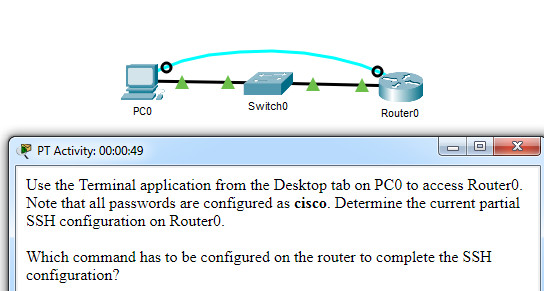
47. Open the PT Activity. Perform the tasks in the activity instructions and then answer the question.
CCNA 1 v7 Modules 16 - 17 Building and Securing a Small Network Exam
CCNA 1 v7 Modules 16 – 17 Building and Securing a Small Network Exam
Which command has to be configured on the router to complete the SSH configuration?
  • service password-encryption
  • transport input ssh
  • enable secret class
  • ip domain-name cisco.com
Explanation: The missing command to complete the SSH configuration is transport input ssh in line vty 0 4 mode.The commands service password-encryption and enable secret class do configure secure features on the router, but are not required to configure SSH. The command ip domain-name cisco.com is not required because the command ip domain-name span.com has been used.
48. An administrator decides to use “WhatAreyouwaiting4” as the password on a newly installed router. Which statement applies to the password choice?
  • It is strong because it uses a passphrase.
  • It is weak because it is often the default password on new devices.
  • It is weak since it uses easily found personal information.
  • It is weak since it is a word that is easily found in the dictionary.
49. An administrator decides to use “pR3s!d7n&0” as the password on a newly installed router. Which statement applies to the password choice?
  • It is strong because it uses a minimum of 10 numbers, letters and special characters.
  • It is weak because it is often the default password on new devices.
  • It is weak since it uses easily found personal information.
  • It is weak since it is a word that is easily found in the dictionary.
50. An administrator decides to use “5$7*4#033!” as the password on a newly installed router. Which statement applies to the password choice?
  • It is strong because it contains 10 numbers and special characters.
  • It is weak because it is often the default password on new devices.
  • It is weak since it uses easily found personal information.
  • It is strong because it uses a minimum of 10 numbers, letters and special characters.
51. An administrator decides to use “pR3s!d7n&0” as the password on a newly installed router. Which statement applies to the password choice?
  • It is strong because it uses a minimum of 10 numbers, letters and special characters.
  • It is weak since it is a word that is easily found in the dictionary.
  • It is strong because it uses a passphrase.
  • It is strong because it contains 10 numbers and special characters.
52. An administrator decides to use “12345678!” as the password on a newly installed router. Which statement applies to the password choice?
  • It is weak because it uses a series of numbers or letters.
  • It is strong because it uses a passphrase.
  • It is weak since it is a word that is easily found in the dictionary.
  • It is strong because it uses a minimum of 10 numbers, letters and special characters.
53. An administrator decides to use “admin” as the password on a newly installed router. Which statement applies to the password choice?
  • It is weak because it is often the default password on new devices.
  • It is strong because it uses a passphrase.
  • It is strong because it uses a minimum of 10 numbers, letters and special characters.
  • It is strong because it contains 10 numbers and special characters.
54. An administrator decides to use “Feb121978” as the password on a newly installed router. Which statement applies to the password choice?
  • It is weak because it uses easily found personal information.
  • It is strong because it uses a passphrase.
  • It is weak since it is a word that is easily found in the dictionary.
  • It is strong because it uses a minimum of 10 numbers, letters and special characters.
55. An administrator decides to use “password” as the password on a newly installed router. Which statement applies to the password choice?
  • It is weak because it is a commonly used password.
  • It is weak since it is a word that is easily found in the dictionary.
  • It is strong because it uses a passphrase.
  • It is strong because it uses a minimum of 10 numbers, letters and special characters.
56. An administrator decides to use “RobErT” as the password on a newly installed router. Which statement applies to the password choice?
  • It is weak since it uses easily found personal information.
  • It is strong because it uses a passphrase.
  • It is strong because it uses a minimum of 10 numbers, letters and special characters.
  • It is strong because it contains 10 numbers and special characters.
57. An administrator decides to use “Elizabeth” as the password on a newly installed router. Which statement applies to the password choice?
  • It is weak because it uses easily found personal information.
  • It is strong because it uses a passphrase.
  • It is weak since it is a word that is easily found in the dictionary.
  • It is strong because it uses a minimum of 10 numbers, letters and special characters.
Rules for strong passwords:
* minimum of 8 characters, preferably 10.
* use complex combinations of numbers, special characters, and upper and lower case letters.
* avoid repetition, common dictionary words, letter or number sequences.
* avoid names of children, relatives, pets, birthdays, or any easily identifiable personal information.
* can be created by misspelling words or replacing vowels with numbers or special characters.
58. A network technician is troubleshooting an issue and needs to verify the IP addresses of all interfaces on a router. What is the best command to use to accomplish the task?
  • show ip interface brief
  • nslookup
  • ipconfig getifaddr en0
  • show ip route
59. Students who are connected to the same switch are having slower than normal response times. The administrator suspects a duplex setting issue. What is the best command to use to accomplish the task?
  • show interfaces
  • ipconfig getifaddr en0
  • copy running-config startup-config
  • show ip nat translations
60. A user wants to know the IP address of the PC. What is the best command to use to accomplish the task?
  • ipconfig
  • copy running-config startup-config
  • show interfaces
  • show ip nat translations
61. A student wants to save a router configuration to NVRAM. What is the best command to use to accomplish the task?
  • copy running-config startup-config
  • show interfaces
  • show ip nat translations
  • show ip route
62. A support technician needs to know the IP address of the wireless interface on a MAC. What is the best command to use to accomplish the task?
  • ipconfig getifaddr en0
  • copy running-config startup-config
  • show interfaces
  • show ip nat translations
63. A network technician is troubleshooting an issue and needs to verify all of the IPv6 interface addresses on a router. What is the best command to use to accomplish the task?
  • show ipv6 interface
  • show interfaces
  • show ip nat translations
  • show ip route
64. A teacher is having difficulties connecting his PC to the classroom network. He needs to verify that a default gateway is configured correctly. What is the best command to use to accomplish the task?
  • ipconfig
  • copy running-config startup-config
  • show interfaces
  • show ip nat translations
65. Only employees connected to IPv6 interfaces are having difficulty connecting to remote networks. The analyst wants to verify that IPv6 routing has been enabled. What is the best command to use to accomplish the task?
  • show running-config
  • show interfaces
  • copy running-config startup-config
  • show ip nat translations
66. An administrator is troubleshooting connectivity issues and needs to determine the IP address of a website. What is the best command to use to accomplish the task?
  • nslookup
  • show ipv6 route
  • show ipv6 interface
  • copy startup-config running-config
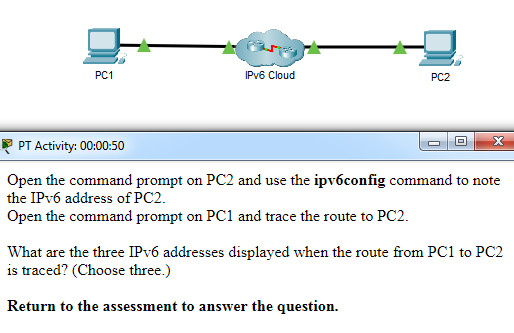
67. Only employees connected to IPv6 interfaces are having difficulty connecting to remote networks. The analyst wants to verify that IPv6 routing has been enabled. What is the best command to use to accomplish the task?
  • show running-config
  • show ipv6 route
  • show ipv6 interface
  • copy startup-config running-config
CCNA 1 version 7 Modules 14 – 15: Network Application Communications Exam Answers 2020

1. Which action is performed by a client when establishing communication with a server via the use of UDP at the transport layer?
  • The client sets the window size for the session.
  • The client sends an ISN to the server to start the 3-way handshake.
  • The client randomly selects a source port number.
  • The client sends a synchronization segment to begin the session.
2. Which transport layer feature is used to guarantee session establishment?
  • UDP ACK flag
  • TCP 3-way handshake
  • UDP sequence number
  • TCP port number
3. What is the complete range of TCP and UDP well-known ports?
  • 0 to 255
  • 0 to 1023
  • 256 – 1023
  • 1024 – 49151
4. What is a socket?
  • the combination of the source and destination IP address and source and destination Ethernet address
  • the combination of a source IP address and port number or a destination IP address and port number
  • the combination of the source and destination sequence and acknowledgment numbers
  • the combination of the source and destination sequence numbers and port numbers
5. A PC is downloading a large file from a server. The TCP window is 1000 bytes. The server is sending the file using 100-byte segments. How many segments will the server send before it requires an acknowledgment from the PC?
  • 1 segment
  • 10 segments
  • 100 segments
  • 1000 segments
6. Which factor determines TCP window size?
  • the amount of data to be transmitted
  • the number of services included in the TCP segment
  • the amount of data the destination can process at one time
  • the amount of data the source is capable of sending at one time
Explanation: Window is the number of bytes that the sender will send prior to expecting an acknowledgement from the destination device. The initial window is agreed upon during the session startup via the three-way handshake between source and destination. It is determined by how much data the destination device of a TCP session is able to accept and process at one time.
7. What does a client do when it has UDP datagrams to send?
  • It just sends the datagrams.
  • It queries the server to see if it is ready to receive data.
  • It sends a simplified three-way handshake to the server.
  • It sends to the server a segment with the SYN flag set to synchronize the conversation.
Explanation: When a client has UDP datagrams to send, it just sends the datagrams.
8. Which three fields are used in a UDP segment header? (Choose three.)
  • Window Size
  • Length
  • Source Port
  • Acknowledgment Number
  • Checksum
  • Sequence Number
Explanation: A UDP header consists of only the Source Port, Destination Port, Length, and Checksum fields. Sequence Number, Acknowledgment Number, and Window Size are TCP header fields.
9. What are two roles of the transport layer in data communication on a network? (Choose two.)
  • identifying the proper application for each communication stream
  • tracking the individual communication between applications on the source and destination hosts
  • providing frame delimiting to identify bits making up a frame
  • performing a cyclic redundancy check on the frame for errors
  • providing the interface between applications and the underlying network over which messages are transmitted
Explanation: The transport layer has several responsibilities. The primary responsibilities include the following:
  • Tracking the individual communication streams between applications on the source and destination hosts
  • Segmenting data at the source and reassembling the data at the destination
  • Identifying the proper application for each communication stream through the use of port numbers
10. What information is used by TCP to reassemble and reorder received segments?
  • port numbers
  • sequence numbers
  • acknowledgment numbers
  • fragment numbers
11. What important information is added to the TCP/IP transport layer header to ensure communication and connectivity with a remote network device?
  • timing and synchronization
  • destination and source port numbers
  • destination and source physical addresses
  • destination and source logical network addresses
12. Which two characteristics are associated with UDP sessions? (Choose two.)
  • Destination devices receive traffic with minimal delay.
  • Transmitted data segments are tracked.
  • Destination devices reassemble messages and pass them to an application.
  • Received data is unacknowledged.
  • Unacknowledged data packets are retransmitted.
Explanation:
TCP:
  • Provides tracking of transmitted data segments
  • Destination devices will acknowledge received data.
  • Source devices will retransmit unacknowledged data.
UDP
  • Destination devices will not acknowledge received data
  • Headers use very little overhead and cause minimal delay.​
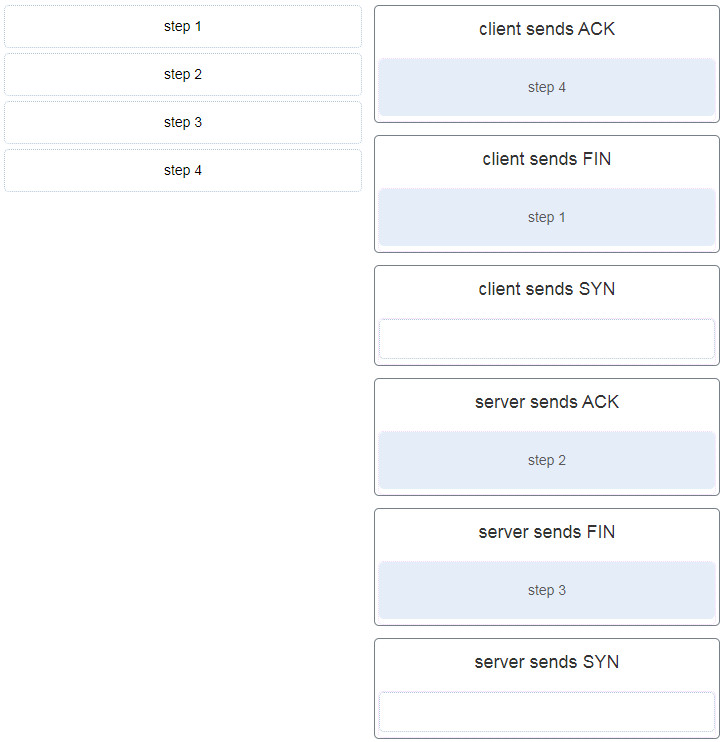
13. A client application needs to terminate a TCP communication session with a server. Place the termination process steps in the order that they will occur. (Not all options are used.)

14. Which flag in the TCP header is used in response to a received FIN in order to terminate connectivity between two network devices?
  • FIN
  • ACK
  • SYN
  • RST
15. Which protocol or service uses UDP for a client-to-server communication and TCP for server-to-server communication?
  • HTTP
  • FTP
  • DNS
  • SMTP
Explanation: Some applications may use both TCP and UDP. DNS uses UDP when clients send requests to a DNS server, and TCP when two DNS serves directly communicate.
16. What is a characteristic of UDP?
  • UDP datagrams take the same path and arrive in the correct order at the destination.​
  • Applications that use UDP are always considered unreliable.​
  • UDP reassembles the received datagrams in the order they were received.
  • UDP only passes data to the network when the destination is ready to receive the data.
Explanation: UDP has no way to reorder the datagrams into their transmission order, so UDP simply reassembles the data in the order it was received and forwards it to the application.​
17. What kind of port must be requested from IANA in order to be used with a specific application?
  • registered port
  • private port
  • dynamic port
  • source port
Explanation: Registered ports (numbers 1024 to 49151) are assigned by IANA to a requesting entity to use with specific processes or applications. These processes are primarily individual applications that a user has chosen to install, rather than common applications that would receive a well-known port number. For example, Cisco has registered port 1985 for its Hot Standby Routing Protocol (HSRP) process.​
18. Which three application layer protocols use TCP? (Choose three.)
  • SMTP
  • FTP
  • SNMP
  • HTTP
  • TFTP
  • DHCP
Explanation: Some protocols require the reliable data transport that is provided by TCP. In addition, these protocols do not have real time communication requirements and can tolerate some data loss while minimizing protocol overhead. Examples of these protocols are SMTP, FTP, and HTTP.
19. Which three statements characterize UDP? (Choose three.)
  • UDP provides basic connectionless transport layer functions.
  • UDP provides connection-oriented, fast transport of data at Layer 3.
  • UDP relies on application layer protocols for error detection.
  • UDP is a low overhead protocol that does not provide sequencing or flow control mechanisms.
  • UDP relies on IP for error detection and recovery.
  • UDP provides sophisticated flow control mechanisms.
20. Which two fields are included in the TCP header but not in the UDP header? (Choose two.)
  • window
  • checksum
  • source port
  • destination port
  • sequence number
Explanation: The sequence number and window fields are included in the TCP header but not in the UDP header.
21. Which field in the TCP header indicates the status of the three-way handshake process?
  • window
  • reserved
  • checksum
  • control bits
Explanation: The value in the control bits field of theTCP header indicates the progress and status of the connection.
22. Why does HTTP use TCP as the transport layer protocol?
  • to ensure the fastest possible download speed
  • because HTTP is a best-effort protocol
  • because transmission errors can be tolerated easily
  • because HTTP requires reliable delivery
23. Which two types of applications are best suited for UDP? (Choose two.)
  • applications that need data flow control
  • applications that require reliable delivery
  • applications that handle reliability themselves
  • applications that need the reordering of segments
  • applications that can tolerate some data loss, but require little or no delay
24. How are port numbers used in the TCP/IP encapsulation process?
  • Source port numbers and destination port numbers are not necessary when UDP is the transport layer protocol being used for the communication.
  • Source port and destination port numbers are randomly generated.
  • If multiple conversations occur that are using the same service, the source port number is used to track the separate conversations.
  • Destination port numbers are assigned automatically and cannot be changed.
Explanation: Both UDP and TCP use port numbers to provide a unique identifier for each conversation. Source port numbers are randomly generated and are used to track different conversations. Destination port numbers identify specific services by using either a default port number for the service or a port number that is assigned manually by a system administrator.
25. In what two situations would UDP be better than TCP as the preferred transport protocol? (Choose two.)
  • when applications need to guarantee that a packet arrives intact, in sequence, and unduplicated
  • when a faster delivery mechanism is needed
  • when delivery overhead is not an issue
  • when applications do not need to guarantee delivery of the data
  • when destination port numbers are dynamic
Explanation: UDP is a very simple transport layer protocol that does not guarantee delivery. Devices on both ends of the conversation are not required to keep track of the conversation. UDP is used as the transport protocol for applications that need a speedy, best-effort delivery.
26. What are three responsibilities of the transport layer? (Choose three.)
  • meeting the reliability requirements of applications, if any
  • multiplexing multiple communication streams from many users or applications on the same network
  • identifying the applications and services on the client and server that should handle transmitted data
  • directing packets towards the destination network
  • formatting data into a compatible form for receipt by the destination devices
  • conducting error detection of the contents in frames
27. Which three statements describe a DHCP Discover message? (Choose three.)
  • The source MAC address is 48 ones (FF-FF-FF-FF-FF-FF).
  • The destination IP address is 255.255.255.255.
  • The message comes from a server offering an IP address.
  • The message comes from a client seeking an IP address.
  • All hosts receive the message, but only a DHCP server replies.
  • Only the DHCP server receives the message.
Explanation: When a host configured to use DHCP powers up on a network it sends a DHCPDISCOVER message. FF-FF-FF-FF-FF-FF is the L2 broadcast address. A DHCP server replies with a unicast DHCPOFFER message back to the host.
28. Which two protocols may devices use in the application process that sends email? (Choose two.)
  • HTTP
  • SMTP
  • POP
  • IMAP
  • DNS
  • POP3
29. What is true about the Server Message Block protocol?
  • Different SMB message types have a different format.
  • Clients establish a long term connection to servers.
  • SMB messages cannot authenticate a session.
  • SMB uses the FTP protocol for communication.
Explanation: The Server Message Block protocol is a protocol for file, printer, and directory sharing. Clients establish a long term connection to servers and when the connection is active, the resources can be accessed. Every SMB message has the same format. The use of SMB differs from FTP mainly in the length of the sessions. SMB messages can authenticate sessions.
30. What is the function of the HTTP GET message?
  • to request an HTML page from a web server
  • to send error information from a web server to a web client
  • to upload content to a web server from a web client
  • to retrieve client email from an email server using TCP port 110
31. Which OSI layer provides the interface between the applications used to communicate and the underlying network over which messages are transmitted?
  • application
  • presentation
  • session
  • transport
32. Which networking model is being used when an author uploads one chapter document to a file server of a book publisher?
  • peer-to-peer
  • master-slave
  • client/server
  • point-to-point
Explanation: In the client/server network model, a network device assumes the role of server in order to provide a particular service such as file transfer and storage. In the client/server network model, a dedicated server does not have to be used, but if one is present, the network model being used is the client/server model. In contrast, a peer-to-peer network does not have a dedicated server.
33. What do the client/server and peer-to-peer network models have in common?
  • Both models have dedicated servers.
  • Both models support devices in server and client roles.
  • Both models require the use of TCP/IP-based protocols.
  • Both models are used only in the wired network environment.
Explanation: In both the client/server and peer-to-peer network models, clients and servers exist. In peer-to-peer networks, no dedicated server exists, but a device can assume the server role to provide information to a device serving in the client role.
34. In what networking model would eDonkey, eMule, BitTorrent, Bitcoin, and LionShare be used?
  • peer-to-peer
  • client-based
  • master-slave
  • point-to-point
Explanation: In a peer-to-peer networking model, data is exchanged between two network devices without the use of a dedicated server. Peer-to-peer applications such as Shareaz, eDonkey, and Bitcoin allow one network device to assume the role of server, while one or more other network devices assume the role of client using the peer-to-peer application.
35. What is a common protocol that is used with peer-to-peer applications such as WireShare, Bearshare, and Shareaza?
  • Ethernet
  • Gnutella
  • POP
  • SMTP
36. What is a key characteristic of the peer-to-peer networking model?
  • wireless networking
  • social networking without the Internet
  • network printing using a print server
  • resource sharing without a dedicated server
Explanation: The peer-to-peer (P2P) networking model allows data, printer, and resource sharing without a dedicated server.​​
37. The application layer of the TCP/IP model performs the functions of what three layers of the OSI model? (Choose three.)
  • physical
  • session
  • network
  • presentation
  • data link
  • transport
  • application
Explanation: The network access layer of the TCP/IP model performs the same functions as the physical and data link layers of the OSI model. The internetwork layer equates to the network layer of the OSI model. The transport layers are the same in both models. The application layer of the TCP/IP model represents the session, presentation, and application layers of the OSI model.​
38. What is an example of network communication that uses the client-server model?
  • A user uses eMule to download a file that is shared by a friend after the file location is determined.
  • A workstation initiates an ARP to find the MAC address of a receiving host.
  • A user prints a document by using a printer that is attached to a workstation of a coworker.
  • A workstation initiates a DNS request when the user types www.cisco.com in the address bar of a web browser.
Explanation: When a user types a domain name of a website into the address bar of a web browser, a workstation needs to send a DNS request to the DNS server for the name resolution process. This request is a client/server model application. The eMule application is P2P. Sharing a printer on a workstation is a peer-to-peer network. Using ARP is just a broadcast message sent by a host.
39. Which layer in the TCP/IP model is used for formatting, compressing, and encrypting data?
  • internetwork
  • session
  • presentation
  • application
  • network access
Explanation: The application layer of the TCP/IP model performs the functions of three layers of the OSI model – application, presentation, and session. The application layer of the TCP/IP model is the layer that provides the interface between the applications, is responsible for formatting, compressing, and encrypting data, and is used to create and maintain dialogs between source and destination applications.
40. What is an advantage of SMB over FTP?​
  • Only with SMB can data transfers occur in both directions.
  • Only SMB establishes two simultaneous connections with the client, making the data transfer faster.​
  • SMB is more reliable than FTP because SMB uses TCP and FTP uses UDP.​
  • SMB clients can establish a long-term connection to the server.​
41. A manufacturing company subscribes to certain hosted services from its ISP. The services that are required include hosted world wide web, file transfer, and e-mail. Which protocols represent these three key applications? (Choose three.)
  • FTP
  • HTTP
  • DNS
  • SNMP
  • DHCP
  • SMTP
42. Which application layer protocol uses message types such as GET, PUT, and POST?
  • DNS
  • DHCP
  • SMTP
  • HTTP
  • POP3
Explanation: The GET command is a client request for data from a web server. A PUT command uploads resources and content, such as images, to a web server. A POST command uploads data files to a web server.
43. What type of information is contained in a DNS MX record?
  • the FQDN of the alias used to identify a service
  • the IP address for an FQDN entry
  • the domain name mapped to mail exchange servers
  • the IP address of an authoritative name server
Explanation: MX, or mail exchange messages, are used to map a domain name to several mail exchange servers that all belong to the same domain.
44. Which three protocols operate at the application layer of the TCP/IP model? (Choose three.)
  • ARP
  • TCP
  • UDP
  • FTP
  • POP3
  • DHCP
Explanation: FTP, DHCP, and POP3 are application layer protocols. TCP and UDP are transport layer protocols. ARP is a network layer protocol.
45. Which protocol is used by a client to communicate securely with a web server?
  • SMTP
  • SMB
  • IMAP
  • HTTPS
Explanation: HTTPS is a secure form of HTTP used to access web content hosted by a web server.
46. Which applications or services allow hosts to act as client and server at the same time?
  • client/server applications
  • email applications
  • P2P applications
  • authentication services
47. What are two characteristics of peer-to-peer networks? (Choose two.)
  • scalability
  • one way data flow
  • decentralized resources
  • centralized user accounts
  • resource sharing without a dedicated server
Explanation: Peer-to-peer networks have decentralized resources because every computer can serve as both a server and a client. One computer might assume the role of server for one transaction while acting as a client for another transaction. Peer-to-peer networks can share resources among network devices without the use of a dedicated server.
48. Which scenario describes a function provided by the transport layer?
  • A student is using a classroom VoIP phone to call home. The unique identifier burned into the phone is a transport layer address used to contact another network device on the same network.
  • A student is playing a short web-based movie with sound. The movie and sound are encoded within the transport layer header.
  • A student has two web browser windows open in order to access two web sites. The transport layer ensures the correct web page is delivered to the correct browser window.
  • A corporate worker is accessing a web server located on a corporate network. The transport layer formats the screen so the web page appears properly no matter what device is being used to view the web site.
Explanation: The source and destination port numbers are used to identify the correct application and window within that application.
49. Which three layers of the OSI model provide similar network services to those provided by the application layer of the TCP/IP model? (Choose three.)
  • physical layer
  • session layer
  • transport layer
  • application layer
  • presentation layer
  • data link layer
Explanation: The three upper layers of the OSI model, the session, presentation, and application layers, provide application services similar to those provided by the TCP/IP model application layer. Lower layers of the OSI model are more concerned with data flow.
50. A PC that is communicating with a web server has a TCP window size of 6,000 bytes when sending data and a packet size of 1,500 bytes. Which byte of information will the web server acknowledge after it has received two packets of data from the PC?
  • 3001
  • 6001
  • 4500
  • 6000
51. A PC that is communicating with a web server has a TCP window size of 6,000 bytes when sending data and a packet size of 1,500 bytes. Which byte of information will the web server acknowledge after it has received three packets of data from the PC?
  • 4501
  • 6001
  • 6000
  • 4500
52. A PC that is communicating with a web server has a TCP window size of 6,000 bytes when sending data and a packet size of 1,500 bytes. Which byte of information will the web server acknowledge after it has received four packets of data from the PC?
  • 6001
  • 3001
  • 1501
  • 1500
53. A PC that is communicating with a web server has a TCP window size of 6,000 bytes when sending data and a packet size of 1,500 bytes. Which byte of information will the web server acknowledge after it has received four packets of data from the PC?
  • 6001
  • 3001
  • 3000
  • 1500
54. A PC that is communicating with a web server has a TCP window size of 6,000 bytes when sending data and a packet size of 1,500 bytes. Which byte of information will the web server acknowledge after it has received two packets of data from the PC?
  • 3001
  • 4501
  • 3000
  • 1500
55. A PC that is communicating with a web server has a TCP window size of 6,000 bytes when sending data and a packet size of 1,500 bytes. Which byte of information will the web server acknowledge after it has received two packets of data from the PC?
  • 3001
  • 4501
  • 4500
  • 1500
56. A PC that is communicating with a web server has a TCP window size of 6,000 bytes when sending data and a packet size of 1,500 bytes. Which byte of information will the web server acknowledge after it has received two packets of data from the PC?
  • 3001
  • 6001
  • 4500
  • 3000
57. A PC that is communicating with a web server has a TCP window size of 6,000 bytes when sending data and a packet size of 1,500 bytes. Which byte of information will the web server acknowledge after it has received two packets of data from the PC?
  • 3001
  • 6001
  • 6000
  • 3000
58. A PC that is communicating with a web server has a TCP window size of 6,000 bytes when sending data and a packet size of 1,500 bytes. Which byte of information will the web server acknowledge after it has received three packets of data from the PC?
  • 4501
  • 6001
  • 6000
  • 3000
59. A PC that is communicating with a web server has a TCP window size of 6,000 bytes when sending data and a packet size of 1,500 bytes. Which byte of information will the web server acknowledge after it has received three packets of data from the PC?
  • 4501
  • 6001
  • 1500
  • 4500
60. A client creates a packet to send to a server. The client is requesting TFTP service. What number will be used as the destination port number in the sending packet?
  • 69
  • 67
  • 53
  • 80
61. A client creates a packet to send to a server. The client is requesting FTP service. What number will be used as the destination port number in the sending packet?
  • 21
  • 69
  • 67
  • 80
62. A client creates a packet to send to a server. The client is requesting SSH service. What number will be used as the destination port number in the sending packet?
  • 22
  • 69
  • 67
  • 80
63. A client creates a packet to send to a server. The client is requesting HTTP service. What number will be used as the destination port number in the sending packet?
  • 80
  • 67
  • 53
  • 69
64. A client creates a packet to send to a server. The client is requesting POP3 service. What number will be used as the destination port number in the sending packet?
  • 110
  • 67
  • 53
  • 69
65. A client creates a packet to send to a server. The client is requesting telnet service. What number will be used as the destination port number in the sending packet?
  • 23
  • 443
  • 161
  • 110
66. A client creates a packet to send to a server. The client is requesting POP3 service. What number will be used as the destination port number in the sending packet?
  • 110
  • 443
  • 161
  • 80
67. A client creates a packet to send to a server. The client is requesting SNMP service. What number will be used as the destination port number in the sending packet?
  • 161
  • 443
  • 110
  • 80
68. A client creates a packet to send to a server. The client is requesting SMTP service. What number will be used as the destination port number in the sending packet?
  • 25
  • 443
  • 161
  • 110
69. A client creates a packet to send to a server. The client is requesting HTTPS service. What number will be used as the destination port number in the sending packet?
  • 443
  • 161
  • 110
  • 80

CCNA 1 version 7 Modules 11 – 13: IP Addressing Exam Answers Full 2020


1. What is the prefix length notation for the subnet mask 255.255.255.224?
  • /25
  • /26
  • /27
  • /28
Explanation: The binary format for 255.255.255.224 is 11111111.11111111.11111111.11100000. The prefix length is the number of consecutive 1s in the subnet mask. Therefore, the prefix length is /27.
2. How many valid host addresses are available on an IPv4 subnet that is configured with a /26 mask?
  • 254
  • 190
  • 192
  • 62
  • 64
3. Which subnet mask would be used if 5 host bits are available?
  • 255.255.255.0
  • 255.255.255.128
  • 255.255.255.224​
  • 255.255.255.240
4. A network administrator subnets the 192.168.10.0/24 network into subnets with /26 masks. How many equal-sized subnets are created?
  • 1
  • 2
  • 4
  • 8
  • 16
  • 64
5. Match the subnetwork to a host address that would be included within the subnetwork. (Not all options are used.)

6. An administrator wants to create four subnetworks from the network address 192.168.1.0/24. What is the network address and subnet mask of the second useable subnet?
  • subnetwork 192.168.1.64
    subnet mask 255.255.255.192
  • subnetwork 192.168.1.32
    subnet mask 255.255.255.240
  • subnetwork 192.168.1.64
    subnet mask 255.255.255.240
  • subnetwork 192.168.1.128
    subnet mask 255.255.255.192
  • subnetwork 192.168.1.8
    subnet mask 255.255.255.224
7. How many bits must be borrowed from the host portion of an address to accommodate a router with five connected networks?
  • two
  • three
  • four
  • five
Explanation: Each network that is directly connected to an interface on a router requires its own subnet. The formula 2n, where n is the number of bits borrowed, is used to calculate the available number of subnets when borrowing a specific number of bits.
8. How many host addresses are available on the 192.168.10.128/26 network?
  • 30
  • 32
  • 60
  • 62
  • 64
Explanation: A /26 prefix gives 6 host bits, which provides a total of 64 addresses, because 26 = 64. Subtracting the network and broadcast addresses leaves 62 usable host addresses.
9. How many host addresses are available on the network 172.16.128.0 with a subnet mask of 255.255.252.0?
  • 510
  • 512
  • 1022
  • 1024
  • 2046
  • 2048
Explanation: A mask of 255.255.252.0 is equal to a prefix of /22. A /22 prefix provides 22 bits for the network portion and leaves 10 bits for the host portion. The 10 bits in the host portion will provide 1022 usable IP addresses (210 – 2 = 1022).
10. Match each IPv4 address to the appropriate address category. (Not all options are used.)

11. What three blocks of addresses are defined by RFC 1918 for private network use? (Choose three.)
  • 10.0.0.0/8
  • 172.16.0.0/12
  • 192.168.0.0/16
  • 100.64.0.0/14
  • 169.254.0.0/16
  • 239.0.0.0/8
Explanation: RFC 1918, Address Allocation for Private Internets, defines three blocks of IPv4 address for private networks that should not be routable on the public Internet.
  • 10.0.0.0/8
  • 172.16.0.0/12
  • 192.168.0.0/16
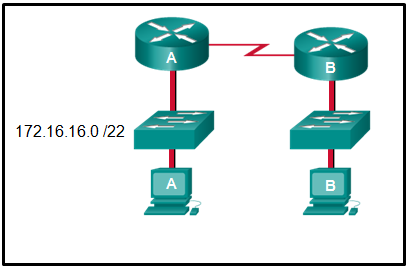
12. Refer to the exhibit. An administrator must send a message to everyone on the router A network. What is the broadcast address for network 172.16.16.0/22?

  • 172.16.16.255
  • 172.16.20.255
  • 172.16.19.255
  • 172.16.23.255
  • 172.16.255.255
Explanation: The 172.16.16.0/22 network has 22 bits in the network portion and 10 bits in the host portion. Converting the network address to binary yields a subnet mask of 255.255.252.0. The range of addresses in this network will end with the last address available before 172.16.20.0. Valid host addresses for this network range from 172.16.16.1-172.16.19.254, making 172.16.19.255 the broadcast address.
13. A site administrator has been told that a particular network at the site must accommodate 126 hosts. Which subnet mask would be used that contains the required number of host bits?
  • 255.255.255.0
  • 255.255.255.128
  • 255.255.255.224
  • 255.255.255.240
Explanation: The subnet mask of 255.255.255.0 has 8 host bits. The mask of 255.255.255.128 results in 7 host bits. The mask of 255.255.255.224 has 5 host bits. Finally, 255.255.255.240 represents 4 host bits.
14. Refer to the exhibit. Considering the addresses already used and having to remain within the 10.16.10.0/24 network range, which subnet address could be assigned to the network containing 25 hosts?

  • 10.16.10.160/26
  • 10.16.10.128/28
  • 10.16.10.64/27
  • 10.16.10.224/26
  • 10.16.10.240/27
  • 10.16.10.240/28
Explanation: Addresses 10.16.10.0 through 10.16.10.63 are taken for the leftmost network. Addresses 10.16.10.192 through 10.16.10.207 are used by the center network.The address space from 208-255 assumes a /28 mask, which does not allow enough host bits to accommodate 25 host addresses.The address ranges that are available include 10.16.10.64/26 and10.16.10.128/26. To accommodate 25 hosts, 5 host bits are needed, so a /27 mask is necessary. Four possible /27 subnets could be created from the available addresses between 10.16.10.64 and 10.16.10.191:
10.16.10.64/27
10.16.10.96/27
10.16.10.128/27
10.16.10.160/27
15. What is the usable number of host IP addresses on a network that has a /26 mask?
  • 256
  • 254
  • 64
  • 62
  • 32
  • 16
Explanation: A /26 mask is the same as 255.255.255.192. The mask leaves 6 host bits. With 6 host bits, 64 IP addresses are possible. One address represents the subnet number and one address represents the broadcast address, which means that 62 addresses can then be used to assign to network devices.
16. Which address prefix range is reserved for IPv4 multicast?
  • 240.0.0.0 – 254.255.255.255
  • 224.0.0.0 – 239.255.255.255
  • 169.254.0.0 – 169.254.255.255
  • 127.0.0.0 – 127.255.255.255
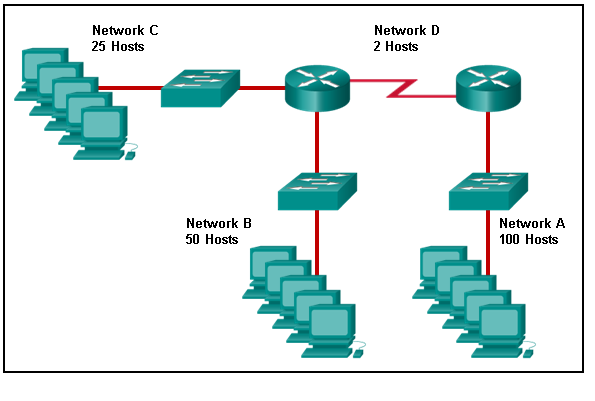
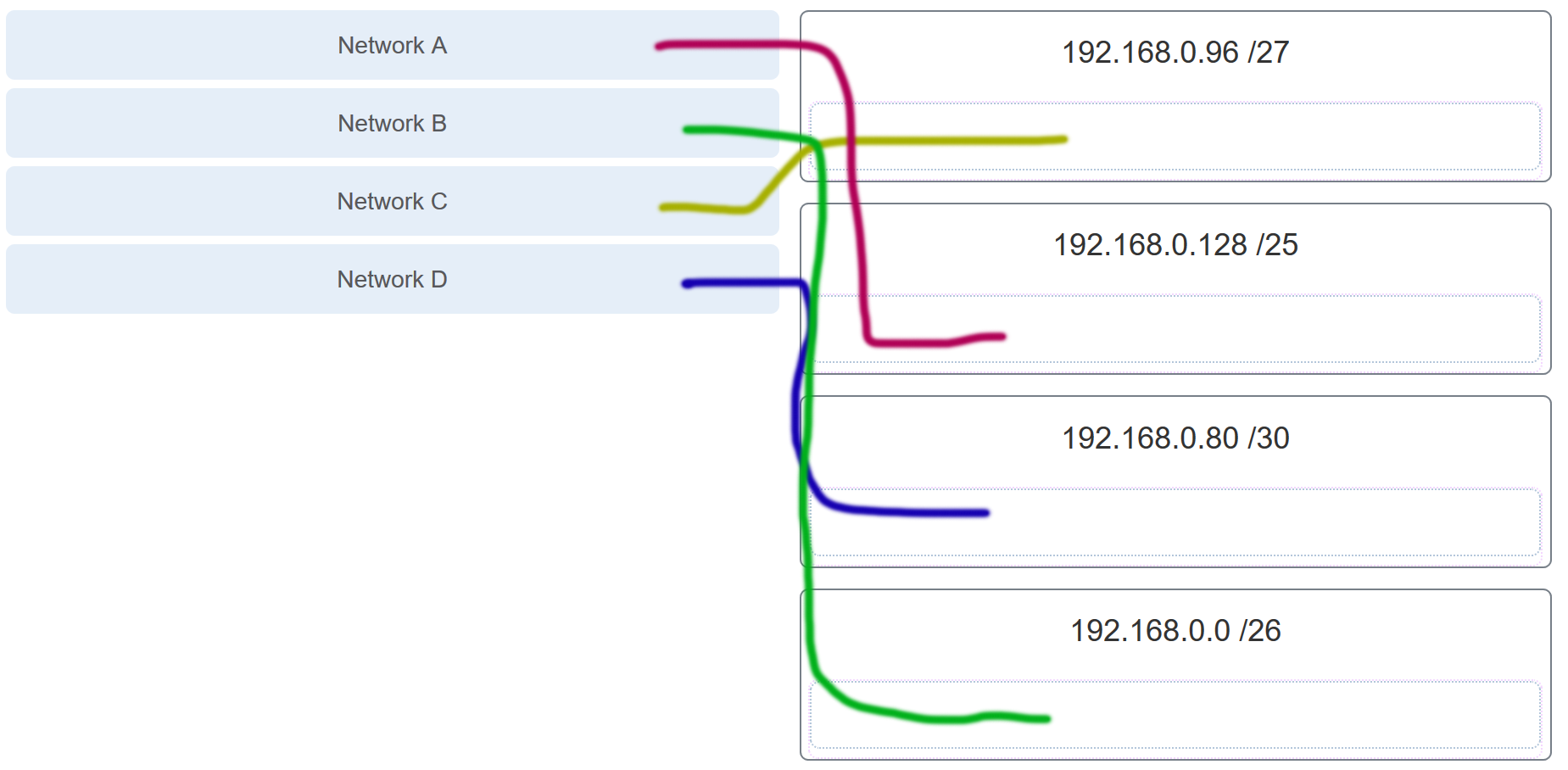
17. Refer to the exhibit. Match the network with the correct IP address and prefix that will satisfy the usable host addressing requirements for each network.


Explanation: Network A needs to use 192.168.0.128 /25, which yields 128 host addresses.
Network B needs to use 192.168.0.0 /26, which yields 64 host addresses.
Network C needs to use 192.168.0.96 /27, which yields 32 host addresses.
Network D needs to use 192.168.0.80/30, which yields 4 host addresses.
18. A high school in New York (school A) is using videoconferencing technology to establish student interactions with another high school (school B) in Russia. The videoconferencing is conducted between two end devices through the Internet. The network administrator of school A configures the end device with the IP address 209.165.201.10. The administrator sends a request for the IP address for the end device in school B and the response is 192.168.25.10. Neither school is using a VPN. The administrator knows immediately that this IP will not work. Why?
  • This is a loopback address.
  • This is a link-local address.
  • This is a private IP address.
  • There is an IP address conflict.
19. Which three addresses are valid public addresses? (Choose three.)
  • 198.133.219.17
  • 192.168.1.245
  • 10.15.250.5
  • 128.107.12.117
  • 172.31.1.25
  • 64.104.78.227
Explanation: The ranges of private IPv4 addresses are as folllows:
10.0.0.0 – 10.255.255.255
172.16.0.0 – 172.31.255.255
192.168.0.0 – 192.168.255.255
20. A message is sent to all hosts on a remote network. Which type of message is it?
  • limited broadcast
  • multicast
  • directed broadcast
  • unicast
Explanation: A directed broadcast is a message sent to all hosts on a specific network. It is useful for sending a broadcast to all hosts on a nonlocal network. A multicast message is a message sent to a selected group of hosts that are part of a subscribing multicast group. A limited broadcast is used for a communication that is limited to the hosts on the local network. A unicast message is a message sent from one host to another.
21. A company has a network address of 192.168.1.64 with a subnet mask of 255.255.255.192. The company wants to create two subnetworks that would contain 10 hosts and 18 hosts respectively. Which two networks would achieve that? (Choose two.)
  • 192.168.1.16/28
  • 192.168.1.64/27
  • 192.168.1.128/27
  • 192.168.1.96/28
  • 192.168.1.192/28
22. Which address is a valid IPv6 link-local unicast address?
  • FEC8:1::FFFF
  • FD80::1:1234
  • FE80::1:4545:6578:ABC1
  • FE0A::100:7788:998F
  • FC90:5678:4251:FFFF
Explanation: IPv6 LLAs are in the fe80::/10 range. The /10 indicates that the first 10 bits are 1111 1110 10xx xxxx. The first hextet has a range of 1111 1110 1000 0000 (fe80) to 1111 1110 1011 1111 (febf).
23. Which of these addresses is the shortest abbreviation for the IP address:
3FFE:1044:0000:0000:00AB:0000:0000:0057?
  • 3FFE:1044::AB::57
  • 3FFE:1044::00AB::0057
  • 3FFE:1044:0:0:AB::57
  • 3FFE:1044:0:0:00AB::0057
  • 3FFE:1044:0000:0000:00AB::57
  • 3FFE:1044:0000:0000:00AB::0057
Explanation: The rules for reducing the notation of IPv6 addresses are:
1. Omit any leading 0s (zeros) in any hextet.
2. Replace any single, contiguous string of one or more 16-bit hextets consisting of all zeros with a double colon (::) .
3. The double colon (::) can only be used once within an address.
24. A network administrator has received the IPv6 prefix 2001:DB8::/48 for subnetting. Assuming the administrator does not subnet into the interface ID portion of the address space, how many subnets can the administrator create from the /48 prefix?
  • 16
  • 256
  • 4096
  • 65536
Explanation: With a network prefix of 48, there will be 16 bits available for subnetting because the interface ID starts at bit 64. Sixteen bits will yield 65536 subnets.
25. Given IPv6 address prefix 2001:db8::/48, what will be the last subnet that is created if the subnet prefix is changed to /52?
  • 2001:db8:0:f00::/52
  • 2001:db8:0:8000::/52
  • 2001:db8:0:f::/52
  • 2001:db8:0:f000::/52
Explanation: Prefix 2001:db8::/48 has 48 network bits. If we subnet to a /52, we are moving the network boundary four bits to the right and creating 16 subnets. The first subnet is 2001:db8::/52 the last subnet is 2001:db8:0:f000::/52.
26. Consider the following range of addresses:
2001:0DB8:BC15:00A0:0000::
2001:0DB8:BC15:00A1:0000::
2001:0DB8:BC15:00A2:0000::

2001:0DB8:BC15:00AF:0000::
The prefix-length for the range of addresses is   /60 .
Explanation: All the addresses have the part 2001:0DB8:BC15:00A in common. Each number or letter in the address represents 4 bits, so the prefix-length is /60.
27. What type of IPv6 address is FE80::1?
  • loopback
  • link-local
  • multicast
  • global unicast
28. Refer to the exhibit. A company is deploying an IPv6 addressing scheme for its network. The company design document indicates that the subnet portion of the IPv6 addresses is used for the new hierarchical network design, with the site subsection to represent multiple geographical sites of the company, the sub-site section to represent multiple campuses at each site, and the subnet section to indicate each network segment separated by routers. With such a scheme, what is the maximum number of subnets achieved per sub-site?

  • 0
  • 4
  • 16
  • 256
Explanation: Because only one hexadecimal character is used to represent the subnet, that one character can represent 16 different values 0 through F.
29. What is used in the EUI-64 process to create an IPv6 interface ID on an IPv6 enabled interface?
  • the MAC address of the IPv6 enabled interface
  • a randomly generated 64-bit hexadecimal address
  • an IPv6 address that is provided by a DHCPv6 server
  • an IPv4 address that is configured on the interface
Explanation: The EUI-64 process uses the MAC address of an interface to construct an interface ID (IID). Because the MAC address is only 48 bits in length, 16 additional bits (FF:FE) must be added to the MAC address to create the full 64-bit interface ID.
30. What is the prefix for the host address 2001:DB8:BC15:A:12AB::1/64?
  • 2001:DB8:BC15
  • 2001:DB8:BC15:A
  • 2001:DB8:BC15:A:1
  • 2001:DB8:BC15:A:12
31. An IPv6 enabled device sends a data packet with the destination address of FF02::1. What is the target of this packet?​
  • the one IPv6 device on the link that has been uniquely configured with this address
  • all IPv6 enabled devices on the local link​ or network
  • only IPv6 DHCP servers​
  • only IPv6 configured routers
32. Match the IPv6 address with the IPv6 address type. (Not all options are used.)

Explanation: FF02::1:FFAE:F85F is a solicited node multicast address.
2001:DB8::BAF:3F57:FE94 is a global unicast address.
FF02::1 is the all node multicast address. Packets sent to this address will be received by all IPv6 hosts on the local link.
::1 is the IPv6 loopback address.
There are no examples of link local or unique local addresses provided.
33. Which IPv6 prefix is reserved for communication between devices on the same link?
  • FC00::/7
  • 2001::/32
  • FE80::/10
  • FDFF::/7
Explanation: IPv6 link-local unicast addresses are in the FE80::/10 prefix range and are not routable. They are used only for communications between devices on the same link.
34. Which type of IPv6 address refers to any unicast address that is assigned to multiple hosts?
  • unique local
  • global unicast
  • link-local
  • anycast
35. What are two types of IPv6 unicast addresses? (Choose two.)
  • multicast
  • loopback
  • link-local
  • anycast
  • broadcast
Explanation: Multicast, anycast, and unicast are types of IPv6 addresses. There is no broadcast address in IPv6. Loopback and link-local are specific types of unicast addresses.
36. Which service provides dynamic global IPv6 addressing to end devices without using a server that keeps a record of available IPv6 addresses?
  • stateful DHCPv6
  • SLAAC
  • static IPv6 addressing
  • stateless DHCPv6
Explanation: Using stateless address autoconfiguration (SLAAC), a PC can solicit a router and receive the prefix length of the network. From this information the PC can then create its own IPv6 global unicast address.
37. Which protocol supports Stateless Address Autoconfiguration (SLAAC) for dynamic assignment of IPv6 addresses to a host?
  • ARPv6
  • DHCPv6
  • ICMPv6
  • UDP
Explanation: SLAAC uses ICMPv6 messages when dynamically assigning an IPv6 address to a host. DHCPv6 is an alternate method of assigning an IPv6 addresses to a host. ARPv6 does not exist. Neighbor Discovery Protocol (NDP) provides the functionality of ARP for IPv6 networks. UDP is the transport layer protocol used by DHCPv6.
38. Three methods allow IPv6 and IPv4 to co-exist. Match each method with its description. (Not all options are used.)

39. A technician uses the ping 127.0.0.1 command. What is the technician testing?
  • the TCP/IP stack on a network host
  • connectivity between two adjacent Cisco devices
  • connectivity between a PC and the default gateway
  • connectivity between two PCs on the same network
  • physical connectivity of a particular PC and the network
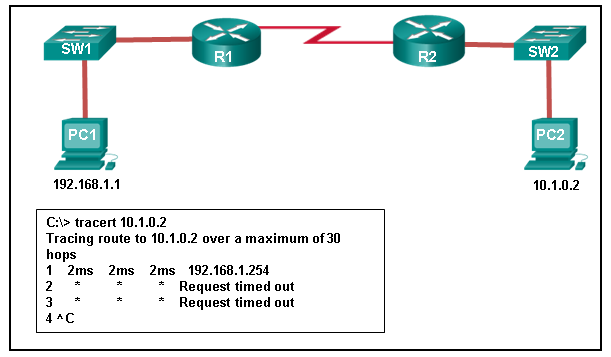
40. Refer to the exhibit. An administrator is trying to troubleshoot connectivity between PC1 and PC2 and uses the tracert command from PC1 to do it. Based on the displayed output, where should the administrator begin troubleshooting?

  • PC2
  • R1
  • SW2
  • R2
  • SW1
41. Which protocol is used by the traceroute command to send and receive echo-requests and echo-replies?
  • SNMP
  • ICMP
  • Telnet
  • TCP
Explanation: Traceroute uses the ICMP (Internet Control Message Protocol) to send and receive echo-request and echo-reply messages.
42. Which ICMPv6 message is sent when the IPv6 hop limit field of a packet is decremented to zero and the packet cannot be forwarded?
  • network unreachable
  • time exceeded
  • protocol unreachable
  • port unreachable
43. A user executes a traceroute over IPv6. At what point would a router in the path to the destination device drop the packet?
  • when the value of the Hop Limit field reaches 255
  • when the value of the Hop Limit field reaches zero
  • when the router receives an ICMP time exceeded message
  • when the target host responds with an ICMP echo reply message
44. What is the purpose of ICMP messages?
  • to inform routers about network topology changes
  • to ensure the delivery of an IP packet
  • to provide feedback of IP packet transmissions
  • to monitor the process of a domain name to IP address resolution
Explanation: The purpose of ICMP messages is to provide feedback about issues that are related to the processing of IP packets.
45. What source IP address does a router use by default when the traceroute command is issued?
  • the highest configured IP address on the router
  • a loopback IP address
  • the IP address of the outbound interface
  • the lowest configured IP address on the router
Explanation: When sending an echo request message, a router will use the IP address of the exit interface as the source IP address. This default behavior can be changed by using an extended ping and specifying a specific source IP address.
46. Match each description with an appropriate IP address. (Not all options are used.)

Explanation: Link-Local addresses are assigned automatically by the OS environment and are located in the block 169.254.0.0/16. The private addresses ranges are 10.0.0.0/8, 172.16.0.0/12, and 192.168.0.0/16. TEST-NET addresses belong to the range 192.0.2.0/24. The addresses in the block 240.0.0.0 to 255.255.255.254 are reserved as experimental addresses. Loopback addresses belong to the block 127.0.0.0/8.
47. A user issues a ping 192.135.250.103 command and receives a response that includes a code of 1. What does this code represent?
  • host unreachable
  • protocol unreachable
  • port unreachable
  • network unreachable
48. Which subnet would include the address 192.168.1.96 as a usable host address?
  • 192.168.1.64/26
  • 192.168.1.32/27
  • 192.168.1.32/28
  • 192.168.1.64/29
Explanation: For the subnet of 192.168.1.64/26, there are 6 bits for host addresses, yielding 64 possible addresses. However, the first and last subnets are the network and broadcast addresses for this subnet. Therefore, the range of host addresses for this subnet is 192.168.1.65 to 192.168.1.126. The other subnets do not contain the address 192.168.1.96 as a valid host address.
49. Open the PT Activity. Perform the tasks in the activity instructions and then answer the question.
CCNA 1 v7 Modules 11 - 13 IP Addressing Exam Answers Full
CCNA 1 v7 Modules 11 – 13 IP Addressing Exam Answers Full
What are the three IPv6 addresses displayed when the route from PC1 to PC2 is traced? (Choose three.)
  • 2001:DB8:1:1::1
  • 2001:DB8:1:1::A
  • 2001:DB8:1:2::2
  • 2001:DB8:1:2::1
  • 2001:DB8:1:3::1
  • 2001:DB8:1:3::2
  • 2001:DB8:1:4::1
Explanation: Using the ipv6config command on PC2 displays the IPv6 address of PC2, which is 2001:DB8:1:4::A. The IPV6 link-local address, FE80::260:70FF:FE34:6930, is not used in route tracing. Using the tracert 2001:DB8:1:4::A command on PC1 displays four addresses: 2001:DB8:1:1::1, 2001:DB8:1:2::1 , 2001:DB8:1:3::2, and 2001:DB8:1:4::A.
50. A host is transmitting a broadcast. Which host or hosts will receive it?
  • all hosts in the same subnet
  • a specially defined group of hosts
  • the closest neighbor on the same network
  • all hosts on the Internet
51. A host is transmitting a unicast. Which host or hosts will receive it?
  • one specific host
  • a specially defined group of hosts
  • all hosts on the Internet
  • the closest neighbor on the same network
52. A user issues a ping 2001:db8:FACE:39::10 command and receives a response that includes a code of 3. What does this code represent?
  • address unreachable
  • network unreachable
  • host unreachable
  • protocol unreachable
53. A host is transmitting a multicast. Which host or hosts will receive it?
  • a specially defined group of hosts
  • one specific host
  • all hosts with the same IP address
  • the closest neighbor on the same network
54. A host is transmitting a multicast. Which host or hosts will receive it?
  • a specially defined group of hosts
  • one specific host
  • directly connected network devices
  • the closest neighbor on the same network
55. A host is transmitting a multicast. Which host or hosts will receive it?
  • a specially defined group of hosts
  • one specific host
  • all hosts with the same IP address
  • all hosts on the Internet
56. A host is transmitting a multicast. Which host or hosts will receive it?
  • a specially defined group of hosts
  • one specific host
  • directly connected network devices
  • all hosts on the Internet
57. A host is transmitting a multicast. Which host or hosts will receive it?
  • a specially defined group of hosts
  • all hosts in the same subnet
  • directly connected network devices
  • the closest neighbor on the same network
58. A host is transmitting a broadcast. Which host or hosts will receive it?
  • all hosts in the same subnet
  • one specific host
  • the closest neighbor on the same network
  • directly connected network devices
59. A host is transmitting a broadcast. Which host or hosts will receive it?
  • all hosts in the same subnet
  • one specific host
  • all hosts on the Internet
  • directly connected network devices
60. Which is the compressed format of the IPv6 address 2001:0db8:0000:0000:0000:a0b0:0008:0001?
  • 2001:db8::a0b0:8:1
  • 2001:db8::ab8:1:0:1000
  • 2001:db80:0:1::80:1
  • 2001:db80:::1::80:1
61. Which is the compressed format of the IPv6 address fe80:09ea:0000:2200:0000:0000:0fe0:0290?
  • fe80:9ea:0:2200::fe0:290
  • fe80:9:20::b000:290
  • fe80:9ea0::2020:0:bf:e0:9290
  • fe80:9ea0::2020::bf:e0:9290
62. Which is the compressed format of the IPv6 address 2002:0042:0010:c400:0000:0000:0000:0909?
  • 2002:42:10:c400::909
  • 200:420:110:c4b::910:0:90
  • 2002:4200::25:1090:0:99
  • 2002:42::25:1090:0:99
63. Which is the compressed format of the IPv6 address 2001:0db8:0000:0000:0ab8:0001:0000:1000?
  • 2001:db8::ab8:1:0:1000
  • 2001:db8::a0b0:8:1
  • 2001:db8:1::ab8:0:1
  • 2001:db8:0:1::8:1
64. Which is the compressed format of the IPv6 address 2002:0420:00c4:1008:0025:0190:0000:0990?
  • 2002:420:c4:1008:25:190::990
  • 2002:42:10:c400::909
  • 2002:4200::25:1090:0:99
  • 2002:42::25:1090:0:99
65. Which is the compressed format of the IPv6 address 2001:0db8:0000:0000:0000:a0b0:0008:0001?
  • 2001:db8::a0b0:8:1
  • 2001:db8:1::ab8:0:1
  • 2001:db8::ab8:1:0:1000
  • 2001:db8:0:1::8:1
66. Which is the compressed format of the IPv6 address fe80:0000:0000:0000:0220:0b3f:f0e0:0029?
  • fe80::220:b3f:f0e0:29
  • fe80:9ea:0:2200::fe0:290
  • fe80:9ea0::2020:0:bf:e0:9290
  • fe80:9ea0::2020::bf:e0:9290
67. Which is the compressed format of the IPv6 address 2001:0db8:0000:0000:0000:a0b0:0008:0001?
  • 2001:db8::a0b0:8:1
  • 2001:db8::ab8:1:0:1000
  • 2001:db80:0:1::80:1
  • 2001:db8:0:1::8:1
68. Which is the compressed format of the IPv6 address 2002:0042:0010:c400:0000:0000:0000:0909?
  • 2002:42:10:c400::909
  • 2002:4200::25:1090:0:99
  • 2002:420:c4:1008:25:190::990
  • 2002:42::25:1090:0:99
69. Which is the compressed format of the IPv6 address fe80:09ea:0000:2200:0000:0000:0fe0:0290?
  • fe80:9ea:0:2200::fe0:290
  • fe80:9ea0::2020:0:bf:e0:9290
  • fe80::220:b3f:f0e0:29
  • fe80::0220:0b3f:f0e0:0029
70. A user issues a ping 2001:db8:FACE:39::10 command and receives a response that includes a code of 2 . What does this code represent?
  • beyond scope of the source address
  • communication with the destination administratively prohibited
  • address unreachable
  • no route to destination
71. A user issues a ping 192.135.250.103 command and receives a response that includes a code of 1. What does this code represent?
  • host unreachable
  • beyond scope of the source address
  • address unreachable
  • communication with the destination administratively prohibited
72. A user issues a ping fe80:65ab:dcc1::100 command and receives a response that includes a code of 3. What does this code represent?
  • address unreachable
  • communication with the destination administratively prohibited
  • beyond scope of the source address
  • no route to destination
73. A user issues a ping 10.10.14.67 command and receives a response that includes a code of 0. What does this code represent?
  • network unreachable
  • protocol unreachable
  • port unreachable
  • host unreachable
74. A user issues a ping fe80:65ab:dcc1::100 command and receives a response that includes a code of 4. What does this code represent?
  • port unreachable
  • host unreachable
  • protocol unreachable
  • network unreachable
75. A user issues a ping 198.133.219.8 command and receives a response that includes a code of 0. What does this code represent?
  • network unreachable
  • protocol unreachable
  • port unreachable
  • host unreachable
76. A user issues a ping 2001:db8:3040:114::88 command and receives a response that includes a code of 4. What does this code represent?
  • port unreachable
  • host unreachable
  • protocol unreachable
  • network unreachable
77. A user issues a ping 2001:db8:FACE:39::10 command and receives a response that includes a code of 2. What does this code represent?
  • beyond scope of the source address
  • host unreachable
  • protocol unreachable
  • network unreachable