Correction CCNA Version 7

Correction CCNA Version 7

Correction CCNA 1

Correction CCNA 1

Cisco - CCNA version 6 Answes

Cisco - CCNA 4 version 6 Answe

Correction CCNA 3

Correction CCNA 2

CCNA 3 version 7 Modules 13 – 14: Emerging Network Technologies Exam Answers 2020


1. Which statement describes the concept of cloud computing?
  • separation of management plane from control plane
  • separation of control plane from data plane
  • separation of application from hardware
  • separation of operating system from hardware
Explanation: Cloud computing is used to separate the application or service from hardware. Virtualization separates the operating system from the hardware.
2. In which situation would a partner API be appropriate?
  • an internet search engine allowing developers to integrate the search engine into their own software applications
  • company sales staff accessing internal sales data from their mobile devices
  • someone creating an account on an external app or website by using his or her social media credentials
  • a vacation service site interacting with hotel databases to display information from all the hotels on its web site
Explanation: Partner API programs incorporate collaboration with other business. They facilitate communication
and integration of software between a company and its business partners.
3. Because of enormous growth in web traffic, a company has planned to purchase additional servers to help handle the web traffic. What service or technology would support this requirement?
  • virtualization
  • data center
  • cloud services
  • dedicated servers
4. Which network traffic management technology is a basic element in SDN implementations?
  • OpenFlow
  • OpenStack
  • IEEE 802.1aq
  • Interface to the Routing System
5. Which type of hypervisor would most likely be used in a data center?
  • Type 2
  • Type 1
  • Nexus
  • Hadoop
Explanation: The two type of hypervisors are Type 1 and Type 2. Type 1 hypervisors are usually used on enterprise servers. Enterprise servers rather than virtualized PCs are more likely to be in a data center.
6. Which is a characteristic of a Type 1 hypervisor?​
  • installed directly on a server​
  • best suited for consumers and not for an enterprise environment
  • does not require management console software
  • installed on an existing operating system​
Explanation: Type 1 hypervisors are installed directly on a server and are known as “bare metal” solutions giving direct access to hardware resources. They also require a management console and are best suited for enterprise environments.​
7. Which two layers of the OSI model are associated with SDN network control plane functions that make forwarding decisions? (Choose two.)​
  • Layer 1
  • Layer 2
  • Layer 3
  • Layer 4
  • Layer 5
Explanation: The SDN control plane uses the Layer 2 ARP table and the Layer 3 routing table to make decisions about forwarding traffic.
8. What pre-populates the FIB on Cisco devices that use CEF to process packets?
  • the routing table
  • the adjacency table
  • the ARP table
  • the DSP
Explanation: CEF uses the FIB and adjacency table to make fast forwarding decisions without control plane processing. The adjacency table is pre-populated by the ARP table and the FIB is pre-populated by the routing table.​
9. What is a function of the data plane of a network device?
  • sending information to the CPU for processing
  • building the routing table
  • resolving MAC addresses
  • forwarding traffic flows
Explanation: Networking devices operate in two planes; the data plane and the control plane. The control plane maintains Layer 2 and Layer 3 forwarding mechanisms using the CPU. The data plane forwards traffic flows.
10. Which statement describes the concept of cloud computing?
  • separation of application from hardware
  • separation of management plane from control plane
  • separation of operating system from hardware
  • separation of control plane from data plane
Explanation: Cloud computing is used to separate the application or service from hardware. Virtualization separates the operating system from the hardware.
11. Which cloud model provides services for a specific organization or entity?
  • a public cloud
  • a hybrid cloud
  • a private cloud
  • a community cloud
Explanation: Private clouds are used to provide services and applications to a specific organization and may be set up within the private network of the organization or managed by an outside organization.
12. What two benefits are gained when an organization adopts cloud computing and virtualization? (Choose two.)
  • provides a “pay-as-you-go” model, allowing organizations to treat computing and storage expenses as a utility
  • enables rapid responses to increasing data volume requirements
  • distributed processing of large data sets in the size of terabytes
  • elimination of vulnerabilities to cyber attacks
  • increases the dependance on onsite IT resources
Explanation: Organizations can use virtualization to consolidate the number of required servers by running many virtual servers on a single physical server. Cloud computing allows organizations to scale their solutions as required and to pay only for the resources they require.
13. Which type of Hypervisor is implemented when a user with a laptop running the Mac OS installs a Windows virtual OS instance?
  • type 2
  • virtual machine
  • type 1
  • bare metal
Explanation: Type 2 hypervisors, also know as hosted hypervisors, are installed on top of an existing operating system, such as Mac OS, Windows, or Linux.
14. A small company is considering moving many of its data center functions to the cloud. What are three advantages of this plan? (Choose three.)
  • The company only needs to pay for the amount of processing and storage capacity that it uses.
  • Cloud services are billed at a fixed fee no matter how much processing and storage are used by the company.
  • The company does not need to be concerned about how to handle increasing data storage and processing demands with in-house data center equipment.
  • The company can increase processing and storage capacity as needed and then decrease capacity when it is no longer needed.
  • Single-tenant data centers can easily grow to accommodate increasing data storage requirements.
  • Cloud services enable the company to own and administer its own servers and storage devices.
Explanation: Cloud computing offers many advantages to the company. Since the cloud data storage and processing facilities are owned by third-parties, the company does not need to be concerned about how it will handle increasing data storage and processing demands with its own data center equipment. The company can easily increase or decrease processing power and storage capacity based on need. Also, cloud services are billed by usage, so the company does not have the costs of supporting its own expensive data center that is not always used to maximum capacity.
15. How does virtualization help with disaster recovery within a data center?
  • support of live migration
  • guarantee of power
  • improvement of business practices
  • supply of consistent air flow
Explanation: Live migration allows moving of one virtual server to another virtual server that could be in a different location that is some distance from the original data center.
16. What technology allows users to access data anywhere and at any time?
  • Cloud computing
  • virtualization
  • micromarketing
  • data analytics
Explanation: Cloud computing allows organizations to eliminate the need for on-site IT equipment, maintenance, and management. Cloud computing allows organizations to expand their services or capabilities while avoiding the increased costs of energy and space.
17. Which action takes place in the assurance element of the IBN model?
  • verification and corrective action
  • configuring systems
  • translation of policies
  • integrity checks
Explanation: The assurance element of the IBN model is concerned with end-to-end verification of network-wide behavior.
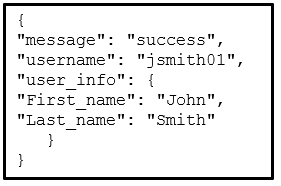
18. Refer to the exhibit. Which data format is used to represent the data for network automation applications?

  • XML
  • YAML
  • HTML
  • JSON
Explanation: The common data formats that are used in many applications including network automation and programmability are as follows:
  • JavaScript Object Notation (JSON) – In JSON, the data known as an object is one or more key/value pairs enclosed in braces { }. Keys must be strings within double quotation marks ” “. Keys and values are separated by a colon.
  • eXtensible Markup Language (XML) – In XML, the data is enclosed within a related set of tags <tag>data</tag>.
  • YAML Ain’t Markup Language (YAML) – In YAML, the data known as an object is one or more key value pairs. Key value pairs are separated by a colon without the use of quotation marks. YAML uses indentation to define its structure, without the use of brackets or commas.
19. What is the function of the key contained in most RESTful APIs?
  • It is the top-level object of the API query.
  • It is used to authenticate the requesting source.
  • It represents the main query components in the API request.
  • It is used in the encryption of the message by an API request.
Explanation: Many RESTful APIs, including public APIs, require a key. The key is used to identify the source of the request through authentication.
20. Which two configuration management tools are developed using Ruby? (Choose two.)
  • Puppet
  • Ansible
  • SaltStack
  • Chef
  • RESTCONF
Explanation: Chef and Puppet are configuration management tools developed using Ruby. Ansible and SaltStack are configuration management tools developed using Python. Ruby is typically considered a more difficult language to learn than Python. RESTCONF is a network management protocol.
21. Which term is used to describe a set of instructions for execution by the configuration management tool Puppet?
  • Playbook
  • Cookbook
  • Manifest
  • Pillar
Explanation: The configuration management tool Puppet uses the name Manifest to describe the set of instructions to be executed.
22. Which term is used to describe a set of instructions for execution by the configuration management tool SaltStack?
  • Cookbook
  • Manifest
  • Pillar
  • Playbook
Explanation: The configuration management tool SaltStack uses the name Pillar to describe the set of instructions to be executed.
23. Which scenario describes the use of a public API?
  • It requires a license.
  • It can be used with no restrictions.
  • It is used between a company and its business partners.
  • It is used only within an organization.
Explanation: Public, or open, APIs have no restrictions and are available to the public. Some API providers do require a user to obtain a free key or token prior to using the API in order to control the volume of API requests received and processed.
24. What is YAML?
  • It is a scripting language.
  • It is a data format and superset of JSON.
  • It is a compiled programming language.
  • It is a web application.
Explanation: Like JSON, YAML Ain’t Markup Language (YAML) is a data format used by applications to store and transport data. YAML is considered a superset of JSON.
25. Which RESTFul operation corresponds to the HTTP GET method?
  • post
  • patch
  • update
  • read
Explanation: RESTful operations correspond to the following HTTP methods (shown to the left with the RESTful operation on the right):
  • POST > Create
  • GET > Read
  • PUT/PATCH > Update
  • DELETE > Delete
26. Which technology virtualizes the network control plane and moves it to a centralized controller?​
  • SDN
  • fog computing
  • cloud computing
  • IaaS
Explanation: Networking devices operate in two planes: the data plane and the control plane. The control plane maintains Layer 2 and Layer 3 forwarding mechanisms using the CPU. The data plane forwards traffic flows. SDN virtualizes the control plane and moves it to a centralized network controller.​
27. What are two functions of hypervisors? (Choose two.)
  • to partition the hard drive to run virtual machines
  • to manage virtual machines
  • to protect the host from malware infection from the virtual machines
  • to share the antivirus software across the virtual machines
  • to allocate physical system resources to virtual machines
Explanation: The hypervisor does not protect the hosting OS from malware. Neither does it allow sharing software across virtual machines. The hard drive of the supporting computer does not need to be partitioned to run virtual machines. The hypervisor creates and manages virtual machines on a host computer and allocates physical system resources to them.
28. What is a difference between the functions of Cloud computing and virtualization?
  • Cloud computing requires hypervisor technology whereas virtualization is a fault tolerance technology.
  • Cloud computing separates the application from the hardware whereas virtualization separates the OS from the underlying hardware.
  • Cloud computing provides services on web-based access whereas virtualization provides services on data access through virtualized Internet connections.
  • Cloud computing utilizes data center technology whereas virtualization is not used in data centers.
Explanation: Cloud computing separates the application from the hardware. Virtualization separates the OS from the underlying hardware. Virtualization is a typical component within cloud computing. Virtualization is also widely used in data centers. Although the implementation of virtualization facilitates an easy server fault tolerance setup, it is not a fault tolerance technology by design. The Internet connection from a data center or service provider needs redundant physical WAN connections to ISPs.​​
29. How is the YAML data format structure different from JSON?
  • It uses indentations.
  • It uses end tags.
  • It uses hierarchical levels of nesting.
  • It uses brackets and commas.
Explanation: The structure in YAML is defined by indentations rather than brackets and commas.
30. What is the most widely used API for web services?
  • XML-RPC
  • SOAP
  • JSON-RPC
  • REST
Explanation: REST accounts for more than 80% of all API types used for web services, making it the most widely used web service API.
31. What is REST?
  • It is a way to store and interchange data in a structured format.
  • It is an architecture style for designing web service applications.
  • It is a human readable data structure that is used by applications for storing, transforming, and reading data.
  • It is a protocol that allows administrators to manage nodes on an IP network.
Explanation: REST is not a protocol or service, but rather a style of software architecture for designing web service applications.
32. What is a difference between the XML and HTML data formats?
  • XML does not use predefined tags whereas HTML does use predefined tags.
  • XML encloses data within a pair of tags whereas HTML uses a pair of quotation makes to enclose data.
  • XML formats data in binary whereas HTML formats data in plain text.
  • XML does not require indentation for each key/value pair but HTML does require indentation.
Explanation: XML is a human readable data structure used to store, transfer, and read data by applications. Like HTML, XML uses a related set of tags to enclose data. However, unlike HTML, XML uses no predefined tags or document structure.
33. To avoid purchasing new hardware, a company wants to take advantage of idle system resources and consolidate the number of servers while allowing for multiple operating systems on a single hardware platform. What service or technology would support this requirement?
  • dedicated servers
  • Cisco ACI
  • virtualization
  • software defined networking
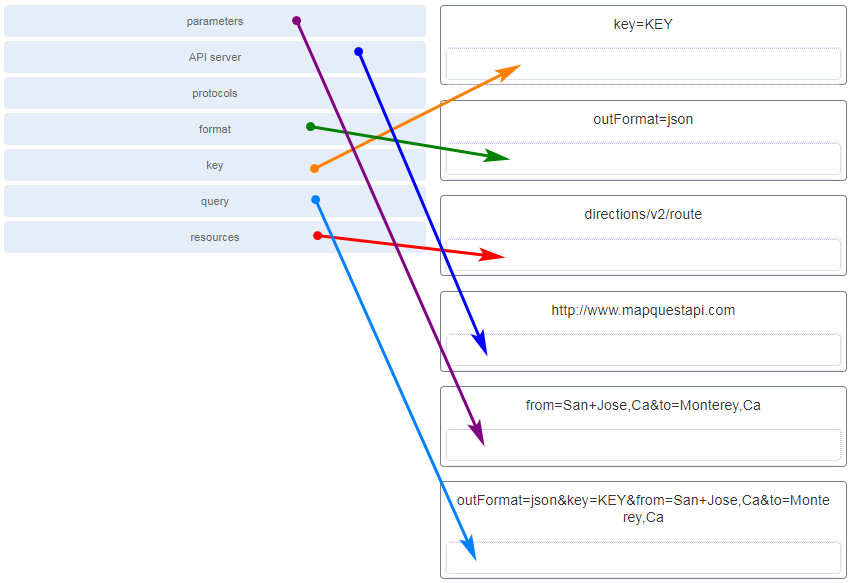
34. Match the term to the RESTful API request http://www.mapquestapi.com/directions/v2/route?outFormat=json&key=KEY&from=San+Jose,Ca&to=Monterey,Ca component. (Not all options are used.)

35. Which cloud computing opportunity would provide the use of network hardware such as routers and switches for a particular company?
  • software as a service (SaaS)
  • wireless as a service (WaaS)
  • infrastructure as a service (IaaS)
  • browser as a service (BaaS)
Explanation: This item is based on information contained in the presentation.
Routers, switches, and firewalls are infrastructure devices that can be provided in the cloud.
36. What component is considered the brains of the ACI architecture and translates application policies​?
  • the Application Network Profile endpoints
  • the Nexus 9000 switch
  • the hypervisor​
  • the Application Policy Infrastructure Controlle

37. A company uses a cloud-based payroll system. Which cloud computing technology is this company using?
  • browser as a service (BaaS)
  • infrastructure as a service (IaaS)
  • software as a service (SaaS)
  • wireless as a service (WaaS)
38. For a data center, what is the difference in the server virtualization data traffic compared with the traditional client-server model?
  • Data traffic from clients will be routed to multiple virtual servers.
  • There are significant data exchanges between virtual servers.
  • There is more data traffic flowing from virtual servers to clients.
  • More network control traffic is generated between virtual servers and clients.
39. Which component in a traditional infrastructure device provides Layer 2 and Layer 3 functions to create data paths within a network?
  • data plane
  • control plane
  • adjacency table
  • forwarding information base

CCNA 3 version 7 Modules 9 – 12: Optimize, Monitor, and Troubleshoot Networks Exam Answers 2020

1. Which troubleshooting tool would a network administrator use to check the Layer 2 header of frames that are leaving a particular host?
  • knowledge base
  • protocol analyzer
  • CiscoView
  • baselining tool
Explanation: A protocol analyzer such as Wireshark is capable of displaying the headers of data at any OSI Layer.
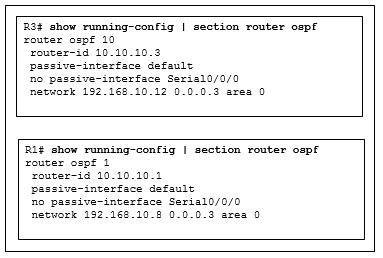
2. Refer to the exhibit. R1 and R3 are connected to each other via the local serial 0/0/0 interface. Why are they not forming an adjacency?

  • They have different routing processes.
  • They have different router IDs.
  • They are in different subnets.
  • The connecting interfaces are configured as passive.
Explanation: The routers need to be in the same subnet in order to form an adjacency. The routing processes can be different on each router. The router IDs must be different for routers that participate in the same routing domain. The interfaces are not passive.
3. What type of traffic is described as not resilient to loss?
  • data
  • video
  • voice
4. A network manager wants lists the contents of flash. What command should the administrator use on a Cisco router?
  • show file systems
  • dir
  • lldp enable
  • service timestamps log datetime
5. Voice packets are being received in a continuous stream by an IP phone, but because of network congestion the delay between each packet varies and is causing broken conversations. What term describes the cause of this condition?
  • buffering
  • latency
  • queuing
  • jitter
6. What is the function of a QoS trust boundary?
  • A trust boundary identifies the location where traffic cannot be remarked.
  • A trust boundary only allows traffic to enter if it has previously been marked.
  • A trust boundary identifies which devices trust the marking on packets that enter a network.
  • A trust boundary only allows traffic from trusted endpoints to enter the network.
Explanation: Network traffic is classified and marked as close to the source device as possible. The trust boundary is the location where the QoS markings on a packet are trusted as they enter an enterprise network.
7. What are two approaches to prevent packet loss due to congestion on an interface? (Choose two.)
  • Decrease buffer space.
  • Disable queuing mechanisms.
  • Drop lower-priority packets.
  • Prevent bursts of traffic.
  • Increase link capacity.
Explanation: There are three approaches to prevent sensitive traffic from being dropped:
  • Increase link capacity to ease or prevent congestion.
  • Guarantee enough bandwidth and increase buffer space to accommodate bursts of traffic from fragile flows.
  • Prevent congestion by dropping lower-priority packets before congestion occurs.
8. What configuration scenario would offer the most protection to SNMP get and set messages?
  • SNMPv2 for in-band management with read-write community strings
  • SNMPv1 with out-of-band management in a private subnet
  • SNMPv3 configured with the auth security level
  • SNMP community strings
Explanation: SNMPv3 supports authentication and encryption with the auth and priv security levels. SNMPv1 and SNMPv2 do not support authentication or encryption. Using a default community string is not secure because the default string of “public” is well known and would allow anyone with SNMP systems to read device MIBs.
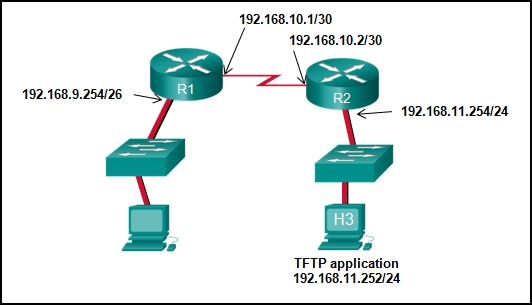
9. Refer to the exhibit. The network administrator enters these commands into the R1 router:
R1# copy running-config tftp
Address or name of remote host [ ]?
When the router prompts for an address or remote host name, what IP address should the administrator enter at the prompt?

  • 192.168.9.254
  • 192.168.10.2
  • 192.168.11.252
  • 192.168.11.254
  • 192.168.10.1
Explanation: The requested address is the address of the TFTP server. A TFTP server is an application that can run on a multitude of network devices including a router, server, or even a networked PC.
10. The command ntp server 10.1.1.1 is issued on a router. What impact does this command have?
  • determines which server to send system log files to
  • synchronizes the system clock with the time source with IP address 10.1.1.1
  • identifies the server on which to store backup configurations
  • ensures that all logging will have a time stamp associated with it
Explanation: The ntp server ip-address global configuration command configures the NTP server for IOS devices.
11. As the network administrator you have been asked to implement EtherChannel on the corporate network. What does this configuration consist of?
  • providing redundant links that dynamically block or forward traffic
  • grouping two devices to share a virtual IP address
  • grouping multiple physical ports to increase bandwidth between two switches
  • providing redundant devices to allow traffic to flow in the event of device failure
Explanation: EtherChannel is utilized on a network to increase speed capabilities by grouping multiple physical ports into one or more logical EtherChannel links between two switches. STP is used to provide redundant links that dynamically block or forward traffic between switches. FHRPs are used to group physical devices to provide traffic flow in the event of failure.
12. What is a definition of a two-tier LAN network design?
  • access and core layers collapsed into one tier, and the distribution layer on a separate tier
  • distribution and core layers collapsed into one tier, and the access layer on a separate tier
  • access, distribution, and core layers collapsed into one tier, with a separate backbone layer
  • access and distribution layers collapsed into one tier, and the core layer on a separate tier
Explanation: Maintaining three separate network tiers is not always required or cost-efficient. All network designs require an access layer, but a two-tier design can collapse the distribution and core layers into one layer to serve the needs of a small location with few users.
13. What are two reasons to create a network baseline? (Choose two.)
  • to select a routing protocol
  • to determine what kind of equipment to implement
  • to design a network according to a proper model
  • to identify future abnormal network behavior
  • to evaluate security vulnerabilities in the network
  • to determine if the network can deliver the required policies
Explanation: A network baseline is created to provide a comparison point, at the time that the network is performing optimally, to whatever changes are implemented in the infrastructure. A baseline helps to keep track of the performance, to track the traffic patterns, and to monitor network behavior.
14. A computer can access devices on the same network but cannot access devices on other networks. What is the probable cause of this problem?
  • The computer has an incorrect subnet mask.
  • The computer has an invalid default gateway address.
  • The cable is not connected properly to the NIC.
  • The computer has an invalid IP address.
Explanation: The default gateway is the address of the device a host uses to access the Internet or another network. If the default gateway is missing or incorrect, that host will not be able to communicate outside the local network. Because the host can access other hosts on the local network, the network cable and the other parts of the IP configuration are working.
15. In which step of gathering symptoms does the network engineer determine if the problem is at the core, distribution, or access layer of the network?
  • Gather information.
  • Narrow the scope.
  • Document the symptoms.
  • Determine ownership.
  • Determine the symptoms.
Explanation: In the “narrow the scope” step of gathering symptoms, a network engineer will determine if the network problem is at the core, distribution, or access layer of the network. Once this step is complete and the layer is identified, the network engineer can determine which pieces of equipment are the most likely cause.
16. A network administrator is deploying QoS with the ability to provide a special queue for voice traffic so that voice traffic is forwarded before network traffic in other queues. Which queuing method would be the best choice?
  • LLQ
  • CBWFQ
  • WFQ
  • FIFO
Explanation: Low latency queuing (LLQ) allows delay-sensitive data, such as voice traffic, to be defined in a strict priority queue (PQ) and to always be sent first before any packets in any other queue are forwarded.
17. What are two characteristics of voice traffic? (Choose two.)
  • Voice traffic latency should not exceed 150 ms.
  • Voice traffic is unpredictable and inconsistent.
  • Voice traffic requires at least 384 kbs of bandwidth.
  • Voice traffic consumes lots of network resources.
  • Dropped voice packets are not retransmitted.
Explanation: Voice traffic does not consume a lot of network resources, such as bandwidth. However, it is very sensitive to delay and dropped packets cannot be retransmitted. For good voice quality, the amount of latency should always be less than 150 milliseconds.
18. Which type of network traffic cannot be managed using congestion avoidance tools?
  • TCP
  • ICMP
  • IP
  • UDP
Explanation: Queuing and compression techniques can help to reduce and prevent UDP packet loss, but there is no congestion avoidance for User Datagram Protocol (UDP) based traffic.
19. When QoS is implemented in a converged network, which two factors can be controlled to improve network performance for real-time traffic? (Choose two.)
  • delay
  • packet addressing
  • jitter
  • packet routing
  • link speed
Explanation: Delay is the latency between a sending and receiving device. Jitter is the variation in the delay of the received packets. Both delay and jitter need to be controlled in order to support real-time voice and video traffic.
20. An administrator wants to replace the configuration file on a Cisco router by loading a new configuration file from a TFTP server. What two things does the administrator need to know before performing this task? (Choose two.)
  • name of the configuration file that is currently stored on the router
  • configuration register value
  • name of the configuration file that is stored on the TFTP server
  • router IP address
  • TFTP server IP address
Explanation: In order to identify the exact location of the desired configuration file, the IP address of the TFTP server and the name of the configuration file are essential information. Because the file is a new configuration, the name of the current configuration file is not necessary.
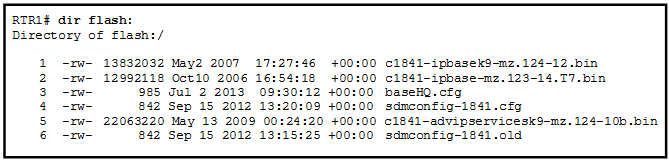
21. Refer to the exhibit. Which of the three Cisco IOS images shown will load into RAM?

  • The router selects an image depending on the boot system command in the configuration.
  • The router selects an image depending on the value of the configuration register.
  • The router selects the third Cisco IOS image because it is the most recent IOS image.
  • The router selects the third Cisco IOS image because it contains the advipservicesk9 image.
  • The router selects the second Cisco IOS image because it is the smallest IOS image.
Explanation: When performing an upgrade or testing different IOS versions, the boot system command is used to select which image is used to boot the Cisco device.
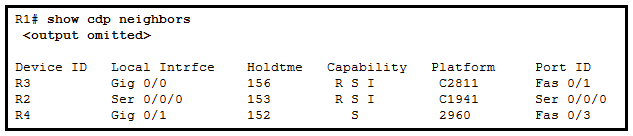
22. Refer to the exhibit. What two types of devices are connected to R1? (Choose two.)

  • switch
  • hub
  • router
  • repeater
  • Source Route Bridge
Explanation: The capabilities of the devices displayed by the output show them to be a Cisco 2811 series router, Cisco 1941 series router, and a Cisco 2960 switch.
23. What are three functions provided by the syslog service? (Choose three.)
  • to select the type of logging information that is captured
  • to periodically poll agents for data
  • to provide statistics on packets that are flowing through a Cisco device
  • to provide traffic analysis
  • to gather logging information for monitoring and troubleshooting
  • to specify the destinations of captured messages
Explanation: There are three primary functions provided by the syslog service:
  1. gathering logging information
  2. selection of the type of information to be logged
  3. selection of the destination of the logged information
24. What is the function of the MIB element as part of a network management system?
  • to collect data from SNMP agents
  • to send and retrieve network management information
  • to change configurations on SNMP agents
  • to store data about a device
Explanation: The Management Information Base (MIB) resides on a networking device and stores operational data about the device. The SNMP manager can collect information from SNMP agents. The SNMP agent provides access to the information.
25. What network design would contain the scope of disruptions on a network should a failure occur?
  • the reduction in the number of redundant devices and connections in the network core
  • the installation of only enterprise class equipment throughout the network
  • the deployment of distribution layer switches in pairs and the division of access layer switch connections between them
  • the configuration of all access layer devices to share a single gateway
Explanation: One way to contain the impact of a failure on the network is to implement redundancy. One way this is accomplished is by deploying redundant distribution layer switches and dividing the access layer switch connections between the redundant distribution layer switches. This creates what is called a switch block. Failures in a switch block are contained to that block and do not bring down the whole network.
26. Which action should be taken when planning for redundancy on a hierarchical network design?
  • add alternate physical paths for data to traverse the network
  • continually purchase backup equipment for the network
  • implement STP portfast between the switches on the network
  • immediately replace a non-functioning module, service or device on a network
Explanation: One method of implementing redundancy is path redundancy, installing alternate physical paths for data to traverse the network. Redundant links in a switched network supports high availability and can be used for load balancing, reducing congestion on the network.
27. What are two benefits of extending access layer connectivity to users through a wireless medium? (Choose two.)
  • increased flexibility
  • increased network management options
  • decreased number of critical points of failure
  • reduced costs
  • increased bandwidth availability
Explanation: Wireless connectivity at the access layer provides increased flexibility, reduced costs, and the ability to grow and adapt to changing business requirements. Utilizing wireless routers and access points can provide an increase in the number of central points of failure. Wireless routers and access points will not provide an increase in bandwidth availability.
28. What is a basic function of the Cisco Borderless Architecture access layer?
  • aggregates Layer 2 broadcast domains
  • provides access to the user
  • aggregates Layer 3 routing boundaries
  • provides fault isolation
Explanation: A function of the Cisco Borderless Architecture access layer is providing network access to the users. Layer 2 broadcast domain aggregation, Layer 3 routing boundaries aggregation, and high availability are distribution layer functions. The core layer provides fault isolation and high-speed backbone connectivity.
29. Which characteristic would most influence a network design engineer to select a multilayer switch over a Layer 2 switch?
  • ability to have multiple forwarding paths through the switched network based on VLAN number(s)
  • ability to build a routing table
  • ability to provide power to directly-attached devices and the switch itself
  • ability to aggregate multiple ports for maximum data throughput
Explanation: Multilayer switches, also known as Layer 3 switches, can route and build a routing table. This capability is required in a multi-VLAN network and would influence the network designer to select a multilayer switch. The other options are features also available on Layer 2 switches, so they would not influence the decision to select a multilayer switch.
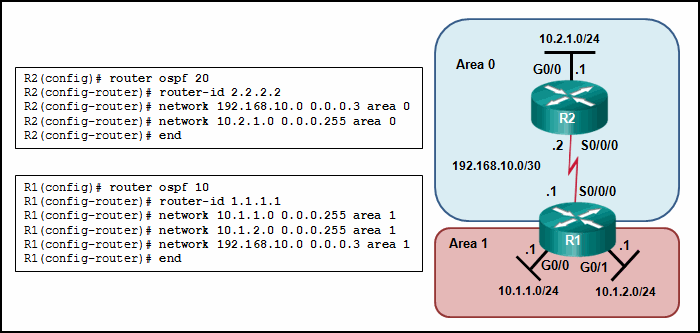
30. Refer to the exhibit. Why are routers R1 and R2 not able to establish an OSPF adjacency?​

  • The serial interfaces are not in the same area.
  • The process numbers are not the same in both routers.
  • A backbone router cannot establish an adjacency with an ABR router.
  • The router ID values are not the same in both routers.
Explanation: On router R1, the network 192.168.10.0/30 is defined in the wrong area (area 1). It has to be defined in area 0 in order to establish adjacency with router R2, which has the network 192.168.10.0/30 defined in area 0.
31. When is the most appropriate time to measure network operations to establish a network performance baseline?
  • whenever high network use is detected, so that how the network performs under stress can be monitored
  • during quiet vacation periods, so that the level of non-data traffic can be determined
  • at the same time each day across a set period of average working days, so that typical traffic patterns can be established
  • at random times during a 10 week period, so that abnormal traffic levels can be detected
Explanation: The purpose of establishing a network performance baseline is to provide a reference of normal or average network use to enable data traffic anomalies to be detected and then investigated. Network operations that are not average, or are not normal, cannot be used to establish a network performance baseline.
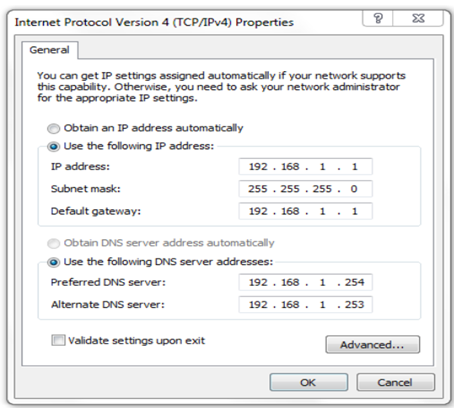
32. Refer to the exhibit. A user has configured a NIC on the PC as shown but finds that the PC is unable to access the Internet. What is the problem?

  • The preferred DNS address is incorrect.
  • The default gateway address is incorrect.
  • The settings were not validated upon exit.
  • There should not be an alternate DNS server.
Explanation: In order for a computer to communicate outside its network, it must have a valid default gateway configured.This address cannot be the same as the IP address of the computer.
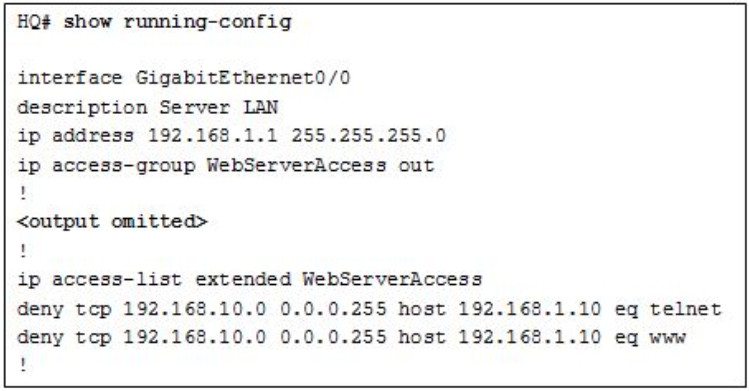
33. Refer to the exhibit. A network engineer configured an ACL preventing Telnet and HTTP access to the HQ web server from guest users in the Branch LAN. The address of the web server is 192.168.1.10 and all guest users are assigned addresses in the 192.168.10.0/24 network. After implementing the ACL, no one can access any of the HQ servers. What is the problem?

  • Inbound ACLs must be routed before they are processed.
  • The ACL is implicitly denying access to all the servers.
  • Named ACLs require the use of port numbers.
  • The ACL is applied to the interface using the wrong direction.
Explanation: Both named and numbered ACLs have an implicit deny ACE at the end of the list. This implicit deny blocks all traffic.
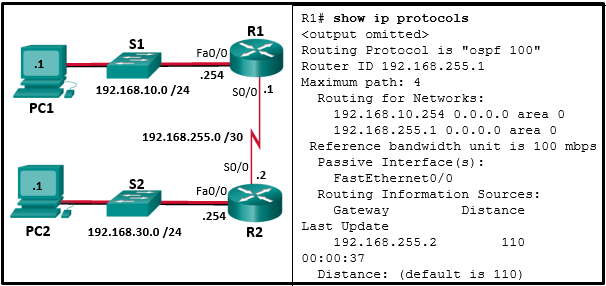
34. Refer to the exhibit. A network administrator has configured OSPFv2 on the two Cisco routers as shown. PC1 is unable to connect to PC2. What should the administrator do first when troubleshooting the OSPFv2 implementation?

  • Disconnect the serial link between router R1 and R2.
  • Turn off OSPFv2.
  • Implement the network 192.168.255.0 0.0.0.3 area 0 command on router R1.
  • Test Layer 3 connectivity between the directly connected routers.
Explanation: A prerequisite for OSPFv2 neighbor relationships to form between two routers is Layer 3 connectivity. A successful ping confirms that a router interface is active and may be able to form an OSPF neighbor adjacency.
35. What type of traffic is described as requiring latency to be no more than 150 milliseconds (ms)?
  • voice
  • video
  • data
36. A network manager wants to add a time to log messages so that there is record of when the message was generated. What command should the administrator use on a Cisco router?
  • show cdp interface
  • ntp server 10.10.14.9
  • service timestamps log datetime
  • clock timezone PST -7
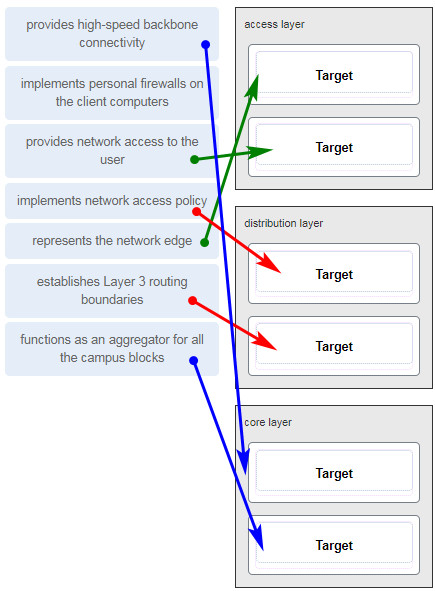
37. Match the functions to the corresponding layers. (Not all options are used.)

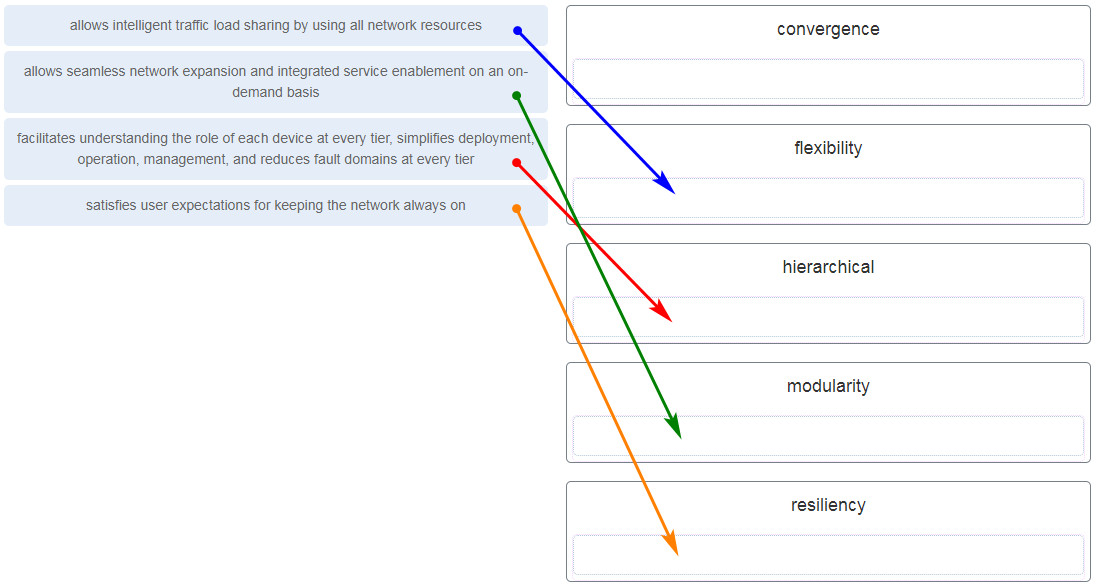
38. Match the borderless switched network guideline description to the principle. (Not all options are used.)

39. What are two characteristics of the best-effort QoS model? (Choose two.)
  • It allows end hosts to signal their QoS needs to the network.
  • It uses a connection-oriented approach with QoS.
  • It provides preferential treatment for voice packets.
  • It does not provide a delivery guarantee for packets.
  • It treats all network packets in the same way.
Explanation: The best-effort QoS model provides no guarantees and it is commonly used on the Internet. The best-effort QoS model treats all network packets in the same way.
40. Why is QoS an important issue in a converged network that combines voice, video, and data communications?
  • Data communications are sensitive to jitter.
  • Legacy equipment is unable to transmit voice and video without QoS.
    Correct Response
  • Voice and video communications are more sensitive to latency.
  • Data communications must be given the first priority.
Explanation: Without any QoS mechanisms in place, time-sensitive packets, such as voice and video, will be dropped with the same frequency as email and web browsing traffic.
41. A network administrator configures a router with the command sequence:
R1(config)# boot system tftp://c1900-universalk9-mz.SPA.152-4.M3.bin
R1(config)# boot system rom
What is the effect of the command sequence?
  • On next reboot, the router will load the IOS image from ROM.
  • The router will search and load a valid IOS image in the sequence of flash, TFTP, and ROM.
  • The router will copy the IOS image from the TFTP server and then reboot the system.
  • The router will load IOS from the TFTP server. If the image fails to load, it will load the IOS image from ROM.
Explanation: The boot system command is a global configuration command that allows the user to specify the source for the Cisco IOS Software image to load. In this case, the router is configured to boot from the IOS image that is stored on the TFTP server and will use the ROMmon imagethat is located in the ROM if it fails to locate the TFTP server or fails to load a valid image from the TFTP server.
42. Which statement describes SNMP operation?
  • An SNMP agent that resides on a managed device collects information about the device and stores that information remotely in the MIB that is located on the NMS.​
  • A set request is used by the NMS to change configuration variables in the agent device.
  • An NMS periodically polls the SNMP agents that are residing on managed devices by using traps to query the devices for data.​
  • A get request is used by the SNMP agent to query the device for data.​
Explanation: An SNMP agent that resides on a managed device collects and stores information about the device and its operation. This information is stored by the agent locally in the MIB. An NMS periodically polls the SNMP agents that are residing on managed devices by using the get request to query the devices for data.
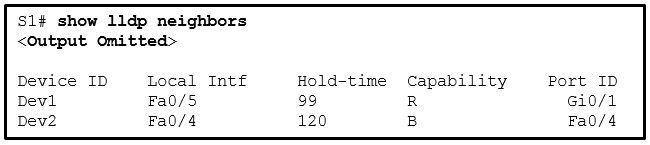
43. Refer to the exhibit. A network administrator issues the show lldp neighbors command on a switch. What are two conclusions that can be drawn? (Choose two.)

  • Dev1 is connected to interface Fa0/5 of S1.
  • Dev1 is a switch with mixed types of interfaces.
  • Dev2 is a switch.
  • Dev1 is connected to interface Fa0/4 of Dev2.
  • S1 has only two interfaces.
Explanation: In the output from the show lldp command, under Capability, R indicates a router and B indicates a bridge (switch). Nothing indicates that Dev1 and Dev2 are connected to one another.
44. What are the three layers of the switch hierarchical design model? (Choose three.)
  • distribution
  • network access
  • data link
  • enterprise
  • access
  • core
Explanation: The access layer is the lowest layer and it provides network access to users. The distribution layer has many functions, but it aggregates data from the access layer, provides filtering, policy control, and sets Layer 3 routing boundaries. The core layer provides high speed connectivity.
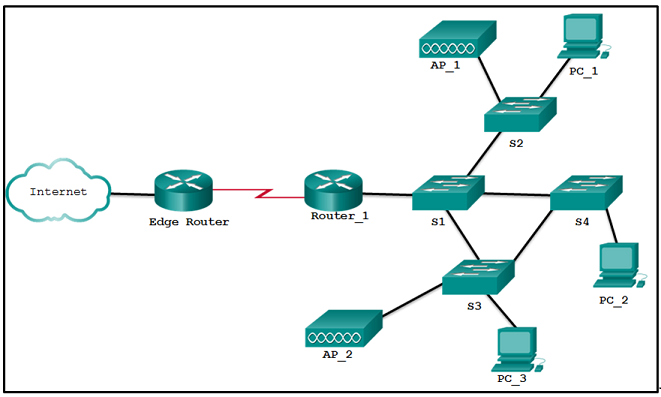
45. Refer to the exhibit. Which devices exist in the failure domain when switch S3 loses power?

  • S4 and PC_2
  • PC_3 and PC_2
  • PC_3 and AP_2
  • S1 and S4
  • AP_2 and AP_1
Explanation: A failure domain is the area of a network that is impacted when a critical device such as switch S3 has a failure or experiences problems.
46. A network designer is considering whether to implement a switch block on the company network. What is the primary advantage of deploying a switch block?
  • This is network application software that prevents the failure of a single network device.
  • The failure of a switch block will not impact all end users.
  • This is a security feature that is available on all new Catalyst switches.
  • A single core router provides all the routing between VLANs.
Explanation: The configuration of a switch block provides redundancy so that the failure of a single network device generally has little or no effect on end users.

47. What is the term used to indicate a variation of delay?
  • latency
  • serialization delay
  • speed mismatch
  • jitter
48. A network engineer performs a ping test and receives a value that shows the time it takes for a packet to travel from a source to a destination device and return. Which term describes the value?
  • jitter
  • latency
  • priority
  • bandwidth
49. What role do network devices play in the IntServ QoS model?
  • Network devices ensure that resources are available before traffic is allowed to be sent by a host through the network.
  • Network devices provide a best-effort approach to forwarding traffic.
  • Network devices are configured to service multiple classes of traffic and handle traffic as it may arrive.
  • Network devices use QoS on a hop-by-hop basis to provide excellent scalability.
50. Which device would be classified as a trusted endpoint?
  • switch
  • router
  • firewall
  • IP phone
51. What is the benefit of deploying Layer 3 QoS marking across an enterprise network?
  • Layer 3 marking can carry the QoS information end-to-end.
  • Layer 3 marking can carry QoS information on switches that are not IP aware.
  • Layer 3 marking can be carried in the 802.1Q fields.
  • Layer 3 marking can be used to carry non-IP traffic.
Explanation: Marking traffic at Layer 2 or Layer 3 is very important and will affect how traffic is treated in a network using QoS.
  • Layer 2 marking of frames can be performed for non-IP traffic.
  • Layer 2 marking of frames is the only QoS option available for switches that are not “IP aware.”
  • Layer 3 marking will carry the QoS information end-to-end.

CCNA 3 version 7 Modules 6 – 8: WAN Concepts Exam Answers 2020


1. Which protocol creates a virtual point-to-point connection to tunnel unencrypted traffic between Cisco routers from a variety of protocols?
  • IKE
  • IPsec
  • OSPF
  • GRE
2. What is a disadvantage when both sides of a communication use PAT?
  • End-to-end IPv4 traceability is lost.
  • The flexibility of connections to the Internet is reduced.
  • The security of the communication is negatively impacted.
  • Host IPv4 addressing is complicated.
3. What two addresses are specified in a static NAT configuration?
  • the outside global and the outside local
  • the inside local and the outside global
  • the inside global and the outside local
  • the inside local and the inside global
4. A company is considering updating the campus WAN connection. Which two WAN options are examples of the private WAN architecture? (Choose two.)
  • municipal Wi-Fi
  • digital subscriber line
  • leased line
  • Ethernet WAN
  • cable
5. Refer to the exhibit. From the perspective of R1, the NAT router, which address is the inside global address?
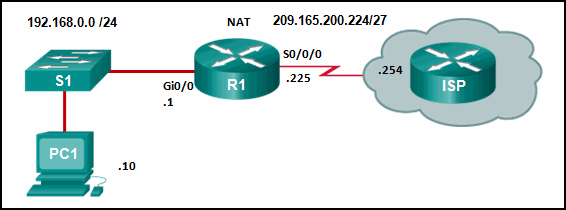
  • 192.168.0.10
  • 192.168.0.1
  • 209.165.200.225
  • 209.165.200.254
Explanation: There are four types of addresses in NAT terminology.
Inside local address
Inside global address
Outside local address
Outside global address
The inside global address of PC1 is the address that the ISP sees as the source address of packets, which in this example is the IP address on the serial interface of R1, 209.165.200.224.
6. Refer to the exhibit. Given the commands as shown, how many hosts on the internal LAN off R1 can have simultaneous NAT translations on R1?
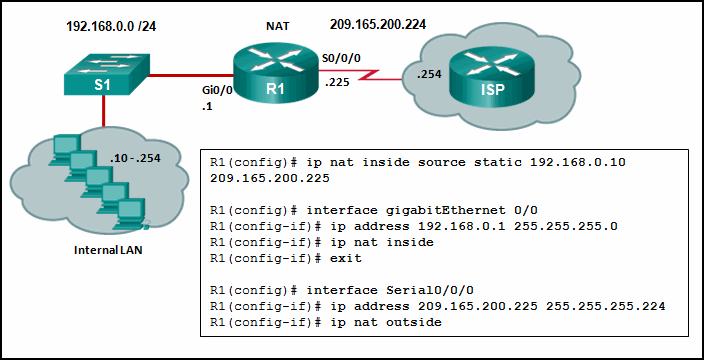
  • 244
  • 10
  • 1
  • 255
Explanation: The NAT configuration on R1 is static NAT which translates a single inside IP address, 192.168.0.10 into a single public IP address, 209.165.200.255. If more hosts need translation, then a NAT pool of inside global address or overloading should be configured.
7. Refer to the exhibit. A network administrator has just configured address translation and is verifying the configuration. What three things can the administrator verify? (Choose three.)
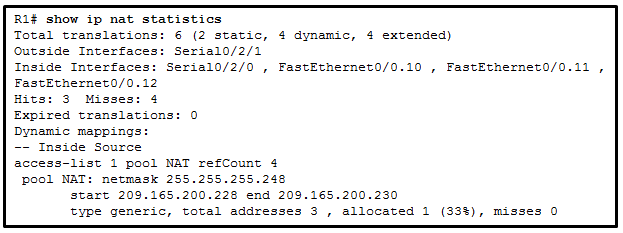
  • A standard access list numbered 1 was used as part of the configuration process.
  • Three addresses from the NAT pool are being used by hosts.
  • Address translation is working.
  • One port on the router is not participating in the address translation.
  • The name of the NAT pool is refCount.
  • Two types of NAT are enabled.
Explanation: The show ip nat statistics, show ip nat translations, and debug ip nat commands are useful in determining if NAT is working and and also useful in troubleshooting problems that are associated with NAT. NAT is working, as shown by the hits and misses count. Because there are four misses, a problem might be evident. The standard access list numbered 1 is being used and the translation pool is named NAT as evidenced by the last line of the output. Both static NAT and NAT overload are used as seen in the Total translations line.
8. Refer to the exhibit. NAT is configured on RT1 and RT2. The PC is sending a request to the web server. What IPv4 address is the source IP address in the packet between RT2 and the web server?
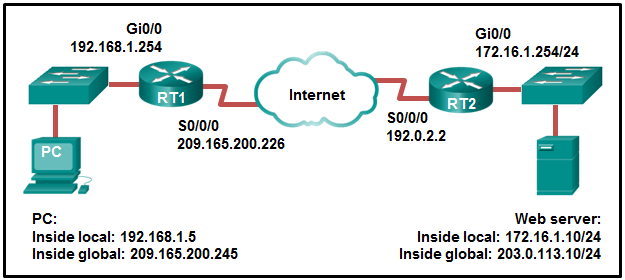
  • 192.168.1.5
  • 203.0.113.10
  • 172.16.1.254
  • 172.16.1.10
  • 209.165.200.245
  • 192.0.2.2
Explanation: Because the packet is between RT2 and the web server, the source IP address is the inside global address of PC, 209.165.200.245.
9. Refer to the exhibit. Based on the output that is shown, what type of NAT has been implemented?

  • dynamic NAT with a pool of two public IP addresses
  • PAT using an external interface
  • static NAT with a NAT pool
  • static NAT with one entry
Explanation: The output shows that there are two inside global addresses that are the same but that have different port numbers. The only time port numbers are displayed is when PAT is being used. The same output would be indicative of PAT that uses an address pool. PAT with an address pool is appropriate when more than 4,000 simultaneous translations are needed by the company.
10. Refer to the exhibit. From the perspective of users behind the NAT router, what type of NAT address is 209.165.201.1?
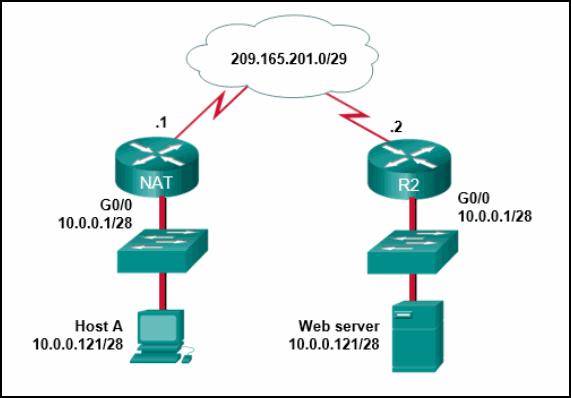
  • inside global
  • outside global
  • outside local
  • inside local
Explanation: From the perspective of users behind NAT, inside global addresses are used by external users to reach internal hosts. Inside local addresses are the addresses assigned to internal hosts. Outside global addresses are the addresses of destinations on the external network. Outside local addresses are the actual private addresses of destination hosts behind other NAT devices.
11. Refer to the exhibit. Static NAT is being configured to allow PC 1 access to the web server on the internal network. What two addresses are needed in place of A and B to complete the static NAT configuration? (Choose two.)
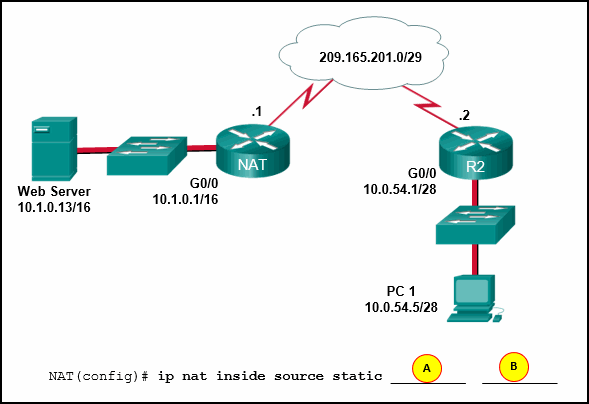
  • A = 209.165.201.2
  • A = 10.1.0.13
  • B = 209.165.201.7
  • B = 10.0.254.5
  • B = 209.165.201.1
Explanation: Static NAT is a one-to-one mapping between an inside local address and an inside global address. By using static NAT, external devices can initiate connections to internal devices by using the inside global addresses. The NAT devices will translate the inside global address to the inside local address of the target host.
12. What is the purpose of the overload keyword in the ip nat inside source list 1 pool NAT_POOL overload command?
  • It allows many inside hosts to share one or a few inside global addresses.
  • It allows a list of internal hosts to communicate with a specific group of external hosts.
  • It allows external hosts to initiate sessions with internal hosts.
  • It allows a pool of inside global addresses to be used by internal hosts.
Explanation: Dynamic NAT uses a pool of inside global addresses that are assigned to outgoing sessions. If there are more internal hosts than public addresses in the pool, then an administrator can enable port address translation with the addition of the overload keyword. With port address translation, many internal hosts can share a single inside global address because the NAT device will track the individual sessions by Layer 4 port number.
13. Refer to the exhibit. Which source address is being used by router R1 for packets being forwarded to the Internet?

  • 10.6.15.2
  • 209.165.202.141
  • 198.51.100.3
  • 209.165.200.225
Explanation: The source address for packets forwarded by the router to the Internet will be the inside global address of 209.165.200.225. This is the address that the internal addresses from the 10.6.15.0 network will be translated to by NAT.
14. Refer to the exhibit. The NAT configuration applied to the router is as follows:
ERtr(config)# access-list 1 permit 10.0.0.0 0.255.255.255
ERtr(config)# ip nat pool corp 209.165.201.6 209.165.201.30 netmask 255.255.255.224
ERtr(config)# ip nat inside source list 1 pool corp overload
ERtr(config)# ip nat inside source static 10.10.10.55 209.165.201.4
ERtr(config)# interface gigabitethernet 0/0
ERtr(config-if)# ip nat inside
ERtr(config-if)# interface serial 0/0/0
ERtr(config-if)# ip nat outside
Based on the configuration and the output shown, what can be determined about the NAT status within the organization?
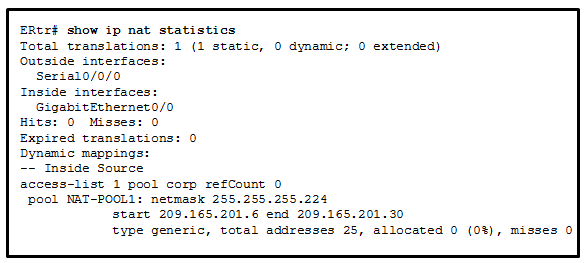
  • Static NAT is working, but dynamic NAT is not.
  • Dynamic NAT is working, but static NAT is not.
  • Not enough information is given to determine if both static and dynamic NAT are working.
  • NAT is working.
Explanation: There is not enough information given because the router might not be attached to the network yet, the interfaces might not have IP addresses assigned yet, or the command could have been issued in the middle of the night. The output does match the given configuration, so no typographical errors were made when the NAT commands were entered.
15. Which situation describes data transmissions over a WAN connection?
  • A network administrator in the office remotely accesses a web server that is located in the data center at the edge of the campus.
  • A manager sends an email to all employees in the department with offices that are located in several buildings.
  • An employee prints a file through a networked printer that is located in another building.
  • An employee shares a database file with a co-worker who is located in a branch office on the other side of the city.
Explanation: When two offices across a city are communicating , it is most likely that the data transmissions are over some type of WAN connection. Data communications within a campus are typically over LAN connections.
16. Which two technologies are categorized as private WAN infrastructures? (Choose two.)
  • Frame Relay
  • VPN
  • MetroE
  • DSL
  • cable
Explanation: Private WAN technologies include leased lines, dialup, ISDN, Frame Relay, ATM, Ethernet WAN (an example is MetroE), MPLS, and VSAT.
17. Which network scenario will require the use of a WAN?
  • Employees need to connect to the corporate email server through a VPN while traveling.
  • Employees need to access web pages that are hosted on the corporate web servers in the DMZ within their building.
  • Employee workstations need to obtain dynamically assigned IP addresses.
  • Employees in the branch office need to share files with the headquarters office that is located in a separate building on the same campus network.
Explanation: When traveling employees need to connect to a corporate email server through a WAN connection, the VPN will create a secure tunnel between an employee laptop and the corporate network over the WAN connection. Obtaining dynamic IP addresses through DHCP is a function of LAN communication. Sharing files among separate buildings on a corporate campus is accomplished through the LAN infrastructure. A DMZ is a protected network inside the corporate LAN infrastructure.
18. What are two hashing algorithms used with IPsec AH to guarantee authenticity? (Choose two.)
  • SHA
  • RSA
  • DH
  • MD5
  • AES
Explanation: The IPsec framework uses various protocols and algorithms to provide data confidentiality, data integrity, authentication, and secure key exchange. Two popular algorithms used to ensure that data is not intercepted and modified (data integrity and authenticity) are MD5 and SHA.
19. What two algorithms can be part of an IPsec policy to provide encryption and hashing to protect interesting traffic? (Choose two.)
  • SHA
  • RSA
  • AES
  • DH
  • PSK
Explanation: The IPsec framework uses various protocols and algorithms to provide data confidentiality, data integrity, authentication, and secure key exchange. Two algorithms that can be used within an IPsec policy to protect interesting traffic are AES, which is an encryption protocol, and SHA, which is a hashing algorithm.
20. Which VPN solution allows the use of a web browser to establish a secure, remote-access VPN tunnel to the ASA?
  • client-based SSL
  • site-to-site using an ACL
  • clientless SSL
  • site-to-site using a preshared key
Explanation: When a web browser is used to securely access the corporate network, the browser must use a secure version of HTTP to provide SSL encryption. A VPN client is not required to be installed on the remote host, so a clientless SSL connection is used.
21. Which IPsec security function provides assurance that the data received via a VPN has not been modified in transit?
  • integrity
  • authentication
  • confidentiality
  • secure key exchange
Explanation: Integrity is a function of IPsec and ensures data arrives unchanged at the destination through the use of a hash algorithm. Confidentiality is a function of IPsec and utilizes encryption to protect data transfers with a key. Authentication is a function of IPsec and provides specific access to users and devices with valid authentication factors. Secure key exchange is a function of IPsec and allows two peers to maintain their private key confidentiality while sharing their public key.
22. Which two types of VPNs are examples of enterprise-managed remote access VPNs? (Choose two.)
  • clientless SSL VPN
  • client-based IPsec VPN
  • IPsec VPN
  • IPsec Virtual Tunnel Interface VPN
  • GRE over IPsec VPN
Explanation: Enterprise managed VPNs can be deployed in two configurations:
  • Remote Access VPN – This VPN is created dynamically when required to establish a secure connection between a client and a VPN server. Remote access VPNs include client-based IPsec VPNs and clientless SSL VPNs.
  • Site-to-site VPN – This VPN is created when interconnecting devices are preconfigured with information to establish a secure tunnel. VPN traffic is encrypted only between the interconnecting devices, and internal hosts have no knowledge that a VPN is used. Site-to-site VPNs include IPsec, GRE over IPsec, Cisco Dynamic Multipoint (DMVPN), and IPsec Virtual Tunnel Interface (VTI) VPNs.
23. Which is a requirement of a site-to-site VPN?
  • It requires hosts to use VPN client software to encapsulate traffic.
  • It requires the placement of a VPN server at the edge of the company network.
  • It requires a VPN gateway at each end of the tunnel to encrypt and decrypt traffic.
  • It requires a client/server architecture.
Explanation: Site-to-site VPNs are static and are used to connect entire networks. Hosts have no knowledge of the VPN and send TCP/IP traffic to VPN gateways. The VPN gateway is responsible for encapsulating the traffic and forwarding it through the VPN tunnel to a peer gateway at the other end which decapsulates the traffic.
24. What is the function of the Diffie-Hellman algorithm within the IPsec framework?
  • guarantees message integrity
  • allows peers to exchange shared keys
  • provides authentication
  • provides strong data encryption
Explanation: The IPsec framework uses various protocols and algorithms to provide data confidentiality, data integrity, authentication, and secure key exchange. DH (Diffie-Hellman) is an algorithm used for key exchange. DH is a public key exchange method that allows two IPsec peers to establish a shared secret key over an insecure channel.
25. What does NAT overloading use to track multiple internal hosts that use one inside global address?
  • port numbers
  • IP addresses
  • autonomous system numbers
  • MAC addresses
Explanation: NAT overloading, also known as Port Address Translation (PAT), uses port numbers to differentiate between multiple internal hosts.
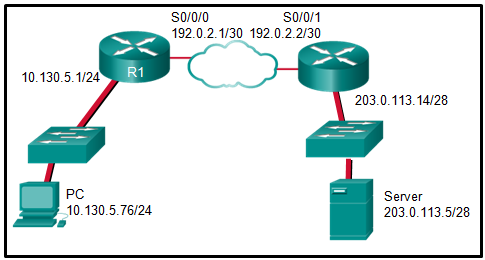
26. Question as presented:
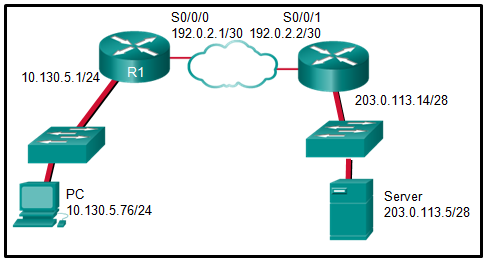
Explanation: The inside local address is the private IP address of the source or the PC in this instance. The inside global address is the translated address of the source or the address as seen by the outside device. Since the PC is using the outside address of the R1 router, the inside global address is 192.0.2.1. The outside addressing is simply the address of the server or 203.0.113.5.
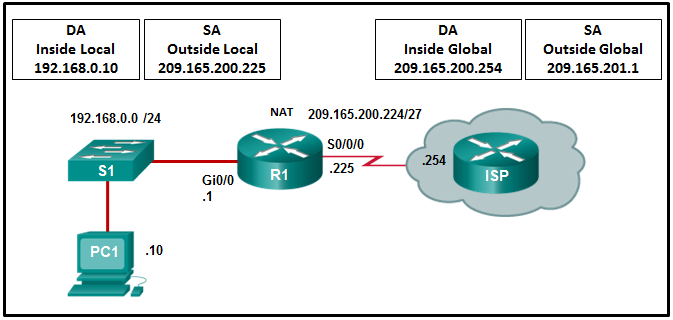
27. Refer to the exhibit. R1 is configured for static NAT. What IP address will Internet hosts use to reach PC1?
  • 192.168.0.1
  • 192.168.0.10
  • 209.165.201.1
  • 209.165.200.225
Explanation: In static NAT a single inside local address, in this case 192.168.0.10, will be mapped to a single inside global address, in this case 209.165.200.225. Internet hosts will send packets to PC1 and use as a destination address the inside global address 209.165.200.225.
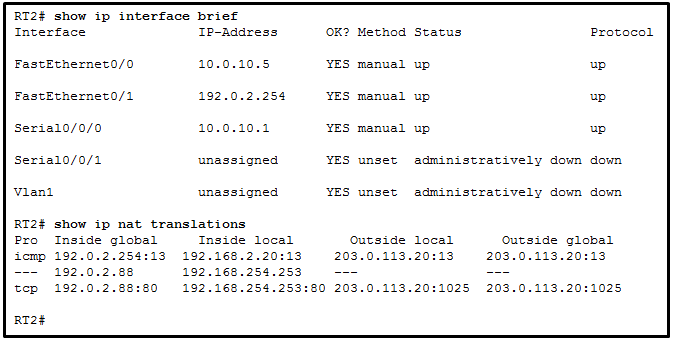
28. Refer to the exhibit. A network administrator is viewing the output from the command show ip nat translations. Which statement correctly describes the NAT translation that is occurring on router RT2?​

  • The traffic from a source IPv4 address of 192.168.254.253 is being translated to 192.0.2.88 by means of static NAT.
  • The traffic from a source IPv4 address of 192.0.2.88 is being translated by router RT2 to reach a destination IPv4 address of 192.168.254.253.
  • The traffic from a source IPv4 public address that originates traffic on the internet would be able to reach private internal IPv4 addresses​.
  • The traffic from a source IPv4 address of 192.168.2.20 is being translated by router RT2 to reach a destination IPv4 address of 192.0.2.254.
Explanation: Because no outside local or outside global address is referenced, the traffic from a source IPv4 address of 192.168.254.253 is being translated to 192.0.2.88 by using static NAT. In the output from the command show ip nat translations, the inside local IP address of 192.168.2.20 is being translated into an outside IP address of 192.0.2.254 so that the traffic can cross the public network. A public IPv4 device can connect to the private IPv4 device 192.168.254.253 by targeting the destination IPv4 address of 192.0.2.88.
29. Which two WAN infrastructure services are examples of private connections? (Choose two.)
  • cable
  • DSL
  • Frame Relay
  • T1/E1
  • wireless
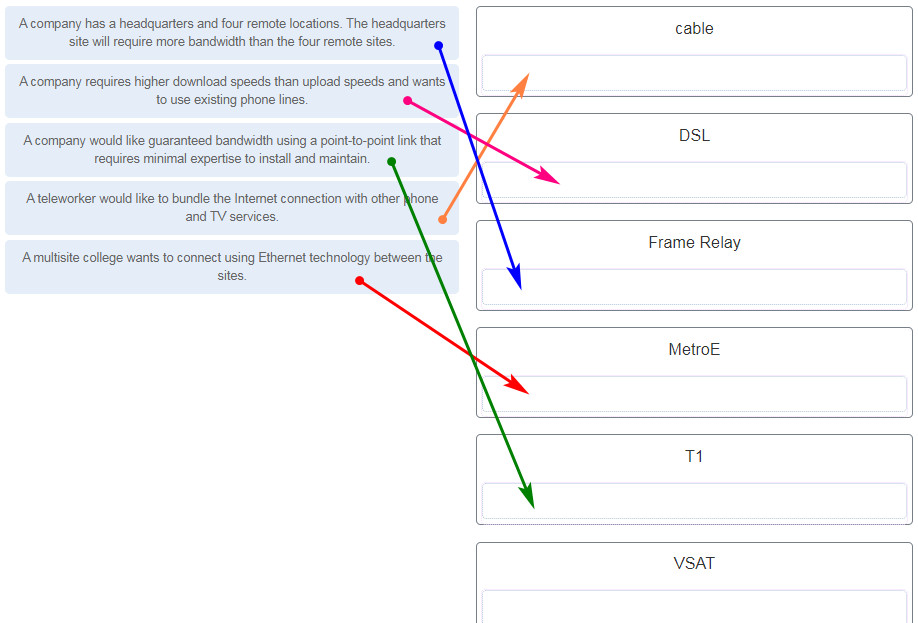
Explanation: Private WANs can use T1/E1, T3/E3, PSTN, ISDN, Metro Ethernet, MPLS, Frame Relay, ATM, or VSAT technology.
30. Which two statements about the relationship between LANs and WANs are true? (Choose two.)
  • Both LANs and WANs connect end devices.
  • WANs are typically operated through multiple ISPs, but LANs are typically operated by single organizations or individuals.
  • WANs must be publicly-owned, but LANs can be owned by either public or private entities.
  • WANs connect LANs at slower speed bandwidth than LANs connect their internal end devices.​
  • LANs connect multiple WANs together.
Explanation: Although LANs and WANs can employ the same network media and intermediary devices, they serve very different areas and purposes. The administrative and geographical scope of a WAN is larger than that of a LAN. Bandwidth speeds are slower on WANs because of their increased complexity. The Internet is a network of networks, which can function under either public or private management.
31. Which statement describes an important characteristic of a site-to-site VPN?
  • It must be statically set up.
  • It is ideally suited for use by mobile workers.
  • It requires using a VPN client on the host PC.
  • After the initial connection is established, it can dynamically change connection information.
  • It is commonly implemented over dialup and cable modem networks.
Explanation: A site-to-site VPN is created between the network devices of two separate networks. The VPN is static and stays established. The internal hosts of the two networks have no knowledge of the VPN.
32. How is “tunneling” accomplished in a VPN?
  • New headers from one or more VPN protocols encapsulate the original packets.
  • All packets between two hosts are assigned to a single physical medium to ensure that the packets are kept private.
  • Packets are disguised to look like other types of traffic so that they will be ignored by potential attackers.
  • A dedicated circuit is established between the source and destination devices for the duration of the connection.
Explanation: Packets in a VPN are encapsulated with the headers from one or more VPN protocols before being sent across the third party network. This is referred to as “tunneling”. These outer headers can be used to route the packets, authenticate the source, and prevent unauthorized users from reading the contents of the packets.
33. Which statement describes a VPN?
  • VPNs use open source virtualization software to create the tunnel through the Internet.
  • VPNs use logical connections to create public networks through the Internet.
  • VPNs use dedicated physical connections to transfer data between remote users.
  • VPNs use virtual connections to create a private network through a public network.
Explanation: A VPN is a private network that is created over a public network. Instead of using dedicated physical connections, a VPN uses virtual connections routed through a public network between two network devices.
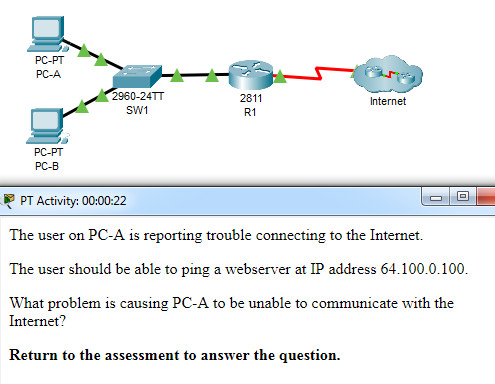
34. Open the PT Activity. Perform the tasks in the activity instructions and then answer the question.
CCNA 3 v7 Modules 6 – 8: WAN Concepts Exam Answers
What problem is causing PC-A to be unable to communicate with the Internet?
  • The ip nat inside source command refers to the wrong interface.
  • The NAT interfaces are not correctly assigned.
  • The static route should not reference the interface, but the outside address instead.
  • The access list used in the NAT process is referencing the wrong subnet.
  • This router should be configured to use static NAT instead of PAT.
Explanation: The output of show ip nat statistics shows that the inside interface is FastEthernet0/0 but that no interface has been designated as the outside interface. This can be fixed by adding the command ip nat outside to interface Serial0/0/0.
35. What type of address is 64.100.190.189?
  • public
  • private
36. Which type of VPN routes packets through virtual tunnel interfaces for encryption and forwarding?
  • MPLS VPN
  • IPsec virtual tunnel interface
  • dynamic multipoint VPN
  • GRE over IPsec
37. Match the scenario to the WAN solution. (Not all options are used.)
38. Question as presented:

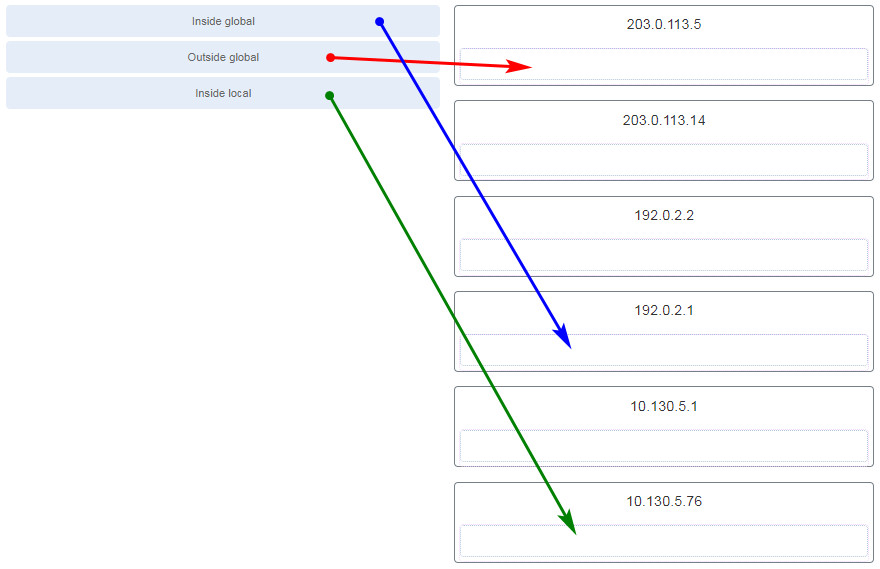
Refer to the exhibit. The PC is sending a packet to the Server on the remote network. Router R1 is performing NAT overload. From the perspective of the PC, match the NAT address type with the correct IP address. (Not all options are used.)
39. Refer to the exhibit. What has to be done in order to complete the static NAT configuration on R1?
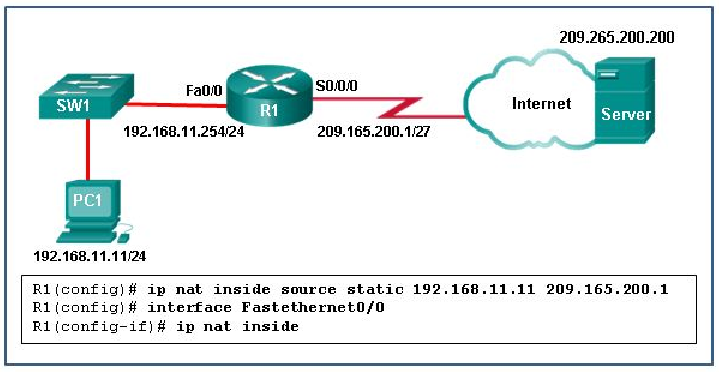
  • Interface Fa0/0 should be configured with the command no ip nat inside.
  • Interface S0/0/0 should be configured with the command ip nat outside.
  • R1 should be configured with the command ip nat inside source static 209.165.200.200 192.168.11.11.
  • R1 should be configured with the command ip nat inside source static 209.165.200.1 192.168.11.11.
Explanation: In order for NAT translations to work properly, both an inside and outside interface must be configured for NAT translation on the router.
40. In NAT terms, what address type refers to the globally routable IPv4 address of a destination host on the Internet?
  • outside global
  • inside global
  • outside local
  • inside local
Explanation: From the perspective of a NAT device, inside global addresses are used by external users to reach internal hosts. Inside local addresses are the addresses assigned to internal hosts. Outside global addresses are the addresses of destinations on the external network. Outside local addresses are the actual private addresses of destination hosts behind other NAT devices.
41. Refer to the exhibit. Which two statements are correct based on the output as shown in the exhibit? (Choose two.)

  • The output is the result of the show ip nat translations command.
  • The host with the address 209.165.200.235 will respond to requests by using a source address of 192.168.10.10.
  • The output is the result of the show ip nat statistics command.
  • Traffic with the destination address of a public web server will be sourced from the IP of 192.168.1.10.
  • The host with the address 209.165.200.235 will respond to requests by using a source address of 209.165.200.235.
Explanation: The output displayed in the exhibit is the result of the show ip nat translations command. Static NAT entries are always present in the NAT table, while dynamic entries will eventually time out.
42. Which circumstance would result in an enterprise deciding to implement a corporate WAN?
  • when the enterprise decides to secure its corporate LAN
  • when its employees become distributed across many branch locations
  • when the number of employees exceeds the capacity of the LAN
  • when the network will span multiple buildings
Explanation: WANs cover a greater geographic area than LANs do, so having employees distributed across many locations would require the implementation of WAN technologies to connect those locations. Customers will access corporate web services via a public WAN that is implemented by a service provider, not by the enterprise itself. When employee numbers grow, the LAN has to expand as well. A WAN is not required unless the employees are in remote locations. LAN security is not related to the decision to implement a WAN.
43. What is the function of the Hashed Message Authentication Code (HMAC) algorithm in setting up an IPsec VPN?
  • protects IPsec keys during session negotiation
  • authenticates the IPsec peers
  • creates a secure channel for key negotiation
  • guarantees message integrity
Explanation: The IPsec framework uses various protocols and algorithms to provide data confidentiality, data integrity, authentication, and secure key exchange. The Hashed Message Authentication Code (HMAC) is a data integrity algorithm that uses a hash value to guarantee the integrity of a message.
44. What algorithm is used with IPsec to provide data confidentiality?
  • Diffie-Hellman
  • SHA
  • MD5
  • RSA
  • AES
Explanation: The IPsec framework uses various protocols and algorithms to provide data confidentiality, data integrity, authentication, and secure key exchange. Two popular algorithms that are used to ensure that data is not intercepted and modified (data integrity) are MD5 and SHA. AES is an encryption protocol and provides data confidentiality. DH (Diffie-Hellman) is an algorithm that is used for key exchange. RSA is an algorithm that is used for authentication.
45. Which two technologies provide enterprise-managed VPN solutions? (Choose two.)
  • remote access VPN
  • Frame Relay
  • Layer 2 MPLS VPN
  • site-to-site VPN
  • Layer 3 MPLS VPN
Explanation: VPNs can be managed and deployed as either of two types:
  • Enterprise VPNs – Enterprise-managed VPNs are a common solution for securing enterprise traffic across the internet. Site-to-site and remote access VPNs are examples of enterprise managed VPNs.
  • Service Provider VPNs – Service provider managed VPNs are created and managed over the provider network. Layer 2 and Layer 3 MPLS are examples of service provider managed VPNs. Other legacy WAN solutions include Frame Relay and ATM VPNs.
46. Question as presented:
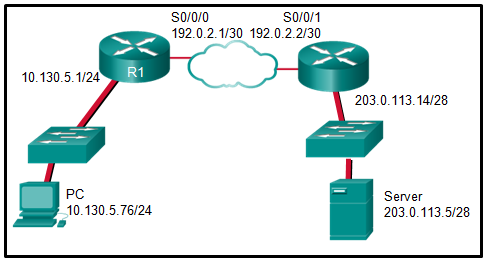
Explanation: The inside local address is the private IP address of the source or the PC in this instance. The inside global address is the translated address of the source or the address as seen by the outside device. Since the PC is using the outside address of the R1 router, the inside global address is 192.0.2.1. The outside addressing is simply the address of the server or 203.0.113.5.
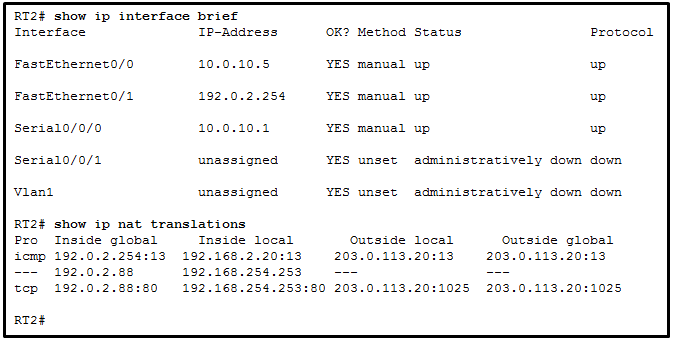
47. Refer to the exhibit. A network administrator is viewing the output from the command show ip nat translations. Which statement correctly describes the NAT translation that is occurring on router RT2?​

  • The traffic from a source IPv4 address of 192.168.254.253 is being translated to 192.0.2.88 by means of static NAT.
  • The traffic from a source IPv4 address of 192.0.2.88 is being translated by router RT2 to reach a destination IPv4 address of 192.168.254.253.
  • The traffic from a source IPv4 public address that originates traffic on the internet would be able to reach private internal IPv4 addresses​.
  • The traffic from a source IPv4 address of 192.168.2.20 is being translated by router RT2 to reach a destination IPv4 address of 192.0.2.254.
Explanation: Because no outside local or outside global address is referenced, the traffic from a source IPv4 address of 192.168.254.253 is being translated to 192.0.2.88 by using static NAT. In the output from the command show ip nat translations, the inside local IP address of 192.168.2.20 is being translated into an outside IP address of 192.0.2.254 so that the traffic can cross the public network. A public IPv4 device can connect to the private IPv4 device 192.168.254.253 by targeting the destination IPv4 address of 192.0.2.88.
48. What type of address is 10.100.126.126?
  • private
  • public
49. Which type of VPN connects using the Transport Layer Security (TLS) feature?
  • SSL VPN
  • MPLS VPN
  • IPsec virtual tunnel interface
  • dynamic multipoint VPN
50. Which two end points can be on the other side of an ASA site-to-site VPN configured using ASDM? (Choose two.)
  • DSL switch
  • ISR router
  • another ASA
  • multilayer switch
  • Frame Relay switch
51. Which two statements accurately describe an advantage or a disadvantage when deploying NAT for IPv4 in a network? (Choose two.)
  • NAT improves packet handling.
  • NAT adds authentication capability to IPv4.
  • NAT will impact negatively on switch performance.
  • NAT causes routing tables to include more information.
  • NAT provides a solution to slow down the IPv4 address depletion.
  • NAT introduces problems for some applications that require end-to-end connectivity.
52. A network administrator wants to examine the active NAT translations on a border router. Which command would perform the task?
  • Router# show ip nat translations
  • Router# show ip nat statistics
  • Router# clear ip nat translations
  • Router# debug ip nat translations
53. What are two tasks to perform when configuring static NAT? (Choose two.)
  • Configure a NAT pool.
  • Create a mapping between the inside local and outside local addresses.
  • Identify the participating interfaces as inside or outside interfaces.
  • Define the inside global address on the server
  • Define the outside global address.
54. What is a disadvantage of NAT?
  • There is no end-to-end addressing.
  • The router does not need to alter the checksum of the IPv4 packets.​
  • The internal hosts have to use a single public IPv4 address for external communication.
  • The costs of readdressing hosts can be significant for a publicly addressed network.​